
The Dragon Behind the Crescent: How China Is Powering Iran's Cyber War Machine
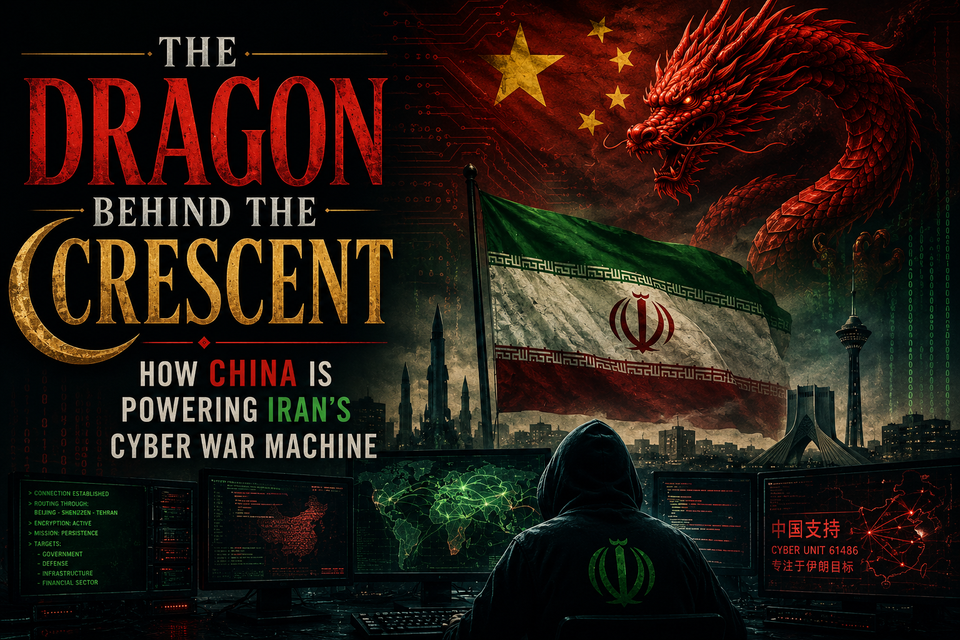
An investigative analysis of Beijing's technological lifeline to the IRGC's digital arsenal
Introduction: A War Fought in the Shadows
When cyberattacks cripple a water treatment plant in the American Midwest, or when the social media accounts of Iranian Kurdish dissidents in Europe are systematically breached overnight, the trail of code often leads back to Tehran. But behind Tehran, increasingly, stands Beijing.
Iran's Islamic Revolutionary Guard Corps (IRGC) operates what intelligence sources describe as roughly 3,000 cyber battalions — a sprawling digital army engaged in electronic warfare, espionage, sabotage, and psychological operations across the globe. What is now coming into sharper focus is the degree to which this machine is not merely Iranian. It is Sino-Iranian. Chinese technology, Chinese advisers, Chinese satellite networks, Chinese surveillance infrastructure, and the ideological blueprint of China's "cyber sovereignty" doctrine have collectively transformed the IRGC from a regionally disruptive force into a genuinely global cyber threat.
This is the story of that partnership — and what it means for the rest of the world.
Part I: The Architecture of Collaboration
The 25-Year Partnership and Its Cyber Dimensions
In 2021, China and Iran signed a sweeping 25-year Comprehensive Strategic Partnership, committing to $400 billion in Chinese investment across oil, gas, transport, manufacturing, and — critically — military and technological sectors. The deal was heralded by both sides as a bulwark against Western pressure. Its cyber dimensions, largely overlooked at the time of signing, are now among its most consequential features.
The partnership formalised what had already been a decade of deepening digital entanglement. Beijing has been involved in shaping Iran's internet control architecture since at least 2010, with Chinese firms supplying equipment and expertise used for internet filtering, deep packet inspection, centralised traffic management, and mass surveillance. The companies at the centre of this transfer — ZTE, Huawei, Tiandy, and HikVision — are all currently subject to United States sanctions. They have not ceased their operations in Iran.
Iran has effectively built what its government calls the National Information Network: a domestic intranet capable of functioning in isolation from the global internet, allowing Tehran to throttle, monitor, or sever its population's digital connections at will. The model is China's. Tehran has explicitly embraced Beijing's concept of "cyber sovereignty" — the doctrine that governments hold near-total authority over information flows within their borders — as the ideological foundation of its digital control architecture.
This matters for offensive cyber operations in a direct and underappreciated way: a regime that has comprehensively mastered the surveillance and control of its own population's digital behaviour has, in the process, cultivated exactly the skills, tools, and institutional culture required to project digital coercion outward.
Training, Advisers, and the Transfer of Expertise
Beyond technology sales, the cooperation between Beijing and Tehran has extended into the domain of human expertise. Iranian opposition sources with knowledge of IRGC Cyber Command operations report that both commanders and operatives receive ongoing training from Russian and Chinese specialists. A number of Russian and Chinese officers serve as permanent advisers embedded within Iran's cyber units, providing guidance on cyber defence, offensive operations, and — particularly relevant — the surveillance and tracking of political opponents.
Most training programs are conducted in Iran. Others take place on Chinese and Russian soil. This is not an arms transfer — it is a doctrine transfer. Iran is not merely purchasing Chinese tools; it is adopting Chinese methods.
Part II: Technology by Technology — The Chinese Toolkit
Surveillance Hardware: The Watchers Made in Shenzhen
The physical infrastructure of Iranian digital repression is substantially Chinese. HikVision, Dahua, and Tiandy Technologies have supplied surveillance equipment to the IRGC and affiliated Iranian security entities through local intermediaries since 2010. These systems — cameras, monitoring hardware, facial recognition platforms — underpin the domestic surveillance architecture that the IRGC uses to track dissidents, opposition figures, and ordinary citizens.
When Iran implemented sweeping internet blackouts in January 2026, in response to a wave of protests, the crackdown demonstrated a level of centralised control that went far beyond social media. Banking systems, healthcare networks, and emergency response services were all disrupted. The sophistication of the operation — including what appeared to be military-grade disruption of Starlink satellite connectivity — pointed to capabilities that Iran had not built alone.
An ARTICLE 19 investigation, released in early 2026, concluded that Chinese assistance has been central to the foundations of Iran's internet control architecture. "Emulating China's infrastructure of oppression," the group noted, "helps Iran entrench power, sidestepping accountability and exercising full control over the information environment."
Space-Based Intelligence: Seeing the Battlefield from Orbit
Iran's own satellite program remains limited. The IRGC's Noor series of military reconnaissance satellites provides basic earth observation, but lacks the persistent global coverage and advanced sensing required for real-time battlefield targeting and dissident tracking abroad.
China has filled this gap. The IRGC has developed documented ties with Chang Guang Satellite Technology — owner of the Jilin-1 constellation, the largest Chinese commercial satellite network in orbit — to secure space-based intelligence and surveillance support. Chang Guang has also been confirmed providing imagery intelligence to Iran-backed Houthi paramilitaries in Yemen, assisting targeting operations against commercial shipping and US Navy vessels in the Red Sea.
A separate Chinese firm, MinoSpace Technology, has similarly developed links with the IRGC for space-based intelligence operations. Both companies maintain close ties to the People's Liberation Army (PLA) and the Chinese Communist Party.
In addition to satellite imagery, Iran gained access to China's BeiDou satellite positioning system at the military-grade level in 2021 — an alternative to GPS that cannot be jammed or denied by the United States, providing Tehran with a resilient navigation backbone for both military and cyber operations.
Cyber Capabilities and Electronic Warfare Doctrine
China's People's Liberation Army Strategic Support Force is among the world's foremost cyber powers, with advanced capabilities in signals intelligence, offensive cyber operations, and electronic countermeasures. Iranian cyber units, through their embedded Chinese advisers and training programs in China, have gained sustained exposure to this expertise.
This transfer is visible in the operational patterns of IRGC-affiliated hacking groups. Iranian Advanced Persistent Threat (APT) actors have shifted from relatively crude intrusions to multi-phase campaigns that embed access inside targeted networks months or years before any overt operation — a hallmark of Chinese APT methodology. They identify vulnerabilities, gather intelligence, and create pre-positioned sabotage capabilities that can be activated on geopolitical cue.
The groups themselves — CyberAv3ngers, Islamic Cyber Resistance, the Dark Storm Team, the Fatemiyoun Cyber Team — represent a networked ecosystem rather than a single command structure. This distributed architecture mirrors Chinese cyber doctrine, which uses a constellation of loosely affiliated groups to provide operational deniability for the state.
Part III: The Operational Record — What This Alliance Has Done
Targeting Critical Infrastructure
The combined effect of Chinese technology transfer and IRGC operational ambition has produced a measurable and dangerous escalation in attacks on critical infrastructure. In April 2026, a joint advisory from the FBI, CISA, NSA, the EPA, the Department of Energy, and US Cyber Command confirmed that Iranian-affiliated APT actors were actively compromising Rockwell Automation industrial control systems — programmable logic controllers deployed in water systems, energy infrastructure, and government facilities across the United States. This was not an opportunistic intrusion. It was a deliberate expansion of attack surface, targeting mainstream industrial systems used across the economy.
Within hours of the outbreak of direct US-Israeli strikes on Iran in February 2026, Tehran mobilised more than 60 affiliated cyber groups to begin offensive operations. Artificial intelligence tools significantly enhanced efforts to identify and target internet-connected US critical infrastructure.
The groups have coordinated data-wiping campaigns and website defacement operations targeting government agencies, financial institutions, and critical infrastructure across the Middle East. Iranian cyber operations typically combine espionage with disruptive tactics — the espionage establishing access, the disruption delivering the strategic message.
Hunting Dissidents Across Borders
The reach of the IRGC's cyber operations extends to individuals. Arif Bawjani, head of the Iranian Kurdistan Freedom Party — an opposition group operating in exile in Europe — reports being under continuous cyberattack since June 2025. "My social media pages and electronic devices are repeatedly targeted," he said. He has survived these attacks only with the assistance of a specialised cybercrime unit in a European country.
This is not an isolated case. The IRGC's Cyber Command directs units specifically tasked with infiltrating the networks of diaspora opposition figures, civil society groups, and journalists. Social engineering is the primary vector: Iranian cyber operators impersonate journalists, academics, conference organizers, or politicians to establish contact with targets, steal login credentials, and gain access to private accounts. The goal is intelligence — and, frequently, intimidation.
This cross-border surveillance of dissidents represents a direct use of the monitoring techniques and tools transferred from China, now weaponised against exiles who believed they had escaped Tehran's reach.
The Telecommunications Agreement: 20 Deals in December 2025
The scale of the technological relationship was thrown into sharp relief in December 2025, when Iran's state news agency IRNA announced that Tehran had signed 20 separate agreements with Russian companies in the telecommunications and information technology sectors. Iran's diplomatic pivot toward Russia and China simultaneously — across military, technological, and cyber domains — reflects a coherent strategic doctrine: build a parallel digital order insulated from Western pressure, and use it both to control the domestic population and to project power abroad.
Part IV: Why Beijing Does It — The Strategic Logic
China's support for Iran's cyber capabilities is not altruistic. It reflects a cold calculation of strategic interest across several dimensions.
Energy security. China purchases over 80% of Iran's exported oil, making Tehran one of Beijing's most important energy suppliers. A stable, capable, and internationally isolated Iran is a dependent Iran — one that sells its oil at a discount and keeps the supply flowing.
Observing Western systems in combat. Every Iranian cyberattack on US or Israeli infrastructure, every electronic warfare engagement, every missile strike using Chinese-assisted navigation systems, generates real-world performance data on the efficacy of Western defensive systems. Chinese strategists collect and analyse this data. Iran is, in effect, a live laboratory for Chinese military intelligence.
Asymmetric pressure without direct confrontation. By empowering Iran's cyber and military capabilities, China exerts pressure on the United States and its allies without ever firing a shot or deploying a PLA soldier. The deniability is baked into the architecture: no Chinese officer commands an IRGC cyberattack; no Chinese satellite is formally assigned to IRGC targeting. The distance is precisely calibrated.
Building the alternative order. The export of Chinese surveillance technology and cyber sovereignty doctrine to Iran, as to dozens of other countries, is part of a larger project: normalising a model of internet governance and digital control that is antithetical to the open, rules-based digital order the West has championed. Every country that adopts the Chinese domestic internet model becomes, in effect, an ally in that contest.
Part V: What the World Must Do
The China-Iran cyber alliance is not an abstraction. It is an active, documented, and accelerating threat to critical infrastructure, democratic governance, and the security of individuals who have done nothing more than oppose authoritarian rule.
Several imperatives now present themselves with some urgency:
First, close the technology transfer channels. Chinese companies supplying surveillance hardware, satellite intelligence, and telecommunications equipment to the IRGC must face consequences proportional to the threat they enable. Sanctions have been imposed; they have not been sufficient. Allies need to coordinate on secondary sanctions with real enforcement teeth.
Second, protect dissidents in exile. European governments hosting Iranian opposition figures must treat IRGC cyber operations against those individuals as the state-sponsored attacks they are — not merely as cybercrime, but as transnational repression requiring a diplomatic response directed at Tehran and its backers.
Third, harden industrial control systems. The escalation from niche industrial hardware to mainstream Rockwell Automation PLCs in 2026 signals a deliberate broadening of Iran's attack surface. Every organisation operating internet-exposed industrial control systems in the water, energy, and government sectors should treat pre-positioned Iranian access as a present reality, not a future risk.
Fourth, name the partnership publicly and persistently. Western governments have been reluctant to directly and systematically attribute Iranian cyber capabilities to Chinese technology transfer and training. That restraint, intended to preserve diplomatic channels with Beijing, has allowed the architecture to deepen in the dark. Sustained, evidence-based public attribution — of the kind used against Russian election interference — is overdue.
Fifth, defend the open internet as a strategic interest. China's export of its digital authoritarian model, from Tehran to Harare to Caracas, is a long-term threat to the democratic information environment. Countering it requires not just defensive measures but an affirmative investment in open, resilient, globally accessible internet infrastructure — including satellite connectivity — for populations living under digital censorship regimes.
Conclusion: The Dragon Is Already in the Network
Iran's cyber war machine is formidable. But it is not Iranian alone. It runs on Chinese chips, Chinese surveillance cameras, Chinese satellite positioning signals, and Chinese doctrine. It was trained by Chinese advisers, built on Chinese blueprints, and sustained by a 25-year strategic partnership explicitly designed to make Tehran resilient against Western pressure.
Understanding the IRGC's cyber threat without understanding the Chinese hand behind it is like diagnosing a disease while ignoring half its symptoms. The threat will not be contained by treating it as a purely Iranian problem.
The dragon is already in the network. The question is whether the world will respond before the access that has been quietly accumulated is finally activated.
This article is based on reporting by Alhurra, analysis from the Hudson Institute, Small Wars Journal, ARTICLE 19, the Irregular Warfare Initiative, Bloomsbury Intelligence and Security Institute, and official advisories from CISA, the FBI, NSA, and the US Departments of Energy and State.
Member discussion