
Five Years Inside: Bulgaria's Breach and Europe's Detection Gap
Bulgaria's five-year cyberespionage breach and the European Commission's ongoing investigation expose a deeper weakness in Europe's cybersecurity: the struggle to detect intrusions, establish their impact and turn intelligence into credible diplomatic responses.
- Filed
- Desk
- Cyberdiplomacy
- Read
- 7 min read
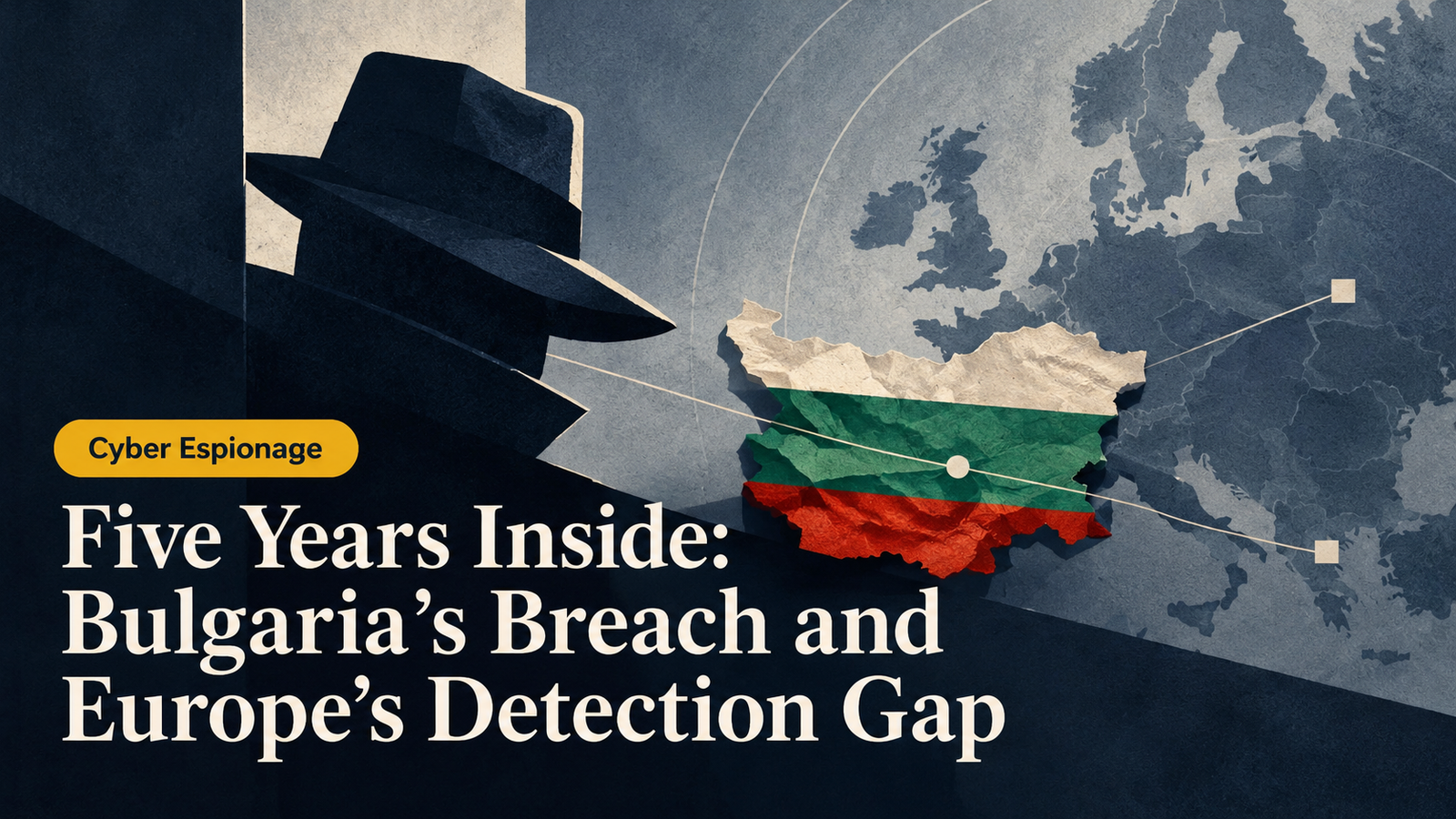
Europe's debate on cyber threats often focuses on who the attackers are, which countries may be behind them and how governments should respond. But developments reported in November 2026 highlight a more fundamental problem: governments and institutions cannot respond effectively to intrusions they have not yet discovered.
On 18 November, Bulgaria disclosed a cyberespionage operation that had accessed government networks since 2021. Days later, the European Commission confirmed that a cyber campaign detected in October had affected its internal infrastructure, including its EU Academy platform, where users' personal information was exposed.
These are separate incidents, and there is no public evidence connecting them. Their significance lies in a shared institutional challenge: establishing visibility over networks, understanding the extent of an intrusion and determining what information has been compromised.
For European cyber diplomacy, this is more than a technical concern. It affects how governments assess responsibility, coordinate responses and establish credible positions against malicious activity.
Bulgaria: Five years of access
On 18 November 2026, Bulgaria's Minister of Innovation and Digital Transformation, Ivan Vassilev, announced that authorities had disrupted what he described as the longest-running known cyberespionage operation against the country's state administration.
According to the minister, attackers had accessed government infrastructure since 2021, targeting online systems used by state institutions to exchange documents and information.
Vassilev said that more than 130 gigabytes of government documents had been downloaded, equivalent to approximately 62 million pages. The material reportedly covered a broad range of government activities, including cabinet work, reports and communications between ministries and state institutions.
Authorities said they had found no evidence so far that Bulgarian citizens' personal data had been compromised.
The intrusion was discovered in August 2026 following the deployment of a new national cybersecurity monitoring system. Suspicious activity identified through this system prompted an investigation involving intelligence agencies, defence authorities, police, cybersecurity specialists and international partners, including the European Union Agency for Cybersecurity (ENISA).
According to the ministry, the compromised infrastructure included servers, workstations, network devices and other systems used by government institutions.
Authorities subsequently isolated affected systems, cut off the identified unauthorised access and removed malicious software. The matter was also referred to the Prosecutor's Office to investigate the attackers' actions and possible failures by state institutions during the period in which the activity remained undetected.
The minister said several international hacking groups were believed to have been involved. However, investigators had not established whether the groups operated independently, as an organised network or on behalf of a foreign intelligence service.
One distinction matters: the five-year period describes the history of the discovered activity. It does not establish that a single identified actor maintained uninterrupted access throughout those years.
The problem was not simply the intrusion
Perhaps the most significant aspect of Bulgaria's disclosure was its explanation of why the activity remained hidden.
The ministry acknowledged that previous protective measures had not operated as a sufficiently integrated system. The newly deployed monitoring capability provided a consolidated view of activity across government networks, enabling investigators to identify suspicious behaviour that had previously escaped detection.
The ministry also acknowledged that the existing security arrangements had failed to provide an adequate picture of what was happening across institutional infrastructure.
This raises an important question about how governments measure cybersecurity readiness.
Security policies, endpoint protection and individual monitoring systems may exist across an administration without providing an effective picture of activity across the wider network.
An organisation may therefore have multiple security controls while still lacking the visibility needed to identify an intrusion moving between different systems.
Bulgaria's experience illustrates the importance of integrating monitoring capabilities, maintaining consistent oversight and ensuring that security operations continue beyond individual political or administrative cycles.
The discovery should also be understood in context: improved detection can expose older compromises. A newly disclosed historical intrusion does not necessarily mean that the threat itself is new.
The European Commission: Detection is only the beginning
The European Commission's incident presents a different problem.
On 19 November, Commission spokesperson Thomas Regnier confirmed that the Commission's IT department had detected a malicious campaign within its internal networks on 22 October.
The Commission said that the incident involved an AI-assisted tool. Several applications had temporarily been taken offline as a precaution, with most subsequently restored. The investigation remained ongoing.
Regnier also stated that the Commission had not detected evidence of a data breach affecting its staff as a whole.
The incident developed further on 23 November, when the Commission's EU Academy platform was taken offline after the organisation confirmed that user information had been exposed.
The platform provides online training and educational material about EU policies. The confirmed exposed information included users' names and email addresses. The number of affected users and the full extent of the exposure remained under investigation.
The Commission had not formally attributed the campaign. Regnier said that attribution would require the investigation to be completed.
There is an additional dimension to the incident.
Euronews reported on 23 November, citing two anonymous sources, that the Commission suspected a China-backed threat network referred to internally as Panda.
The reporting also discussed the possible use of ARTEX, an AI-assisted vulnerability discovery and exploitation framework.
However, the distinction between the Commission's confirmed statements and the reported intelligence assessment is important. The Commission confirmed an AI-assisted campaign, but that does not independently establish the identity of the suspected actor or prove that ARTEX was used in this particular incident.
The Commission's investigation must therefore be treated separately from the reported attribution assessment.
Two incidents, two different detection challenges
Bulgaria and the European Commission illustrate two different stages of the same institutional problem.
In Bulgaria, investigators reconstructed years of unauthorised activity after a new monitoring capability exposed it.
At the Commission, investigators identified a malicious campaign but were still working to establish its full impact and the extent of the compromised information.
The distinction is important.
Detection does not automatically mean an organisation understands the full extent of a compromise. Nor does removing identified malicious activity necessarily establish that every route of access has been eliminated.
These cases also highlight the importance of systems that receive less attention than core government networks: document-exchange infrastructure, internal applications, training platforms and services operated by external providers.
Such systems can contain information of considerable intelligence value, even when they do not hold classified material.
The EU Academy incident is particularly relevant because names and email addresses, although less sensitive than classified government documents, can provide useful material for targeted phishing and impersonation attempts.
The value of compromised information should therefore not be measured only by its classification level.
What this means for European cyber diplomacy
The European Union has spent years developing mechanisms to respond to malicious cyber activity.
In June 2017, the EU established its Framework for a Joint EU Diplomatic Response to Malicious Cyber Activities, commonly known as the Cyber Diplomacy Toolbox.
In May 2019, the Council established a framework allowing the EU to impose targeted sanctions against individuals and entities responsible for, or involved in, significant cyberattacks. The first sanctions under this framework were imposed in July 2020.
An important distinction is necessary: formal public attribution is not a prerequisite for every diplomatic response. The EU framework allows responses to be tailored to the circumstances and available evidence.
However, establishing responsibility with sufficient confidence becomes particularly important when governments consider targeted sanctions, coordinated public accusations or other measures intended to impose costs on a suspected actor.
This is where prolonged detection failures create a serious disadvantage.
The longer an intrusion remains undiscovered, the more difficult it can become to reconstruct activity, establish the extent of data exposure and identify the responsible parties with sufficient confidence.
Bulgaria's case demonstrates the consequences of that problem. The Commission's ongoing investigation illustrates that even after detection, establishing the full scope of an incident can take considerable time.
For European institutions, the challenge is therefore not limited to developing diplomatic mechanisms. It also involves ensuring that the technical and investigative capabilities needed to support those mechanisms are available.
The policy gap is also an implementation gap
There is another dimension to this discussion.
On 8 July 2026, the European Commission referred France, Spain, Ireland and the Netherlands to the Court of Justice of the European Union for failing to notify measures fully transposing the NIS2 Directive into national law.
NIS2 is intended to strengthen cybersecurity requirements across 18 critical sectors, including energy, transport, healthcare and public administration.
Member states were required to transpose the directive by 17 October 2024.
The July proceedings concern the failure to notify full national transposition. They should not be interpreted as proof that these countries lack operational monitoring capabilities.
Nevertheless, the wider implementation challenge is relevant.
Regulatory requirements can establish responsibilities, reporting obligations and security expectations. They cannot, by themselves, guarantee that organisations maintain effective monitoring, investigate suspicious activity or respond consistently.
Bulgaria's experience reinforces the importance of translating cybersecurity policy into operational capabilities.
A government may have the necessary policies on paper, but their effectiveness depends on whether the infrastructure, personnel and institutional arrangements required to implement them are actually in place.
What to watch over the next 12–24 months
The following are analytical assessments rather than predictions of specific events.
1. Bulgaria's investigation
Findings from the Prosecutor's Office could clarify whether institutional failures contributed to the prolonged access and whether further details about the responsible groups emerge.
2. The Commission's investigation
Confirmation of full containment, the scale of the EU Academy exposure and any additional compromised systems will help establish the incident's actual significance.
3. Greater historical disclosures
Improved monitoring across government networks could uncover older intrusions that were previously unidentified. Such disclosures would not necessarily indicate an increase in attacks; they could reflect improved visibility.
4. Third-party security oversight
Government document platforms, external service providers and institutional applications deserve greater attention in security assessments. Their importance should be evaluated according to the information they hold and the access they provide.
5. European cyber coordination
Further investigations and evidence-sharing may influence whether member states coordinate diplomatic responses or develop a stronger common assessment of the incidents.
The measure is visibility
European cyber diplomacy is often evaluated through public statements, sanctions and attribution announcements. These remain important instruments, but they are not the starting point of effective cybersecurity.
The more fundamental requirement is knowing what is happening inside institutional networks.
Bulgaria's disclosure is uncomfortable because it describes years of access before authorities identified the activity. The Commission's investigation demonstrates that identifying an intrusion is only the beginning of understanding its full consequences.
Neither incident establishes a common attacker or a coordinated campaign. Both, however, demonstrate why sustained monitoring, institutional continuity and effective incident investigation must remain central to European cybersecurity policy.
Before governments can establish responsibility, coordinate a response or impose diplomatic costs, they must first establish what happened within their own systems.
Europe's detection gap is therefore not simply a technical weakness. It is a constraint on the credibility and effectiveness of its wider cyber diplomacy.
Sources:
- Bulgarian Ministry – Official breach announcement
- Reuters – Bulgaria's five-year cyberespionage operation
- European Commission – Official briefing, 19 November
- European Commission – EU Academy data breach briefing, 23 November
This brief was prepared with AI assistance from the sources above and reviewed by our editors.
Sources
Keep reading

UK Sets Out AI's Role in UN Peacebuilding
The UK has outlined potential uses of AI in UN peacebuilding, from conflict early warning to mission planning, while emphasising that human judgment and accountability must remain central to its deployment.

LaLiga Breach Exposes the Risks of Shared Fan Platforms
LaLiga's fan-services platform was breached, exposing supporters' personal data across multiple clubs. The incident raises questions about the security of shared digital infrastructure beyond individual football teams.
Austria's Foreign Ministry Breach: Why a Staff Directory Matters
Hackers reached names and official contacts of Austrian diplomats through a contractor-run website. No secrets were reported taken, but for anyone planning targeted phishing against a foreign service, a staff list is where the work begins.