
From Storms to Servers: How the Energy Sector's Vulnerability Story Shifted from Climate to Cyber — and Why That's Actually Good News
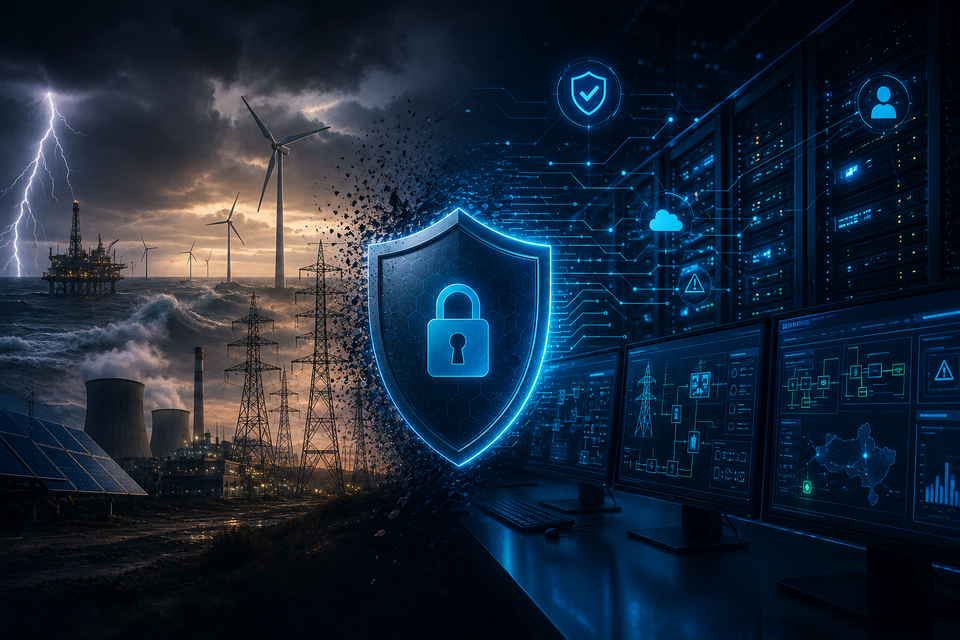
In 2013, the U.S. Department of Energy published a sobering report on how climate change and extreme weather were putting the nation's energy system at risk. Heatwaves shutting down nuclear reactors. Droughts starving hydropower dams. Hurricanes flooding refineries. Wildfires taking out transmission lines. The report's message was clear: an aging energy system, built for the climate of the past, was increasingly being forced to operate outside the conditions it was designed for.
More than a decade later, the energy sector is being handed a strikingly similar warning — but this time the threat isn't coming from the sky. It's coming from a keyboard.
The Same Vulnerability, a Different Cause
Read the 2013 climate report closely, and a certain logic keeps repeating: the grid is aging, its components are increasingly interconnected, and stress on any one part can cascade into failures elsewhere. A wildfire takes out a transmission corridor and knocks out power to tens of thousands of people. A heatwave forces multiple nuclear plants to throttle back at once because they all draw cooling water from the same warming river. One disruption ripples outward because everything is connected.
Today's cybersecurity warnings about the energy sector read almost like an updated version of the same document, with "attacker" swapped in for "heat wave." Utilities are modernizing their grids with smart meters, remote sensors, distributed generation, and cloud-connected control systems — many of the same technologies the 2013 report actually recommended as climate adaptation measures. Substations that once ran isolated, proprietary control systems are now networked. And that same interconnection that makes the grid more resilient to weather also makes it more exposed to attackers, because a compromise in one digital corner can now reach much further than it used to.
Security researchers tracking this shift point out that a large share of attacks on critical infrastructure, including energy, are attributed to sophisticated, patient nation-state actors — groups from countries like Russia, China, Iran, and North Korea running long-term reconnaissance campaigns against grid operational technology, sometimes for months or years before acting. The 2015 attack on Ukraine's power grid is the reference case people keep coming back to: coordinated intrusions that hit multiple substations at once, disabled backup systems, and flooded utility call centers to slow the response — a deliberate, engineered cascading failure, not so different in shape from what a hurricane or heatwave can trigger by accident.
Regulators have taken notice. In North America, the North American Electric Reliability Corporation's Critical Infrastructure Protection standards (NERC CIP) have expanded repeatedly since they were first approved in 2008, and in January 2026 NERC released a new CIP Roadmap explicitly aimed at how compliance needs to evolve as the grid becomes more distributed, more digital, and more dependent on cloud and third-party systems. The document doesn't mince words about where the exposure is coming from: weak asset inventories, poorly defined network boundaries, inconsistent identity controls, outdated software, and limited visibility into what's actually connected to the grid.
The Real Difference: One of These Threats Is Ours to Fix
Here's where the comparison matters most — not in the similarity, but in the difference.
Climate change is, for any individual utility or grid operator, largely an external condition. A power company cannot personally lower the temperature of the river it draws cooling water from, or prevent the next hurricane from forming, or stop sea levels from rising. The 2013 DOE report's own recommendations reflect this reality: most of its "solutions" were about adaptation — building infrastructure that can tolerate a changing environment — rather than prevention, because prevention of the underlying climate trend was never something any single actor in the energy sector could deliver on its own.
Cybersecurity vulnerability is a fundamentally different kind of problem. Every weak point that shows up in an energy-sector breach — an unpatched control system, a default password on a remote sensor, a vendor with excessive network access, a missing multi-factor authentication requirement — is something a human being built, configured, or left unaddressed. Unlike a warming climate, none of it is an act of nature. It is the product of decisions: what to patch and when, who gets administrative access, how quickly a new smart-grid device gets inventoried and secured before it's connected, whether a legacy system that "still works fine" gets replaced or quietly left exposed.
That's the genuinely good news buried in an otherwise unwelcome trend: the energy sector doesn't have to wait on global emissions trajectories or hope for a mild storm season to reduce this particular risk. Cyber risk is, in a very real sense, within the sector's own hands — and every one of the weaknesses regulators keep flagging (poor asset visibility, weak network segmentation, inconsistent identity management, unpatched legacy equipment) is fixable with the right investment, governance, and follow-through, not with a decades-long global policy shift.
What "It's In Our Control" Actually Requires
That control isn't automatic, though — it has to be exercised deliberately. A few things stand out:
Treat digital assets with the same discipline as physical ones. The 2013 climate report catalogued every power plant, pipeline, and transmission line at risk with real specificity — locations, capacities, water sources. Cybersecurity requires the same rigor applied to the digital estate: a genuine, current inventory of every networked device, sensor, and control system, because you cannot secure what you don't know you have.
Don't let modernization outrun security. Many of the smart-grid technologies added to make the system more climate-resilient — remote monitoring, distributed generation, automated switching — were not originally designed with cybersecurity as a first principle. Retrofitting security after the fact is harder and more expensive than building it in from the start, and utilities rolling out new grid technology now have the chance to avoid repeating that mistake.
Plan for the compounding scenario, not just the isolated one. The 2013 report's most useful insight might be its emphasis on cascading, compounding failures — one stress amplifying another. The same logic applies to a cyberattack timed to hit during an already climate-stressed grid condition, such as a heatwave-driven demand emergency, when operational slack is already thin and defenders are stretched. Incident response planning that only accounts for a clean, isolated cyber event is planning for the easy case.
Hold leadership accountable, not just IT teams. Newer regulatory frameworks, including the EU's NIS2 directive, explicitly hold senior management personally accountable for cybersecurity outcomes, not just technical staff. That reflects a broader recognition that this is fundamentally a governance problem as much as a technical one — which, again, is exactly why it's solvable through organizational will in a way that climate physics is not.
The Takeaway
The energy sector's vulnerability narrative has quietly shifted over the past decade — from a physical climate story to a digital cyber one. The two problems share a structure: aging systems, deep interconnection, and cascading risk. But they don't share a cause, and that's the part worth holding onto. Climate risk to the grid is something the sector has to adapt around. Cyber risk is something the sector can, with sustained effort, actually close.
If your organization wants help assessing its exposure to these evolving risks or building out a response strategy, you can book a consultation call or send an enquiry to info@thecyberdiplomat.com.
Member discussion