
"Why a Workshop Just for Women?" — A Question Worth Answering Properly
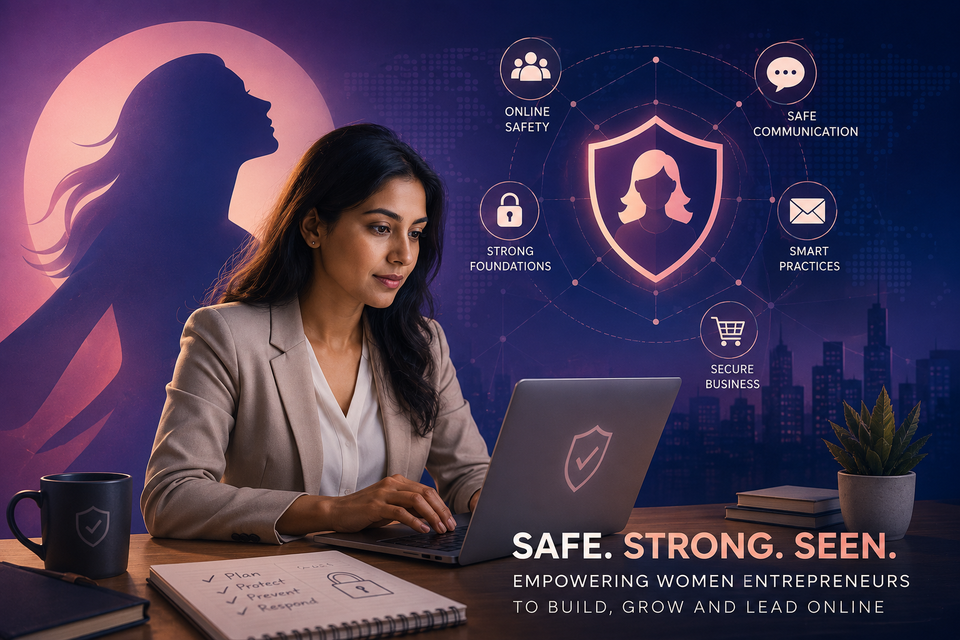
Whenever we announce a cybersecurity or online safety workshop designed specifically for women entrepreneurs, one question comes up almost every time: isn't online safety the same for everyone? Why does this need to be women-only, or women-focused?
It's a fair question, and it deserves a real answer rather than a defensive one. So here it is.
The threats aren't identical, even if the internet looks the same to everyone
Cybersecurity fundamentals — strong passwords, phishing awareness, secure payment gateways — apply to any business owner, regardless of gender. But the pattern of online risk that women entrepreneurs face has some distinct features layered on top of the generic ones, and the data on this is fairly consistent across sources.
Pew Research Center's national surveys have found that although men and women report broadly similar overall rates of online harassment, women are substantially more likely to say the harassment happened because of their gender — roughly 47% of women who have been harassed online believe it was gender-related, compared with 18% of men who say the same. Severe forms of harassment — including sexual harassment, stalking, and sustained targeted abuse — also skew disproportionately toward women.
Research specifically on women entrepreneurs sharpens this further. A recent academic study found that 57% of women entrepreneurs reported experiencing harassment on social media platforms, and 23% reported facing verbal attacks or degrading comments online. For someone running a business — where a visible, active online presence is often not optional but essential for finding clients, building a brand, and closing sales — that's a materially different risk calculus than it is for someone who can simply choose to reduce their public footprint.
A World Bank-affiliated global assessment adds another layer: a European Union study found that 73% of women reported having experienced some form of online abuse, and cyber harassment disproportionately affects women who maintain a public or professional presence online — the exact position most entrepreneurs are in by necessity.
Business exposure compounds personal exposure
For a woman entrepreneur, online safety isn't a purely personal issue that can be kept separate from the business. Her online presence is the business, in most cases — the storefront, the sales pitch, the client-facing communication channel, and often the primary marketing tool all at once. That means:
- Harassment or targeted abuse doesn't just cause personal distress; it can damage the brand and erode client trust, since the target and the business are often the same public-facing identity.
- Being the visible face of the business means she can't simply "log off" the way an employee could step back from a personal social media account.
- Scammers and fraudsters specifically exploit trust dynamics that differ by gender — for example, impersonation scams, fake investment or partnership approaches, and social engineering tactics that are calibrated differently depending on who the target appears to be.
A study on social media use among women entrepreneurs found that harassment was cited as one of the leading barriers to using these platforms for business growth at all — meaning the safety gap isn't just a wellbeing issue, it's a direct constraint on business growth and market access.
So a "women's workshop" isn't about treating women as more fragile — it's about designing for the actual risk profile
A well-designed cybersecurity training doesn't assume that women are inherently more vulnerable to technical failure, less capable with technology, or need a "softer" version of the material. That would be a patronizing and inaccurate premise. What a women-focused workshop should do — and what we set out to do in our own 4-hour session for women entrepreneurs — is address the specific combination of risks this audience actually faces: gendered harassment alongside standard business cybersecurity, brand and reputation protection alongside password hygiene, safe client vetting and negotiation alongside phishing awareness.
That's the logic behind structuring a workshop around content, contact, conduct, and commerce safety together, rather than treating "cybersecurity" and "online harassment" as two unrelated topics taught in separate rooms. For a woman entrepreneur, they're rarely separate problems in practice — a fake business inquiry can be both a fraud attempt and a harassment vector; a public professional profile can invite both cybercriminals and stalkers at once.
You can watch highlights from our recent workshop, "Mastering Online Safety for Women Entrepreneurs,"
The honest answer to "why women-only"
Because the internet doesn't treat everyone identically, and pretending it does doesn't make anyone safer — it just leaves a real, well-documented gap in general-purpose cybersecurity training unaddressed. A workshop built around the actual risk profile of women running businesses online isn't exclusionary; it's precise. The same way a workshop for healthcare workers would cover HIPAA and patient data specifically rather than generic "data protection," a workshop for women entrepreneurs covers the specific intersection of business cybersecurity and gendered online risk that generic trainings usually miss.
If you'd like to bring a similar training to your organization or network, you can reach out for enquiries about our workshops and trainings at sanjana@thecyberdiplomat.com.
Member discussion