
Inside the FBI's Fake Town Built for Cyber Warfare Training
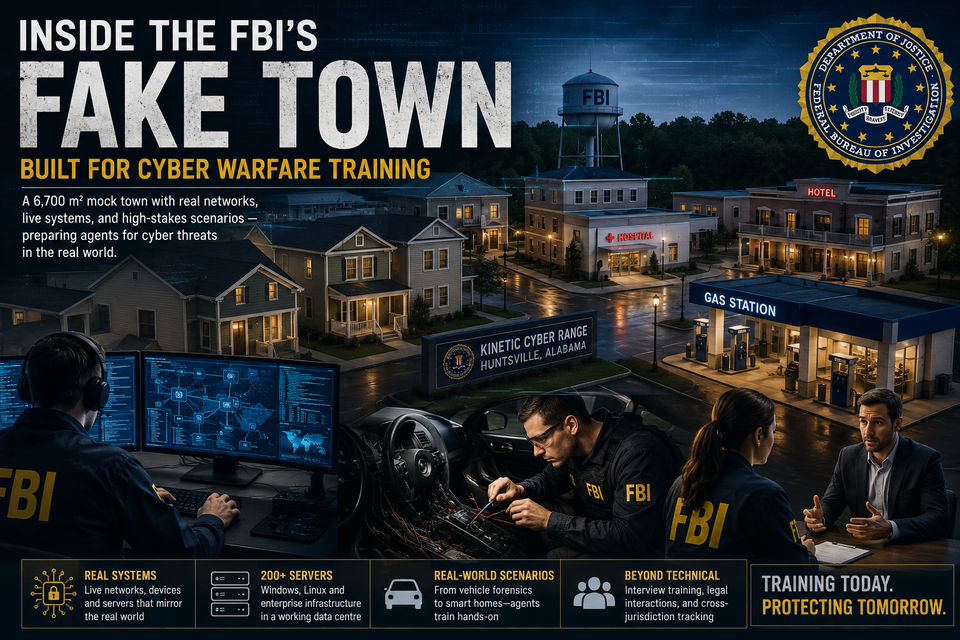
Deep in Huntsville, Alabama, the FBI has constructed an entire mock town — complete with homes, a hotel, a hospital, and a gas station — all designed to train the next generation of cyber investigators.
The facility, known as the Kinetic Cyber Range, spans 6,700 square metres and operates as a fully functional simulation environment. Every building is wired with real networks, live systems, and internet-connected devices that behave exactly as they would in the outside world.
"This is about as real as it's going to get before people go out in the field," said Dave Beachboard, who manages the facility.
From Classrooms to the Field
Before the Kinetic Cyber Range opened its doors in February 2025, FBI training was largely confined to desks and lecture halls. Agents studied theory, processed sample devices, and learned about servers with minimal hands-on experience. That approach has now been completely overhauled.
Since opening, the facility has already trained more than 1,400 agents and agency partners — a significant milestone that underscores both the demand for this type of training and its rapid adoption across law enforcement.
What Agents Actually Do There
Training scenarios inside the facility are deliberately designed to mirror real-world investigations. In one exercise, agents disassemble a vehicle's interior and trace wiring to its electronic control systems — skills that could reveal a vehicle's location history and identify who was behind the wheel.
In another, trainees enter a mock home filled with smart devices and must make critical decisions: what gets seized as evidence, and what gets left behind.
The facility also includes a working data centre running over 200 servers — some on Windows, others on Linux — giving agents direct experience navigating the kind of infrastructure they'll encounter during actual investigations.
"When they start diving into the network, they're going to see active directory, email, firewalls — everything that's typical of that venue," Beachboard said.
The Human Side of Cyber Crime
Not all of the training is technical. Agents also practice conducting interviews with actors playing business owners, corporate executives, and legal teams. The goal is to sharpen communication skills — explaining what investigators are collecting and, just as importantly, what they are not.
"Cyber is not just technical," said Stephanie Cassioppi, who leads the cyber training unit in Huntsville. "It's also practicing those soft skills, the dealing with people."
Cassioppi's team also trains agents to track digital activity across multiple networks and jurisdictions — a critical capability given that many cyber threats originate overseas.
"The odds are I'm never going to get my hands on their computer or their phone," she said. "So we have to teach agents to follow the trail wherever it leads."
A New Standard for Law Enforcement Training
The Kinetic Cyber Range represents a broader shift in how law enforcement approaches the growing complexity of cybercrime. By immersing agents in realistic, high-pressure environments before they hit the field, the FBI is betting that hands-on experience will produce sharper, more confident investigators.
As cyber threats continue to evolve, facilities like this one may well become the new standard — not just for the FBI, but for agencies around the world.
Member discussion