
The LATAM Pivot: Why Businesses Are Fleeing the Middle East — and What It Means for Cybersecurity
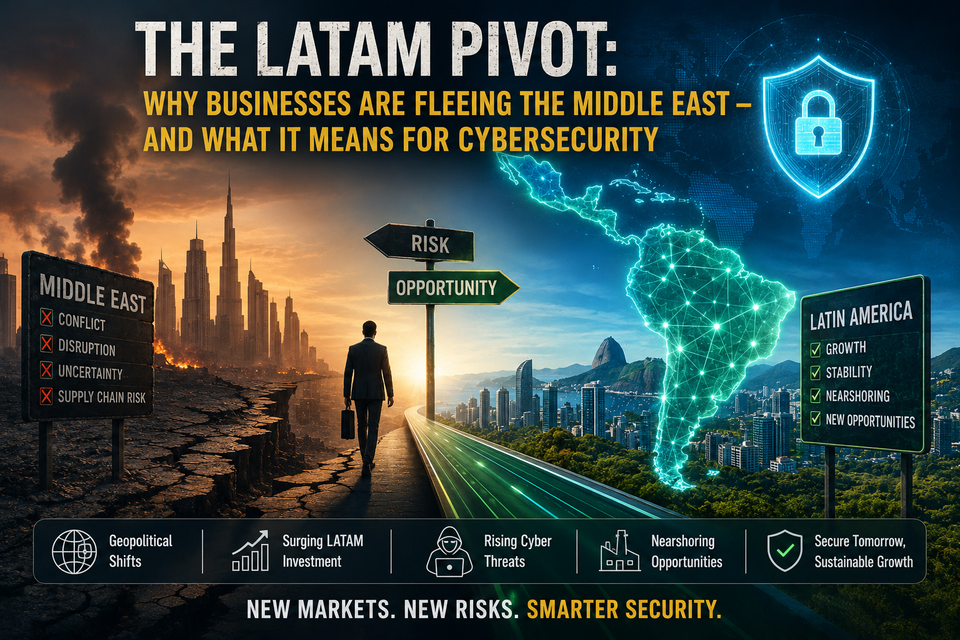
As the Middle East crisis rewrites the rules of global trade, Latin America is emerging as the world's most attractive alternative. But with that surge in investment comes a cybersecurity reckoning no one is fully prepared for.
A Region on Fire, A Region on the Rise
On February 28, 2026, coordinated military strikes on Iran triggered a rapid unraveling of some of the world's most critical trade corridors. Within days, major ocean carriers suspended Suez Canal transits, airlines halted flights across the Gulf, and emergency shipping surcharges began landing in shipper inboxes worldwide.
The ripple effects were immediate and severe. Qatar was unable to divert its LNG supply, forcing QatarEnergy to declare force majeure on long-term delivery contracts with South Korea, China, Italy, and Belgium. Air cargo capacity on the Asia-Europe corridor dropped by an estimated 26%, with roughly a quarter of China-Europe air freight normally routed through Gulf hubs suddenly displaced.
For multinational corporations already grappling with supply chain fragility, the message was clear: over-reliance on any single region is a liability. And with the Middle East now firmly in the danger zone, eyes turned south — to Latin America.
Why LATAM?
The shift was already underway before the crisis. Surveys of executives toward the end of 2025 showed record confidence in Latin America's market potential, with around 62% of business leaders saying that opportunities for mergers and acquisitions in the region have never been greater. Venture investment ticked back up in 2025 after a dip, with startup funding rising about 14% year-on-year, indicating renewed bullishness on Latin American innovation.
The region offers a compelling mix of geographic proximity to the US, a growing skilled workforce, favorable time zones for North American and European partners, and relative insulation from the current geopolitical storm. Geopolitical disruptions in key trade regions create ripple effects across global supply chains — and retailers and manufacturers are now actively diversifying their sourcing and logistics footprints in response.
Trade, industrial policy, and geopolitics are reshaping how and where capital moves, altering deal structures, investment horizons, and the balance of risk between the public and private sectors. For many companies, LATAM is no longer just an emerging market — it is a strategic hedge.
The Cybersecurity Blind Spot
But here's the part that boardrooms are not talking about enough: Latin America is simultaneously the world's fastest-growing business destination and its most heavily targeted region for cyberattacks.
As of 2026, researchers confirmed Latin America to be the most heavily targeted region on the planet, with organizations facing an average of around 3,100 cyber threats per week — more than double the roughly 1,500 weekly threats faced by their counterparts in the United States.
Latin America has recorded the fastest global growth in disclosed cyber incidents, with reported activity increasing at an average annual rate of about 25% over the past decade. The first quarter of 2025 alone saw a 108% year-over-year increase.
The numbers are staggering. SonicWall recorded a 259% surge in Latin American ransomware attacks and a 124% rise in IoT assaults, underscoring dramatically expanding attack surfaces. Between 2023 and 2024, there was a 15% increase in the number of LATAM-based victims named on data extortion and ransomware leak sites, and a nearly 38% increase in access broker advertisements — meaning criminals are actively selling access to compromised Latin American networks.
Who Is Doing the Attacking — and Why
The threats are not random. Ransomware groups like Qilin and Nova have been actively hitting Brazilian industrial companies, Argentine energy firms, and Mexican organizations throughout 2024 and 2025 — actors who are often familiar with regional infrastructure, local vulnerabilities, and domestic context.
The most commonly exploited vulnerability type in Latin America is information disclosure, impacting 75% of organizations. Meanwhile, 62% of malicious files in the region are delivered via email, and top malware threats include Remote Access Trojans, botnets such as FakeUpdates and Androxgh0st, and sophisticated phishing campaigns impersonating Microsoft, Google, and Apple.
As businesses pour capital into LATAM, they are expanding the attack surface — building new data centres, connecting previously isolated industrial systems to the internet, and onboarding thousands of new employees and vendors. Each of those connections is a potential entry point.
The Nearshoring Paradox
One of LATAM's biggest selling points — nearshoring, the practice of relocating manufacturing and operations closer to North American markets — is itself becoming a cybersecurity vulnerability.
Manufacturers protecting nearshoring supply chains are increasingly vulnerable to lateral movement attacks, where a threat actor compromises one node of a supply chain and uses it as a launchpad to move deeper into connected corporate networks. A factory floor in Mexico or Colombia that is now wired into a parent company's systems in New York or London becomes a potential backdoor into that company's entire infrastructure.
Intel 471 tracked more than 200 initial access brokers targeting Latin American entities, alongside multiple advanced persistent threat clusters and at least 119 hacktivist groups operating across 15 countries in the region. These are not opportunistic criminals — they are organized, well-resourced, and increasingly sophisticated.
Is the Region Ready?
The honest answer is: not yet — but it is trying.
The Latin American cybersecurity market is projected to grow at a compound annual growth rate of 12.4% from 2026 to 2033, with governments across the region developing national policies, regulatory frameworks, and threat response centers to address an evolving risk landscape.
Across the region, security teams that were once purely reactive are starting to ask different questions — not just "what happened?" but "what's coming, and how do we get ahead of it?"
But there is a structural problem. A December 2025 report from the Organization of American States noted increasing security maturity for the region, while simultaneously observing an increasingly hostile threat landscape — a gap that is widening faster than institutions can close it. Only 22% of firms were actively preparing for major geopolitical disruption at the end of 2025, with systematic, ongoing scenario planning far from embedded at scale.
What Businesses Moving to LATAM Must Do Now
The opportunity in Latin America is real. The risks are equally real. Companies making the pivot cannot afford to treat cybersecurity as an afterthought to be addressed after the warehouse is built and the contracts are signed.
Any serious LATAM expansion strategy must include:
Threat intelligence investment — understanding the specific threat actors, malware families, and attack vectors that target your industry and geography before operations begin.
Supply chain security reviews — mapping every digital touchpoint between new LATAM operations and existing corporate infrastructure, and hardening those connections against lateral movement.
Local compliance readiness — navigating a patchwork of emerging data protection laws, including Brazil's LGPD and Chile's Law 21.459, which carry real financial and reputational penalties.
Workforce security culture — training local teams on phishing, social engineering, and incident response, given that email remains the dominant attack vector in the region.
Incident response planning — assuming breach and preparing for it, rather than hoping perimeter defenses hold indefinitely.
The Bottom Line
The Middle East crisis has accelerated a strategic realignment that was already in motion. Latin America stands to be one of the biggest beneficiaries — attracting capital, manufacturing capacity, and talent at a pace the region has rarely seen.
But the businesses rushing in must understand that they are entering the world's most cyberattacked region at the exact moment when threat actors are sharpening their tools and expanding their reach. The LATAM opportunity is enormous. So is the risk of walking into it unprepared.
The winners will be the companies that treat cybersecurity not as a compliance checkbox, but as the foundation their entire regional strategy is built on.
Member discussion