
Land, Leadership, and Logins: Why Closing Africa's Gender Gap Starts With Trust
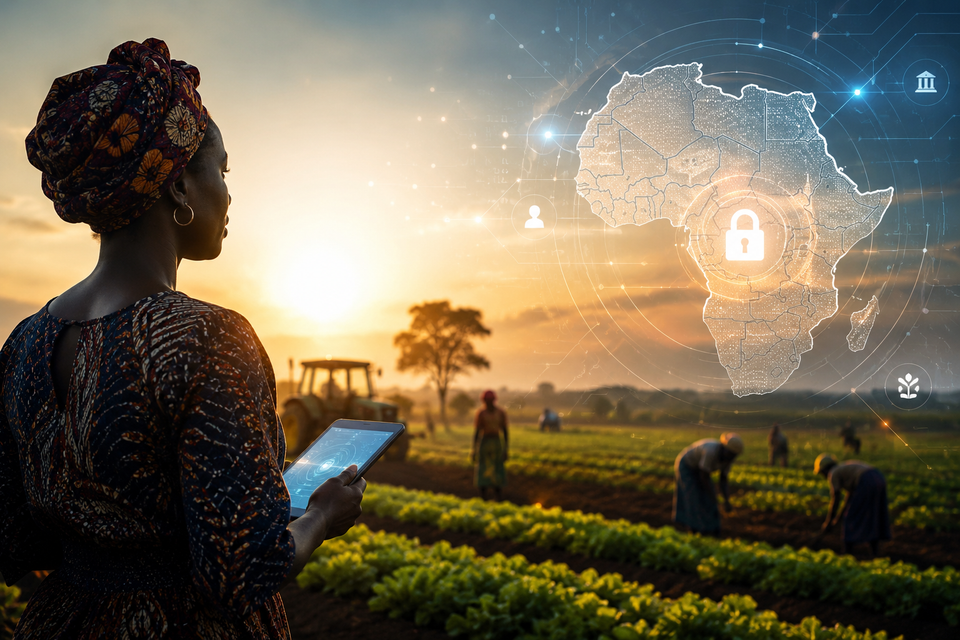
For years, the story told about Africa's digital future has centered on infrastructure: more towers, more fiber, more smartphones. That story is coming true faster than expected — internet penetration across the continent has climbed from roughly 30% in 2020 to about 50% today, with mobile networks now reaching the vast majority of the population. But access to a network was never the whole problem, and nowhere is that clearer than in agriculture, the sector where most of Africa's women actually work.
Women make up an estimated 43% of the agricultural workforce across the developing world, and in Africa specifically, they are responsible for around 70% of family farming. Yet the same women who grow most of the continent's food own barely a fraction of the land they work. Recent research puts the figure starkly: women account for only about 12% of Africa's agricultural landowners, and in some regions — North Africa among them — that share falls closer to 5%. In parts of West Africa, women's land ownership trails men's by as much as 40 percentage points. In a handful of countries, women still cannot legally own or inherit land at all.
This is not a side issue to Africa's digital transformation. It is arguably the central obstacle to it.
Why "Access" Was Never the Real Barrier
The original framing of Africa's digital gender gap tended to treat it as a hardware and connectivity problem — get more women online, and the benefits will follow. That framing undersells what's actually happening. Digital and economic exclusion in African agriculture is downstream of something more structural: land is the collateral that unlocks credit, credit is what allows a farmer to invest in equipment, inputs, and — increasingly — the digital tools now reshaping agricultural productivity. When women are locked out of land ownership, they are locked out of that entire chain, regardless of how many mobile towers go up around them.
The numbers make the stakes concrete. If women farmers had the same access to productive resources as men — land, credit, extension services, technology — evidence suggests they could raise yields on their own farms by 20 to 30%, lifting total agricultural output in developing countries by several percentage points. That's not an abstract equity argument; it's a food security and GDP argument, in a region where agriculture still accounts for a substantial share of economic output.
Nigeria's experience with land registration illustrates how deep the structural problem runs, independent of gender. Since formal land titling began, less than 3% of land nationally has been registered, largely because of slow, case-by-case ("sporadic") registration processes. Research into Ondo State's shift toward systematic, geospatial land titling found it faster and cheaper than the old approach — but even an efficient registration system doesn't automatically correct who ends up on the title. Without deliberate attention to gender in how land rights are formalized, digitizing a broken system just produces a faster version of the same imbalance.
The Rwanda Counter-Example
Rwanda offers the clearest evidence that this pattern isn't inevitable. Following the 1994 genocide, Rwanda rebuilt its political institutions with mandatory gender inclusion at their core — and today women hold 63.8% of seats in the Chamber of Deputies, the highest share of any parliament in the world, along with roughly a third of cabinet positions. That political representation didn't stay confined to Kigali. It shaped agricultural policy directly, through mandates requiring women's inclusion in the leadership of agricultural cooperatives — the institutions through which most Rwandan farmers access credit, inputs, and markets.
The results show up in something harder to legislate than a quota: trust. Studies of Rwandan agricultural cooperatives find that women members report unusually high trust in both cooperative leadership and government institutions — a level of institutional confidence that correlates with Rwanda's broader gains in poverty reduction, economic stability, and comparatively low corruption relative to other countries in the region.
That pattern has a name in social capital theory: the distinction between bonding social capital (trust within a close-knit group) and bridging social capital (trust that extends across groups and institutions). Rwanda's post-genocide recovery required rebuilding both, deliberately, as government policy — treating trust itself as a form of capital that, like land or credit, could be systematically built rather than assumed. What some researchers describe as Rwanda's "soft power" governance style — leadership built around consensus, value alignment, and institutional trust rather than top-down control — turns out to be difficult to separate from its economic outcomes.
From Dead Capital to Working Capital
Development economists have long used the term "dead capital" for land and assets that exist but can't be leveraged — unregistered, untitled, or held by someone the formal system won't recognize as an owner. Across Africa, land held by women disproportionately falls into this category: farmed, sometimes for generations, but never converted into the kind of formal asset that can back a loan, anchor a cooperative membership, or serve as the basis for accessing agri-tech platforms now emerging across the continent.
Turning dead capital into working capital is not fundamentally a technology problem. It's an institutional one. Digital land registries, mobile banking, and agri-tech platforms can all help — but only once women are recognized, in law and in practice, as people who can hold property and make decisions about it. Tanzania's experience with gender-responsive land titling is instructive here: when land-use programs paired digital registration tools with deliberate community sensitization on women's land rights, women's land ownership rose measurably, and land disputes affecting women dropped sharply in targeted districts. The technology mattered, but the institutional design mattered more.
What This Means for Africa's Agri-Tech Moment
Africa's agricultural sector is entering a period of real digital opportunity — mobile-based extension services, digital marketplaces, satellite-assisted land mapping, and fintech products built for smallholder farmers are all expanding quickly. None of it will close the gender gap on its own. A digital platform built on top of an unequal land and credit system will tend to reproduce that inequality faster, not correct it, unless institutional design puts gender access at the center rather than treating it as an afterthought.
Rwanda's experience suggests what that looks like in practice: mandated representation in the institutions that control resources, policy that treats trust and inclusion as economic infrastructure rather than a soft add-on, and a willingness to measure success not just in yields or GDP, but in whether the people doing the work are the ones who end up owning what they've built. For the rest of the continent, closing the digital divide in agriculture will depend less on the next generation of mobile technology and more on whether land, credit, and decision-making power finally reach the women already doing most of the work.
Member discussion