
Pretty Good Privacy: How One 1991 Tool Still Shapes the Way We Protect Digital Communication
Every day, people send emails and store files they'd rather no one else read — tax records, medical details, business plans, personal messages. In theory, almost anything sent over the internet can be intercepted along the way. Pretty Good Privacy, better known as PGP, was one of the first widely available tools built to stop that from mattering, and more than three decades after its release, its core ideas still underpin how modern systems keep communication private.
A Tool Born From a Simple Problem
PGP was created in 1991 by Phil Zimmermann, a software engineer concerned about the growing ability of governments and corporations to monitor digital communication. He released it as freeware, which let it spread quickly among early internet users looking for a way to keep their messages private. Its popularity wasn't just about being free — PGP solved a genuine technical problem: two people who had never met, and had no way to safely exchange a secret password in advance, could still send each other a message that only the intended recipient could read.
That single idea — secure communication without a pre-shared secret — is what made PGP different from earlier encryption approaches, and it's the same principle that powers much of the secure internet today.
The Two-Lock System Behind PGP
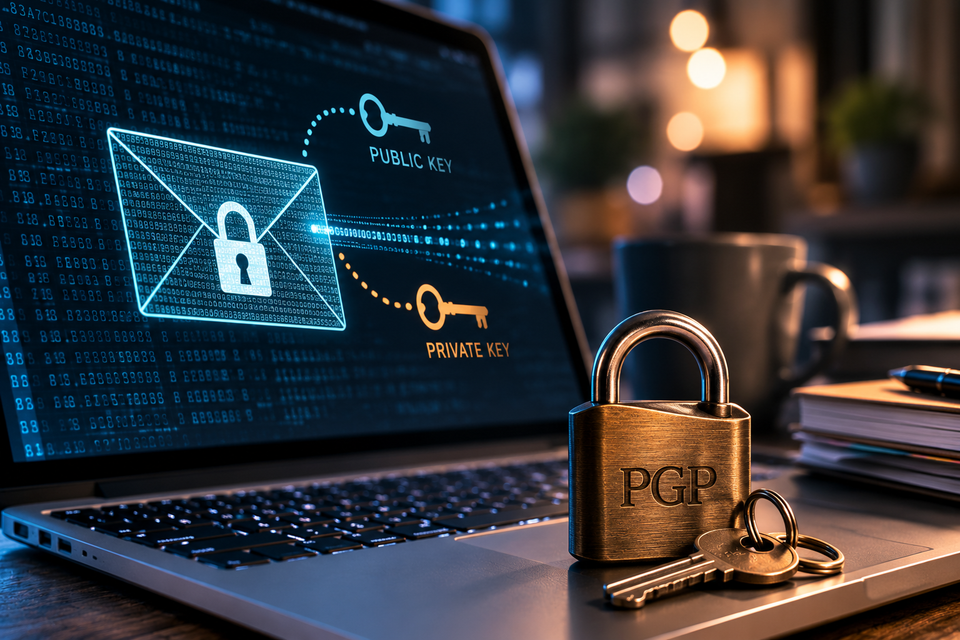
At its core, PGP combines two different kinds of encryption. The first, symmetric encryption, uses one key to both lock and unlock a message — fast, but it requires both parties to somehow already share that key safely, which is difficult over an open network. The second, public-key encryption, solves that problem using two mathematically linked keys: a public key anyone can use to lock a message, and a private key, kept secret, that's the only thing that can unlock it. Public-key encryption is secure, but it's slow when used on large amounts of data.
PGP's solution is to use each technique for what it's good at. When you send a PGP-encrypted message, the software generates a random, one-time code called a session key and uses it to quickly encrypt the actual message. Then, that session key — not the message itself — gets encrypted using the recipient's public key. The recipient uses their private key to unlock the session key, and the session key unlocks the message. It sounds like an extra, unnecessary step, but it's what lets PGP be both fast and secure at the same time.
Services like ProtonMail build this entire process into a single click. Select an option like "Sign Mail," and a padlock icon appears — the software handles the session key generation, encryption, and delivery automatically. If you're messaging someone outside that platform, you simply exchange public keys first, often as a small attached file, and the same process runs from there.
More Than Just Secrecy
Encryption isn't the only thing PGP does. It also supports digital signatures, which let a recipient verify that a message really came from who it claims to be from, and that nothing was altered along the way. This works almost like a tamper-proof seal: the sender generates a unique digital fingerprint of their message and locks it with their own private key. Anyone with the sender's public key can check that fingerprint against the message they received — if even one character has changed, the fingerprint won't match, and the recipient knows something is wrong.
Beyond email, the same techniques extend to encrypting files sitting on a hard drive or in cloud storage, which is why PGP-based tools remain common in industries that handle sensitive records, from healthcare to legal services.
Trusting a Key You've Never Seen in Person
One of PGP's more distinctive design choices is how it handles trust. Many secure systems on the web — the padlock icon in your browser, for example — rely on centralized Certificate Authorities that vouch for a website's identity. PGP instead uses what's called a Web of Trust: individual users vouch for each other's keys directly, creating a decentralized network of trust relationships rather than depending on one central authority. It's a system with no single point of failure, but it also puts more responsibility on the individual user to double-check that a key genuinely belongs to who it claims to.
Strong, But Not Invincible — and Not Anonymous
It's tempting to describe PGP's encryption as unbreakable, and the mathematics behind it — when properly implemented, using adequately long keys — is not something that can be cracked through brute computing force with current technology. But real-world security problems with PGP have almost always come from somewhere else: how the software is implemented, not the underlying cryptography. The Efail vulnerability, disclosed in 2018, is a good example — it exploited how certain email clients displayed decrypted content, not a weakness in PGP's actual math.
It's also worth being clear about what PGP doesn't do. It hides the content of a message, but not the fact that a message was sent — who emailed whom, and when, remains visible, and subject lines are never encrypted. Anyone relying on PGP for genuinely sensitive communication should treat it as protection for content, not as a tool for anonymity.
A Legal History as Complicated as Its Cryptography
PGP's story isn't purely technical. When it first spread internationally in the early 1990s, U.S. law classified strong encryption software as a controlled munition, and Zimmermann became the subject of a federal investigation into unlicensed export — a case that was eventually closed without charges, but which became a landmark moment in the debate over whether software source code counts as protected speech. Courts later agreed that it does, a ruling that helped ease export restrictions on encryption software in the years that followed.
That tension between privacy and government access hasn't disappeared; it's just shifted form. Some countries, like the UK, have laws that can compel someone to hand over an encryption key or password, with real legal consequences for refusing. At the same time, a wave of newer data protection regulations — GDPR in Europe, HIPAA in U.S. healthcare, and industry standards like PCI-DSS for payment data — now treat strong encryption not as a threat to be restricted, but as an expected safeguard for protecting personal information.
Why It Still Matters
PGP isn't the newest or the most user-friendly encryption tool available today — messaging apps like Signal have since built simpler, more automatic versions of similar ideas. But PGP remains a useful lens for understanding how modern secure communication actually works, because it makes its design choices visible rather than hiding them behind a simple app interface. Anyone trying to understand why your browser's padlock icon works the way it does, why messaging apps advertise "end-to-end encryption," or why security engineers talk about key management as much as they talk about algorithms, is really tracing ideas back to the same problem PGP set out to solve more than thirty years ago: how do you talk privately with someone you've never met, over a network you can't fully trust?
Member discussion