
Securing the Power Sector: Why Energy Is the Backbone of Critical Infrastructure
What Makes Infrastructure "Critical"?
Every society runs on a small set of essentials — food, water, shelter, and energy. Of these, energy is the one that quietly enables all the others. It powers the pumps that treat water, the cold storage that preserves food, the equipment hospitals rely on, and the networks that keep banks, factories, and communication systems running. When any of these systems goes offline, even briefly, the effects ripple outward because modern infrastructure sectors are deeply interconnected.
Governments formally recognize this interdependence through the concept of critical infrastructure: the assets and systems so essential to a functioning economy and society that their failure or destruction would have a debilitating effect on public safety, health, or economic security. The commonly recognized critical infrastructure sectors include:
- Food and Agriculture
- Water and Wastewater Systems
- Dams
- Energy
- Chemical
- Government
- Telecommunications
- Emergency Services
- Manufacturing
- Information Technology
- Financial Services
- Healthcare and Public Health
- Transportation Systems
- Defense Industrial Base
- Nuclear Reactors, Materials, and Waste
Because these sectors depend on one another, a disruption in one — say, a power outage — can cascade into failures across several others simultaneously. This is why protecting critical infrastructure, particularly against cyber-attacks, is treated as a matter of national and economic security. A single breach can lead to business interruption, environmental harm, financial losses, and even threats to human life.
Among all these sectors, energy holds a special place: it's the one nearly every other sector depends on to function at all.
The Energy Sector as the Foundation
Food preservation, water treatment, communications, banking, industrial production, hospitals, and emergency response all share one dependency — electricity. Strip away power, and every one of these systems grinds to a halt. That single point of dependency is precisely why the energy sector, and the power grid in particular, sits at the center of critical infrastructure protection efforts.
From Traditional Grids to Smart Grids
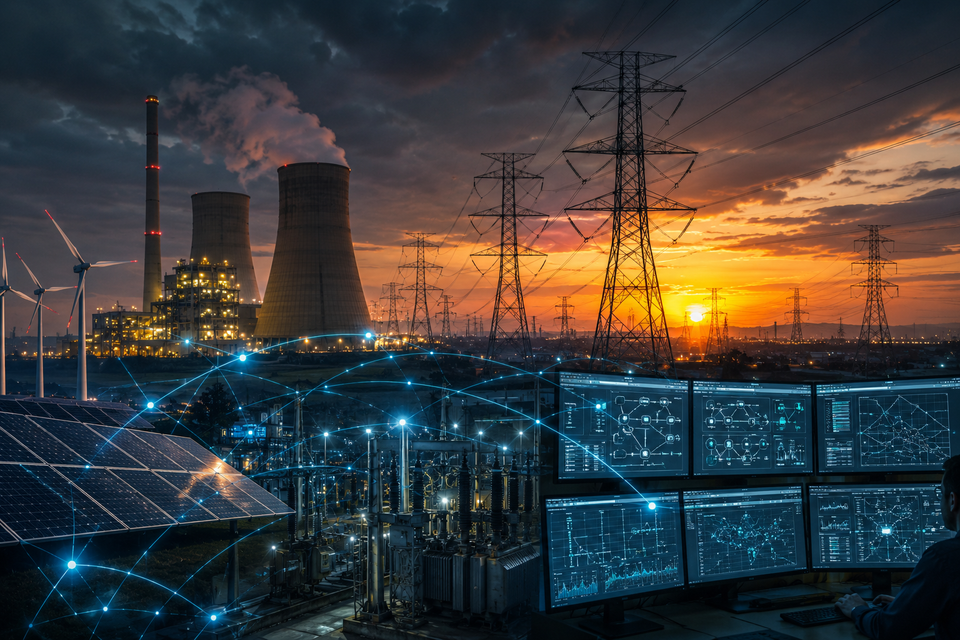
Power delivery has traditionally followed a one-way path: generate electricity at a large plant, transmit it over long distances, and distribute it to homes and businesses. Today, that model is being replaced by the smart grid — a digitally managed electricity network built on two-way communication between utilities and consumers.
Smart grids bring several advantages over legacy systems:
- Two-way power flow. Consumers with rooftop solar panels or other small-scale generation can feed surplus electricity back into the grid, rather than only drawing from it.
- Decentralization. Rather than relying on a single centralized distribution point, a smart grid distributes intelligence and control throughout the network, incorporating everything from wind and solar farms to nuclear, thermal, and hydroelectric plants.
- Real-time visibility. Continuous monitoring, analysis, and control across the supply chain improve efficiency, cut costs, and increase transparency and reliability.
In short, the smart grid turns electricity distribution into a responsive, data-driven system rather than a static one-way pipeline — but that added intelligence also means added complexity, and complexity introduces new points of vulnerability.
SCADA: The Nervous System of the Power Grid
That added complexity is managed largely through SCADA — Supervisory Control and Data Acquisition — an industrial control framework used across energy, manufacturing, water, and transportation systems. SCADA doesn't just collect data; it acts on it, sending instructions back to field equipment to keep operations running smoothly.
In the power sector, SCADA typically comprises:
- Substation automation across generation, transmission, and distribution sites
- EMS/TMS (Energy Management Systems / Transmission Management Systems)
- DMS/ADMS (Distribution Management Systems / Advanced Distribution Management Systems)
- OMS (Outage Management Systems)
- DRMS/DERMS (Distributed Resource and Distributed Energy Resource Management Systems)
- HMI/GUI interfaces for data logging and operator control
- Supporting engineering services: design, simulation, programming, communications, training, and maintenance
The Building Blocks of a SCADA System
A SCADA system is really an assembly of several interdependent components, each playing a distinct role:
Field instruments — sensors and transmitters that detect physical changes (temperature, voltage, flow, pressure) and convert them into measurable data. Larger, more complex systems require more of these sensors distributed throughout the network.
Conversion units — the intermediaries that translate raw sensor data into digital form for transmission to the central system. The two most common conversion units are:
- Programmable Logic Controllers (PLCs) — industrial digital computers well-suited to localized control, valued for their flexibility and affordability, though they require solid programming expertise to use effectively.
- Remote Terminal Units (RTUs) — microprocessor-based devices that typically communicate wirelessly, making them ideal for monitoring assets spread across wide geographic areas.
Communication network — the connective tissue linking field devices to the central control system. Depending on the facility, this might run over ethernet, fiber optics, telephone lines, power-line carriers, cellular, radio, satellite, or Wi-Fi. For security reasons, many facilities favor dedicated, specialized network connections over public infrastructure.
Master unit — the central processing hub, usually a set of powerful computer consoles, that hosts the human-machine interface (HMI) and automatically adjusts the managed system based on sensor input.
Human-Machine Interface (HMI) — the dashboard operators use to view live data, generate reports, create diagrams, and receive alerts.
Remote communication server (RCS) — the secure storage and access layer that connects the HMI to the field-level conversion units, making historical and real-time data available for analysis.
SCADA in Action: Generation, Transmission, and Distribution
SCADA's role changes shape depending on where in the power delivery chain it's applied.
Generation
At power plants, SCADA supervises the moment-to-moment mechanics of producing electricity:
- Continuous monitoring of speed and frequency of electrical machines
- Tracking fuel logistics, such as coal delivery, and water treatment processes
- Planning electricity generation operations and load scheduling
- Managing active and reactive power output
- Protecting boilers and turbines in thermal plants
- Monitoring renewable energy farms and coordinating load dispatch
- Logging historical generation data and recording sequences of events
- Overseeing circuit breakers, protective relays, and other safety systems
Transmission
Once electricity leaves the plant, SCADA keeps the high-voltage transmission network accurate and stable. Without it, discrepancies between modeled circuit parameters and real-world measurements can distort economic dispatch calculations, leading to billing errors or inflated costs, and can compromise stability and contingency analyses. Key SCADA functions here include:
- Re-routing power during station maintenance
- Restoring service after outages
- Interfacing with protective relays
- Managing voltage regulation and load tap changers
- Real-time network modeling and single-line displays
- Automated circuit isolation and switch control
- System diagnostics through automated alarm management
Distribution
At the final stage — delivering power to homes and businesses — SCADA replaces much of the manual labor traditionally required to monitor and manage the grid. PLCs installed at substations continuously track conditions and relay that information to the central system, enabling:
- Maintaining efficient power factor ranges
- Limiting peak power demand
- Alerting operators to developing problems
- Storing historical data accessible from remote locations
- Faster response to customer service interruptions
- Feeder automation and load sectionalizing
- Manual override of automatic capacitor bank controls
- Automated meter reading
- Circuit breaker control, lockout, and interlocking
- Monitoring power quality issues like harmonic distortion
Why This Matters for Security
The same connectivity that makes SCADA so powerful is also what makes it a target. As more administrative, business, and operational systems are networked together, the number of potential attack surfaces grows. A vulnerability exploited in a SCADA system isn't just an IT problem — it can disrupt the physical operation of generation plants, substations, and transmission lines, with consequences ranging from localized outages to widespread damage and economic loss.
Because the energy sector underpins nearly every other critical infrastructure sector, securing SCADA systems isn't optional — it's foundational to protecting the broader systems society depends on every day.
Member discussion