
Why Africa's Cybercrime Fight Needs More Than a Drill — And Why Drills Alone Won't Win It
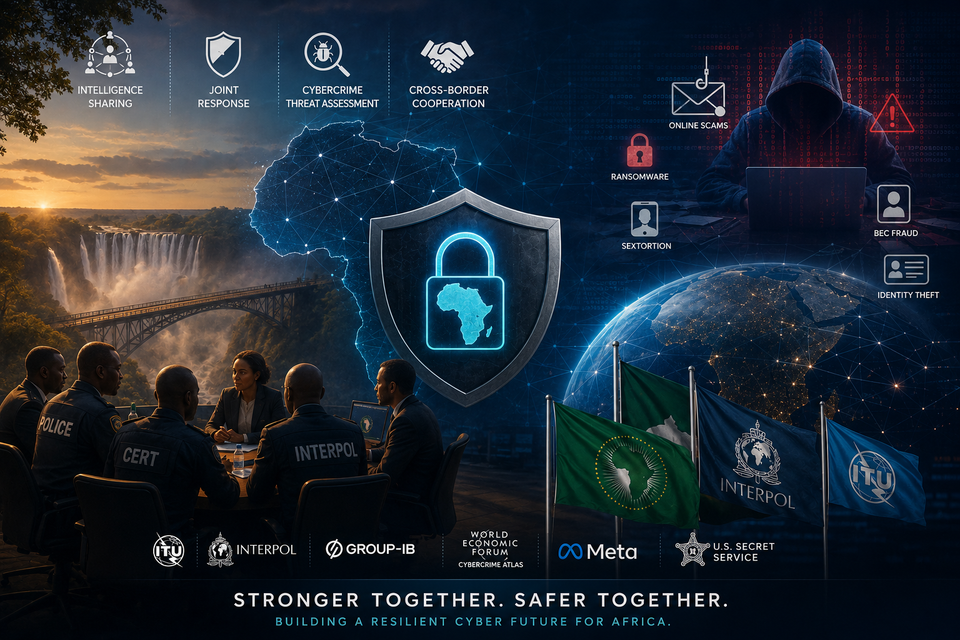
A Week in Victoria Falls
Earlier this year, law enforcement officers, national CERT/CIRT/SOC teams, and cybersecurity practitioners from across Africa and the Arab States gathered in Victoria Falls, Zimbabwe, for the 2026 ITU Inter-Regional CyberDrill. Jointly organized by the International Telecommunication Union (ITU) and INTERPOL, the event brought together an unusually dense mix of expertise in one room: INTERPOL's Cybercrime Directorate, threat intelligence firms like Group-IB, the World Economic Forum's Cybercrime Atlas initiative, Meta, the U.S. Secret Service, and independent security researchers and diplomats.
The agenda covered ground that would have seemed niche a decade ago and now reads like a checklist of the region's most urgent security problems: the soon-to-be-published INTERPOL Africa Threat Assessment Report 2025, detailing how online scams, business email compromise, ransomware, digital sextortion, identity fraud, and data breaches are becoming more organized, transnational, and — increasingly — automated by artificial intelligence. Participants also discussed a recent operational win, the SniperDz takedown in North Africa under Operation Ramz, and used the drill as a venue for real-time intelligence-sharing coordination between member countries.
On paper, this is exactly the kind of event that should be happening more, not less. And yet the pattern of "convene, brief, coordinate, disperse" that defines most international cyber capacity-building efforts has a well-documented failure mode. Understanding both halves — why this matters, and why it routinely falls short — is essential for anyone serious about defending the region.
Why It Matters
Cybercrime in Africa has genuinely changed shape. The threats on the agenda — AI-enabled scam operations, sextortion rings, BEC fraud — aren't isolated incidents anymore; they're increasingly run as organized, cross-border enterprises. A scam call center operating in one country can target victims in a dozen others, launder proceeds through a third, and use AI tools to generate convincing scripts, deepfake voices, or phishing content faster than any single national agency can track. This is precisely the kind of problem that no country can solve unilaterally.
Real intelligence-sharing is rare and valuable. Most international cybersecurity conferences are talk shops. A coordination meeting where INTERPOL member countries, private threat-intelligence firms, and platform companies like Meta share real-time indicators is a genuinely different and more useful mechanism — it moves information from "awareness" to "actionable" in a way that published threat reports alone cannot.
Public-private collaboration is not optional anymore. Platforms, threat intel vendors, and financial institutions often see attacker infrastructure before any government does. Bringing Group-IB, the WEF's Cybercrime Atlas initiative, and law enforcement into the same coordination session reflects a maturing (if still incomplete) recognition that cybercrime disruption depends on private-sector visibility as much as state authority.
Operational wins build trust and momentum. Highlighting takedowns like SniperDz — rather than only threat statistics — matters because it demonstrates that cooperation produces results, not just paperwork. That kind of proof point is what keeps stretched national agencies willing to keep showing up.
Why It Falls Short
The drill ends, but the threat doesn't. A CyberDrill is, definitionally, a fixed-duration event. The relationships, trust, and shared operational tempo built over a few days in Victoria Falls have to survive months of normal bureaucratic friction afterward — different budget cycles, different political priorities, and no built-in mechanism to keep the same people and institutions engaged between events. Momentum decays fast once the delegates fly home.
Fragmented legal frameworks don't get fixed by a workshop. One of the central themes raised at the drill — fragmented legal frameworks across Africa and the Arab States — is a structural, not a technical, problem. Mutual legal assistance treaties, extradition processes, and evidentiary standards for digital crime vary enormously by country, and a week of capacity-building cannot harmonize legislation that individual parliaments haven't prioritized. Attackers exploit exactly this seam: operating from jurisdictions with the weakest legal cooperation infrastructure.
Underreporting hides the true scale of the problem. Victim underreporting — especially for sextortion and financial fraud, where shame and distrust of law enforcement suppress reporting — means even the best threat assessment is working from an incomplete picture. No amount of intelligence-sharing between agencies fixes a data problem that starts with victims who never come forward in the first place.
Capacity gaps are resource problems, not knowledge problems. Many national CERTs and law enforcement cybercrime units in the region are chronically under-resourced relative to the scale of what they're now expected to police. A drill can transfer knowledge and best practice, but it cannot conjure the staffing, tooling, and sustained budget that turns a briefing into an operational capability.
AI is accelerating the offense faster than institutions can adapt. The drill's own agenda acknowledged that AI is helping criminals automate and scale operations. But institutional response cycles — legislation, training curricula, budget approvals, cross-border agreements — move on a timeline measured in years. Attackers adopting new AI tooling move on a timeline measured in weeks. That asymmetry is arguably the single hardest problem in the room, and it is not one a drill format is built to solve.
Coordination between drills is often informal and personality-dependent. Much of the value from events like this comes down to individual relationships built between specific officers, analysts, and private-sector contacts who happened to be in the room. When those individuals move roles or leave their positions, the institutional memory and trust often leave with them, because there's rarely a formalized structure to preserve it.
Closing the Gap Between the Drill and the Defense
None of this is an argument against CyberDrills — it's an argument for what has to surround them. The intelligence-sharing, the threat assessments, and the operational wins showcased in Victoria Falls are necessary inputs. What's missing, in most regions, is the connective tissue between events: sustained policy advocacy to harmonize legal frameworks, ongoing training pipelines rather than one-off workshops, and thought leadership that keeps pressure on governments and industry to act in the months between drills — not just during them.
This is the gap The Cyberdiplomat works to close. We provide thought leadership, research, and advisory support on cyber diplomacy, cross-border cybersecurity cooperation, and capacity-building strategy for governments, NGOs, and private-sector partners — and we help organize and structure exactly these kinds of regional coordination initiatives so their impact outlasts the event itself.
If your organization is working on regional cybersecurity capacity-building, threat intelligence coordination, or cyber policy development, reach out to us at info@thecyberdiplomat.com.
Member discussion