
Latin America's Quantum Problem Is Not Technology — It Is Talent
THREAT INTELLIGENCE BRIEF | THE CYBERDIPLOMAT | JUNE 4, 2026
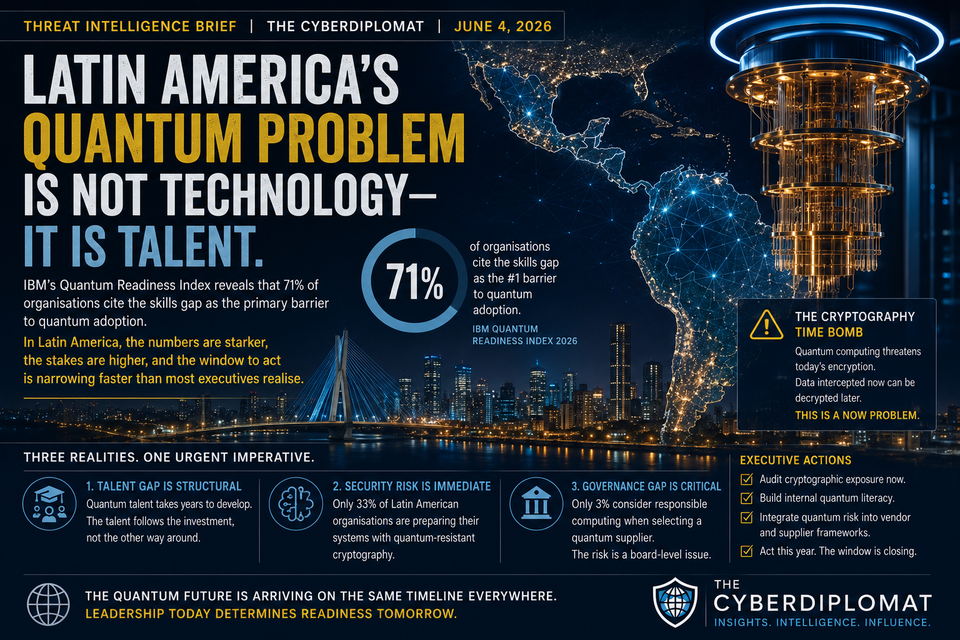
IBM's Quantum Readiness Index reveals that 71% of organisations cite the skills gap as the primary barrier to quantum adoption. In Latin America, the numbers are starker, the stakes are higher, and the window to act is narrowing faster than most executives realise.
The Finding That Should Concern Every Boardroom
New York Tech Week this week became an unlikely stage for one of the most consequential technology briefings of 2026. IBM, presenting findings from its Quantum Readiness Index, confirmed what many in the industry have suspected but few have acted on: the global readiness score for quantum computing sits at just 28 out of 100 — and Latin America is fighting both the global deficit and a pronounced regional one simultaneously.
The skills gap is not a secondary concern or a future problem to be addressed when quantum becomes commercially mainstream. It is the primary barrier right now, identified by nearly three quarters of organisations surveyed. And in a region where the competition for specialised technology talent is already fierce — driven by AI adoption, digital transformation, and an expanding fintech sector — quantum is arriving at the back of a very long queue.
What Quantum Computing Actually Is — And Why the Stakes Are High
Quantum computing is not a faster version of the computers organisations already use. It is a fundamentally different approach to computation, designed to solve categories of problems — molecular simulation, optimisation, cryptographic analysis — that are effectively impossible for classical systems at scale. Moderna has already used quantum simulation to achieve the largest known secondary mRNA structure analysis to date. The technology is not theoretical. It is entering production use in pharmaceuticals, logistics, financial modelling, and — critically — cybersecurity.
That last application is where Latin American executives need to pay the sharpest attention. Quantum computing does not merely create new capabilities. It threatens existing ones. The cryptographic infrastructure that currently secures banking systems, government communications, healthcare records, and corporate intellectual property across the region was designed for a pre-quantum world. When sufficiently powerful quantum systems become available to adversaries — state-sponsored or otherwise — much of that infrastructure becomes vulnerable to decryption retrospectively. Data being intercepted and stored today can be decrypted later. This is not a 2040 problem. It is a now problem that will become acute within the decade.
Yet only 33% of Latin American organisations are currently preparing their systems with quantum-resistant cryptography, according to IBM's research. That means two thirds of the region's organisations are knowingly or unknowingly accumulating cryptographic debt.
The CyberDiplomat's Assessment
Three dynamics define Latin America's quantum predicament — and each has direct implications for executive decision-making.
1. The talent shortage is structural, not cyclical
Alexandre Pfeifer, IBM's quantum business leader for the region, described quantum computing as "a new branch of computing, very difficult — it requires a lot of instruction and a lot of study." This is not a gap that can be closed by retraining existing staff over a weekend programme. The interdisciplinary profiles required — quantum algorithm specialists, hybrid AI-quantum architects, quantum-aware cybersecurity engineers, and governance specialists managing quantum intellectual property — take years to develop and do not yet exist in sufficient numbers anywhere in the world, let alone in Latin America.
The uncomfortable implication for executives is this: organisations that wait for the talent market to mature before engaging with quantum will find themselves permanently behind those that began building internal capability now. The companies shaping quantum strategy today are not doing so because they have all the talent they need. They are doing so because they understand that the talent follows the investment, not the other way around.
2. The AI parallel is instructive — but only up to a point
IBM's Jerry Chow drew an explicit parallel between Latin America's quantum adoption trajectory and its AI adoption journey, suggesting the region will approach quantum the same way it approached AI — with pragmatic, utility-driven integration rather than deep foundational research. That framing is useful, but it obscures an important difference.
AI adoption, for all its complexity, did not fundamentally threaten existing security infrastructure. Quantum does. Organisations that adopt a wait-and-see stance on quantum — reasonable for many AI applications — are not simply delaying a competitive advantage. They are potentially delaying a necessary defensive posture. The distinction matters enormously for how executives should frame the investment case internally.
3. The 3% governance figure is the most alarming number in the report
IBM's research reveals that only 3% of Latin American companies consider responsible computing practices a key factor when selecting a quantum supplier. In a technology that has direct implications for national security, intellectual property protection, regulatory compliance, and cryptographic integrity, this is an extraordinary governance gap. Quantum suppliers are not interchangeable. The provenance of quantum hardware, the jurisdiction of cloud quantum access, the data sovereignty implications of using foreign quantum infrastructure, and the export control constraints on certain quantum technologies are all material decisions that belong at board level — not delegated silently to procurement teams.
What Executives Should Do — This Year
Audit your cryptographic exposure now. Commission an assessment of which systems, data stores, and communications channels rely on encryption standards that are vulnerable to quantum decryption. The National Institute of Standards and Technology finalised its first post-quantum cryptographic standards in 2024. Organisations with no migration roadmap are already behind international peers.
Frame quantum as a complement, not a competitor, to existing technology investment. IBM's data shows that organisations which position quantum as complementary to AI and high-performance computing increase their quantum investment by 33% compared to those that treat it as a competing priority. The internal framing matters — for budget allocation, for talent recruitment, and for board-level buy-in.
Use the talent gap as a first-mover advantage. IBM's SkillsBuild programme and its Quantum Learning Platform offer free, Spanish-language training and access to quantum systems for ten minutes per month — a low-cost entry point for building internal awareness. Organisations that begin developing quantum literacy within their technology and security teams now will be significantly better positioned when commercial quantum applications reach scale.
Build quantum into vendor and supplier risk frameworks today. Any organisation engaging with cloud providers, technology manufacturers, or data processing partners should begin asking about their quantum readiness posture and post-quantum cryptography migration timelines. A supplier's cryptographic vulnerability is your exposure.
Bottom Line
Latin America's quantum talent gap is real, significant, and will not resolve itself. But the organisations treating it as someone else's problem — a challenge for governments, universities, or technology vendors to solve — are misreading the situation. The talent gap is a leadership gap. And the cryptographic exposure that comes with delayed quantum preparedness is not an abstract future risk. It is a present liability that is growing quietly every day that it goes unaddressed.
The quantum future is coming to Latin America on the same timeline as everywhere else. The question is whether the region's business leadership meets it prepared or catches up after the fact.
Analysis by The CyberDiplomat · Based on IBM Quantum Readiness Index findings presented at New York Tech Week, June 2026 · For redistribution enquiries, contact the editorial desk.
Member discussion