
When Spies Target the Market: Email Espionage and the New Front of Financial Warfare
The story of a compromised executive at an unnamed global stock exchange sounds, at first glance, like a routine cybersecurity incident — one of thousands reported each year. It is not. Set against a backdrop of intensifying geopolitical rivalry, economic decoupling, and weaponised financial intelligence, it represents something far more alarming: the steady convergence of state-level espionage and financial market manipulation.
What Actually Happened
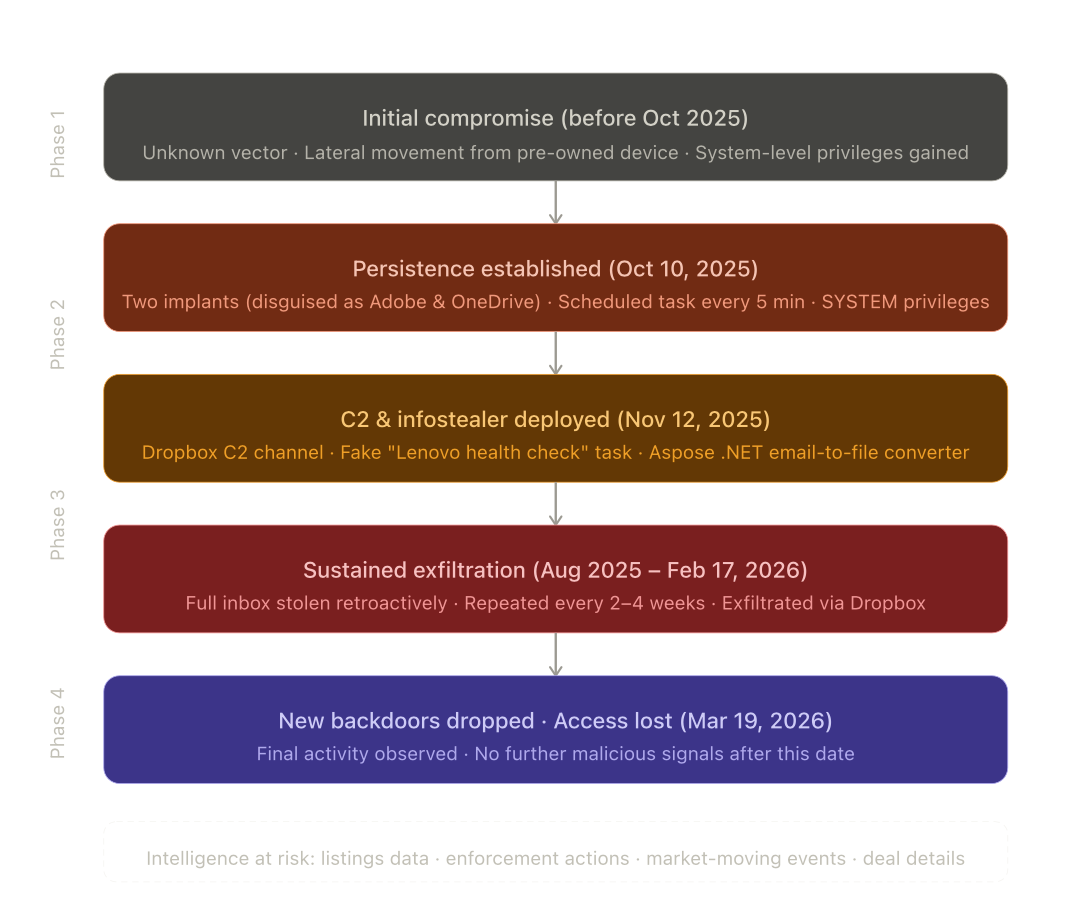
For at least five months, an unknown threat actor maintained near-total visibility into the inbox of a senior executive at a major financial exchange. From as early as August 2025 through February 2026, the attacker exfiltrated the executive's entire email archive and then refreshed that haul every two to four weeks — a meticulous, patient operation designed not for a single heist but for sustained intelligence collection.
The technical execution was notable for its restraint. Rather than deploying noisy, destructive malware, the attacker used legitimate tools already trusted by the target's environment — a real .NET library from document-processing company Aspose to convert emails into files, Dropbox as a command-and-control channel to blend into normal corporate traffic, and Windows scheduled tasks disguised as Adobe software and Lenovo system health checks. It is the operational tradecraft of a professional intelligence operation, not a criminal one.
By the time defenders noticed, the attacker already had administrative access and had been inside the network for weeks. The recorded timeline begins mid-October 2025, but the stolen emails date back to August — meaning the attacker's real foothold preceded what defenders could see.
Why a Stock Exchange? Why Now?
The choice of target is not incidental. Financial exchanges occupy a uniquely privileged position in the global information ecosystem. They receive regulatory filings before they are public. They process enforcement actions. They have visibility into listings, delistings, and market-moving corporate events weeks or months before ordinary investors.
That information, in the right hands at the right moment, is worth an extraordinary amount of money — and not just money. In an era of economic warfare, the line between financial intelligence and statecraft has all but dissolved.
Consider the current environment. The United States and China are engaged in sustained technological and financial decoupling. Sanctions regimes against Russia, Iran, and others are enforced partly through financial market surveillance. Governments around the world are using investment restrictions, export controls, and exchange-listing rules as instruments of foreign policy. A senior executive at a global stock exchange is, effectively, a node in the global intelligence architecture — and whoever reads their emails reads the decisions being made before they are announced.
The attack bears hallmarks consistent with state-sponsored or state-adjacent operations: the patience (months of sustained access rather than a smash-and-grab), the sophistication (living-off-the-land tools that avoid signature-based detection), and the apparent prioritisation of intelligence collection over financial fraud. No ransomware was deployed. No accounts were drained. The attacker wanted to know things, not steal money directly.
The Broader Pattern
This incident does not exist in isolation. Symantec's Threat Hunter Team separately reported Pakistani espionage against Afghanistan's Finance Ministry using a remote-access trojan. Latin American cyber-political operations are escalating. The convergence of financial infrastructure and geopolitical tension is producing a new category of target: institutions that sit at the intersection of money and power.
What makes financial exchanges particularly vulnerable is precisely what makes them valuable. They are deeply interconnected with global systems — cloud services, custodians, regulators, listed companies — and that connectivity creates a vast attack surface. A well-resourced adversary does not need to break the exchange's front door; they can enter through a vendor, a connected device, a trusted partner's compromised network, and then move laterally until they reach someone who knows things worth knowing.
The five-month dwell time in this case is not exceptional. Industry studies consistently find that the average time between compromise and detection runs into months. What is exceptional is that, once the attacker was eventually discovered, they had already achieved everything they came for.
The Intelligence Value: What Was Actually Stolen
To understand the stakes, consider what a senior exchange executive's inbox typically contains over a five-month period. It would include:
Communication with listed companies about pending announcements, earnings guidance, and regulatory submissions. Correspondence with financial regulators about enforcement actions and investigations. Internal discussions about potential delistings, mergers, or market structure changes. Calendar entries revealing which institutions or governments are seeking meetings and about what.
In a world where algorithmic trading can execute thousands of transactions in the time it takes a human to blink, pre-announcement knowledge of even a single major market event is worth hundreds of millions of dollars. Scaled across months of access, the intelligence haul from this operation — if exploited for trading — would be extraordinary. If used for geopolitical purposes, it could inform foreign governments' negotiating positions, investment strategies, or sanctions-evasion planning in ways that are nearly impossible to detect.
The Defensive Failure — and What It Reveals
Researchers from Symantec and Carbon Black were frank about the avoidable nature of this breach. A cloud access security broker would have flagged unusual Dropbox exfiltration. Data loss prevention tools would have caught bulk email conversion and transfer. Endpoint detection and response alerts were, apparently, generated — but not acted upon in time.
This points to a structural problem that goes beyond any single organisation. The security tools exist. The signals were there. What failed was the human and institutional layer: the prioritisation, the response cadence, the assumption that alerts in a financial services environment would be treated with the urgency they deserve.
For high-value targets — and a global stock exchange executive absolutely qualifies — the security posture needs to match the threat posture. State-level adversaries do not make mistakes often. They move slowly, carefully, and they are counting on the defender's attention span being shorter than their own patience.
What This Means Going Forward
The attack on the stock exchange executive is a preview, not an anomaly. As geopolitical competition intensifies, financial infrastructure will increasingly be targeted not for direct theft but for the intelligence it contains. The goal is not to crash markets — that would be too visible, too attributable. The goal is quiet, persistent access to the information that moves markets, shapes regulation, and informs policy.
For the institutions at the centre of this — exchanges, regulators, major custodians, clearinghouses — the implication is uncomfortable: they are, whether they recognise it or not, intelligence targets. Their security strategies need to reflect that reality. Compliance-driven security frameworks designed to satisfy auditors are not built for adversaries who spend months doing reconnaissance before deploying a single tool.
The deeper lesson is simpler. In a world where financial data is geopolitical leverage, the inbox of a senior exchange executive is a national security asset. It should be defended accordingly.
Member discussion