
Small Nations, Large Targets: Assessing Caribbean Cybersecurity Maturity in an Age of Global Turmoil
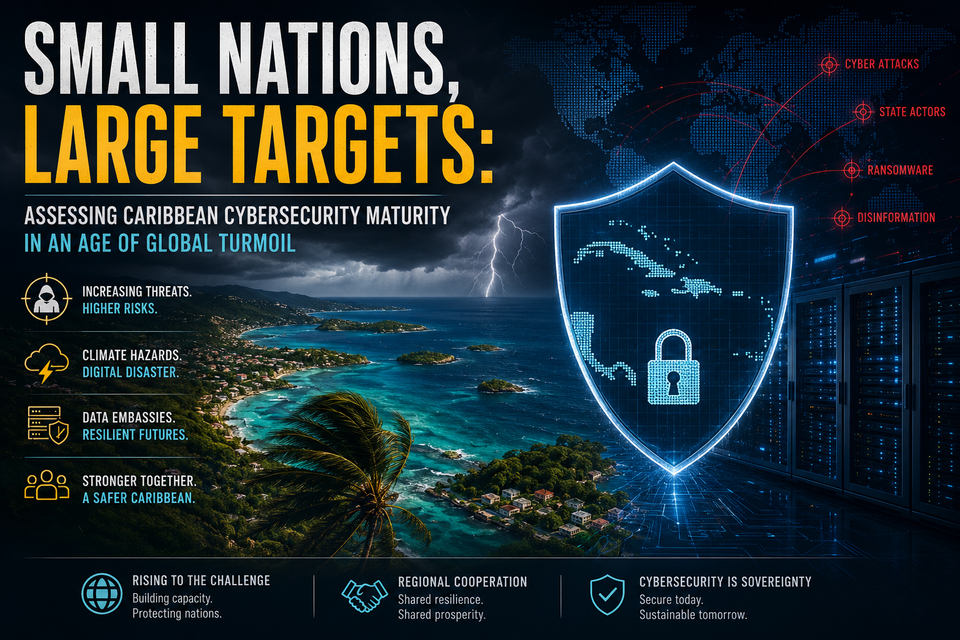
When Belize's Ministry of E-Governance convened regional officials and UN representatives in Belize City this week to discuss "data embassies" and disaster-resilient infrastructure, the meeting carried a weight that its formal agenda only partially conveyed. The Caribbean is not simply trying to improve its technology. It is trying to survive, digitally, in a world that has become considerably more dangerous — and where small, digitally exposed nations are increasingly attractive to both criminal organisations and state-sponsored actors looking for low-resistance entry points.
The Regional Baseline: Progress That Is Real, But Insufficient
The 2025 Cybersecurity Report published by the OAS and the Inter-American Development Bank, developed in collaboration with the Global Cyber Security Capacity Centre at the University of Oxford, provides the most comprehensive assessment to date of cybersecurity maturity across 30 countries in the Latin America and Caribbean region. The picture that emerges is one of genuine, measurable progress — and persistent, structural vulnerability.
The Dominican Republic, Jamaica, and Trinidad and Tobago led the region and demonstrated the greatest cybersecurity capacity maturity. According to the Global Cybersecurity Index of the ITU, only Cuba, Dominican Republic, Jamaica and Trinidad and Tobago are ranked in Tier 3 — the rest of the Caribbean region sits in Tier 4 or worse. That means the majority of island nations — including many with significant financial sectors, tourism infrastructure, and increasingly digitised government services — are operating with fundamentally inadequate defences against the threat environment they now face.
In about half of the Caribbean nations examined, at least one dimension of cybersecurity maturity is still at the lowest "Start-up" stage. While countries generally performed relatively well in policy and strategy, education and skills, and legal and regulatory frameworks, the dimensions of culture and society and standards and technology remained at lower maturity stages across the board. No country in the region has achieved "Dynamic" maturity in any dimension.
That last point deserves emphasis. Dynamic maturity — the highest level in the CMM framework — represents a state where cybersecurity is adaptive, continuously improving, and deeply embedded across institutions. Not a single Caribbean nation has reached it in even one dimension. Against sophisticated, patient, state-level adversaries of the kind documented in recent incidents, this is a sobering gap.
Belize: An Honest Self-Assessment
The Belize workshop is noteworthy partly because of the candour its own officials brought to the discussion. CEO Jose Urbina of the Ministry of E-Governance acknowledged a picture that is simultaneously more advanced than most people in Belize realise, and further behind than the threat environment demands.
On the positive side, Belize's Central Information Technology Office (CETO) — functioning as the government cloud — holds ISO 27001 certification, a meaningful international benchmark for information security management. Belize has successfully implemented its National Cybersecurity Strategy (2020–2023), established inter-institutional cybersecurity task forces, and increased emphasis on public education. These are real achievements for a small nation with limited resources.
But Urbina was frank about what remains. Not all government data centres meet the same standards as CETO. The public sector continues to operate in silos, with agencies managing their own infrastructure independently rather than leveraging shared, resilient platforms. Geographic redundancy — the practice of storing data in multiple physical locations so that a hurricane striking Belize City does not wipe out the entire government's digital capability — remains patchy.
His description of the private sector is, if anything, more concerning. A business with its only data centre in Belize City, with no backup site inland in Belmopan or Orange Walk, is one major storm away from total operational collapse. In a country that sits directly in the Atlantic hurricane corridor, this is not a theoretical risk.
The 2025 CMM assessment revealed that 12 countries showed improvement of 0.5 points or more in at least three dimensions, notably in policy frameworks, risk management, and education. Belize appears to be among the improvers — but its maturity profile tells the story of a nation that has built a credible policy architecture while lagging in the harder, more expensive dimensions of technical standards, cyber culture, and operational resilience.
The "Data Embassy" Model: Geopolitics in a Server Room
The centrepiece concept of the Belize workshop — the "data embassy" — is a deceptively simple idea with enormous geopolitical implications. Under this model, a country stores encrypted copies of its most critical government data in the territory of a trusted partner state. The data remains under the originating country's sovereign control; it simply exists in a physically safer location.
Estonia pioneered this concept after Russia's 2007 cyberattacks on Estonian infrastructure, establishing digital embassies in Luxembourg and other allied nations. For Caribbean states, the motivations are different but the logic is identical: a category-five hurricane, a targeted cyberattack, or a combination of the two could render a small island nation's government data permanently inaccessible.
What makes this particularly urgent in the current global climate is the convergence of two threat vectors — climate and geopolitics — that are usually treated as separate problems. The Caribbean is simultaneously one of the world's most climate-vulnerable regions and one that sits astride critical global shipping lanes, near-shore energy infrastructure, and the financial offshore sectors that serve as conduits for global capital. As great power competition intensifies and the Caribbean becomes an arena of influence competition between the United States, China, and, to a lesser degree, Russia, the digital infrastructure of small states becomes a strategic asset — and a strategic target.
The Structural Challenge: Why Small Island States Are Especially Exposed
The Caribbean's cybersecurity challenge is not primarily a question of will or even policy design. It is structural. The 2025 OAS-IDB report highlights that structural gaps in resources, talent development, and cross-sector coordination persist, continuing to expose the region to an increasingly complex digital threat environment.
Consider what a small island state is working with. A limited tax base means constrained budgets for security infrastructure, incident response teams, and the specialist salaries needed to retain cybersecurity talent. Brain drain is severe — the best cyber professionals trained in the Caribbean are frequently recruited by larger economies. Regulatory capacity is thin, so even where good laws exist, enforcement is inconsistent. And the small size of these economies means they often rely on the same few vendors, the same shared infrastructure, and the same interconnected networks — creating systemic rather than isolated vulnerabilities.
The CARICOM Cybercrime and Cybersecurity Action Plan (CCSCAP) 2025, whose six core pillars are supported by the LAC4 Centre funded by the European Union, was launched to be the shield to protect the Caribbean cyberspace. The LAC4 Centre, based in the Dominican Republic, provides regional training and expertise. But the gap between strategy documents and operational resilience at the country level remains wide.
The Global Turmoil Factor
The timing of the Belize workshop is not coincidental. The global threat landscape has shifted dramatically in recent years in ways that directly affect the Caribbean.
The Russia-Ukraine conflict expanded the deployment of destructive cyberweapons and demonstrated that critical infrastructure — power grids, communications, government systems — is a primary battlefield. That playbook is now studied by actors across the threat spectrum. The US-China technology rivalry has turned digital infrastructure into a geopolitical contest, with Caribbean governments facing pressure over which vendors and platforms they use and which partners they trust with their data. Latin American ransomware groups have become increasingly sophisticated, and the Caribbean, with its mix of tourism revenues, offshore banking, and relatively weak cyber defences, is an attractive target. The rapid adoption of artificial intelligence technologies is transforming the threat landscape, amplifying existing risks and creating new vulnerabilities, with the urgency to update governance frameworks and standards highlighted in the 2025 assessment. IADB
For a country like Belize — English-speaking, geographically positioned between Mexico and the Caribbean Sea, with a growing offshore financial sector and substantial tourism infrastructure — these pressures are not abstract. They arrive as phishing campaigns, ransomware incidents against government agencies, and the constant attrition of probing attacks against under-resourced IT teams.
What Should Come Next
The Belize workshop's focus on regional collaboration and the data embassy model reflects a correct instinct: no Caribbean nation is large enough to defend itself alone, and collective defence — shared incident response teams, shared threat intelligence, pooled infrastructure — is the only realistic path to meaningful resilience.
Countries that integrate cybersecurity into their development agendas and promote public-private partnerships are better positioned to respond to threats and close maturity gaps, according to the IDB report's findings. Belize's revised National Digital Agenda 2026–2030, with collaboration as one of its central pillars, is precisely this kind of integration — if it can be implemented with discipline rather than remaining as aspiration.
Three priorities emerge from any serious analysis of the regional situation. First, closing the geo-redundancy gap is both the most immediately achievable and the most directly relevant to the disaster-climate dimension — it does not require sophisticated adversary intelligence to prioritise it, just political will and infrastructure investment. Second, the cultural and societal dimension, which consistently lags across the region, requires sustained, unglamorous work: awareness campaigns, school curricula, leadership training, and making cybersecurity a boardroom conversation rather than an IT department concern. Third, the region needs to dramatically accelerate the development of local cyber talent, with regional institutions, diaspora networks, and international partners investing in training pipelines that can resist the pull of emigration.
The data embassy concept, for all its elegance, is ultimately a fallback — a way to survive a catastrophic failure. What the Caribbean needs, and what the Belize workshop is at least beginning to address, is the architecture to prevent that catastrophe in the first place.
In a world where an unnamed stock exchange executive's inbox becomes a five-month intelligence asset for a sophisticated state actor, the question for small Caribbean nations is not whether they are targets. They already are. The question is whether they are prepared.
Member discussion