
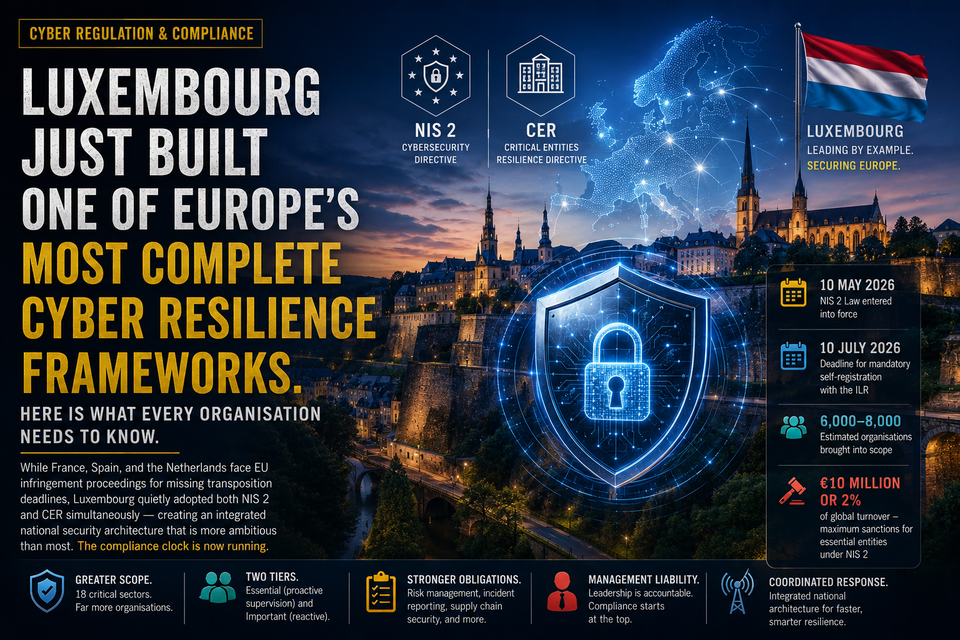
Luxembourg Just Built One of Europe's Most Complete Cyber Resilience Frameworks. Here Is What Every Organisation Needs to Know.
CYBER REGULATION & COMPLIANCE
While France, Spain, and the Netherlands face EU infringement proceedings for missing transposition deadlines, Luxembourg quietly adopted both NIS 2 and CER simultaneously — creating an integrated national security architecture that is more ambitious than most. The compliance clock is now running.
By The CyberDiplomat | June 2026
10 May 2026 — Date Luxembourg's NIS 2 Law entered into force 10 July 2026 — Deadline for mandatory self-registration with the ILR 6,000–8,000 — Estimated organisations brought into scope under the new framework €10 million or 2% of global turnover — Maximum sanctions for essential entities under NIS 2
A Framework Worth Understanding — And Why the Timing Matters
On 5 May 2026, Luxembourg formally transposed the NIS 2 Directive into national law. This new legislation — the Loi du 5 mai 2026 concernant des mesures destinées à assurer un niveau élevé de cybersécurité — entered into force on 10 May 2026.
On the same date, Luxembourg adopted the law transposing the CER Directive on the resilience of critical entities — making Luxembourg one of a small number of EU member states to transpose both frameworks simultaneously and in an integrated manner.
The timing was not accidental, and the integration was not cosmetic. Luxembourg linked the two frameworks deliberately to build a coherent architecture based on risk management, coordination between stakeholders, and operational response capacity. Brussels had been penalising a formal delay — the original transposition deadline was October 2024 — whilst Luxembourg was simultaneously constructing a structured and integrated resilience framework that goes well beyond what a hurried transposition would have delivered.
Luxembourg was among the Member States — alongside Bulgaria, France, the Netherlands, Poland, Spain and Sweden — that faced EU infringement proceedings and referral to the Court of Justice for missing the October 2024 deadline. The Commission sent letters of formal notice in November 2024, followed by reasoned opinions in July 2025. Luxembourg's response was to complete both transpositions simultaneously, producing a national framework that, in depth and integration, arguably surpasses what several of the on-time transposers delivered.
That context matters. Luxembourg did not simply copy-paste the directives. It built something.
NIS 2: What the Law Actually Does
Scope: Far More Organisations Than Before
NIS 2 applies automatically to organisations with 50 or more employees or an annual turnover exceeding €10 million, operating in one of 18 critical sectors. Entities have until 10 July 2026 to self-register with their competent authority.
The 18 sectors span a significantly broader range than the original NIS 1 regime — covering energy, transport, banking, financial market infrastructure, health, drinking water, wastewater, digital infrastructure, ICT service management, public administration, space, postal and courier services, waste management, manufacture and distribution of chemicals, food production, manufacturing, and digital providers.
In addition, the NIS 2 Law applies, regardless of their size, to entities considered "critical" under the Luxembourg CER Law — meaning the two frameworks are structurally linked at the scope level, not merely complementary in policy terms.
The practical effect is substantial. Luxembourg's NIS 2 implementation is expected to sweep 6,000 to 8,000 organisations into scope. For many of these organisations — particularly small and mid-sized businesses in the financial and digital services sectors — binding cybersecurity obligations are genuinely new territory.
Two Tiers: Essential and Important Entities
The law establishes a two-tier structure. Essential entities — large organisations in Annex I sectors exceeding 250 employees and either €50 million in turnover or €43 million in annual balance sheet — are subject to proactive supervision and sanctions of up to €10 million or 2% of global turnover.
Important entities — those meeting the lower size threshold of 50 employees or €10 million turnover across any of the 18 sectors — face reactive supervision and lower but still significant sanction exposure.
The distinction matters for compliance prioritisation: essential entities face ex ante scrutiny, meaning the regulator can assess them before an incident occurs. Important entities face ex post scrutiny, triggered by incidents or complaints. In practice, essential entities need to demonstrate compliance readiness proactively; important entities need to be ready for the call when it comes.
What Compliance Actually Requires
Entities must implement technical, operational, and organisational measures based on an all-hazards approach. Minimum requirements include: security policies and risk analysis; incident handling procedures for detection, response, and recovery; business continuity plans including backup management and crisis recovery; supply chain security covering the evaluation of the cybersecurity practices of direct suppliers and service providers; cyber hygiene and staff training; cryptography policies; and identity management and secure communications.
Incident notification timelines are strict: an early warning within 24 hours of becoming aware of a significant incident, a full incident notification within 72 hours, and a final report within one month. Management governance and liability requirements are explicit — leadership must approve security measures, oversee implementation, and is personally liable in cases of demonstrated failure.
That last point deserves emphasis. The personal liability of management bodies is one of the most significant features of NIS 2 and one that has received insufficient attention in compliance discussions. Board members and senior executives who approve inadequate security programmes are not insulated from enforcement consequences. This is not an IT compliance matter. It is a corporate governance matter.
Who Supervises Whom
The ILR acts as competent authority for most sectors. The CSSF oversees banking and financial market infrastructures. The HCPN serves as Luxembourg's single point of contact for cross-border cooperation and manages major cyber crises. GOVCERT.LU and CIRCL are the two designated CSIRTs — GOVCERT.LU serving state administrations, public establishments, and critical entities; CIRCL serving all other entities and acting as the national coordinator for coordinated vulnerability disclosure.
Supervisory authorities have significant enforcement powers, including the ability to request temporary suspension of service certifications and to prohibit individuals — including CEOs and legal representatives — from exercising management functions until compliance is achieved. The latter power, rarely seen in EU regulatory frameworks, signals that Luxembourg intends this regime to have genuine teeth.
CER: The Other Half of the Architecture
Where NIS 2 addresses cybersecurity — the digital layer of risk — the CER Law addresses the physical, organisational, human, and supply chain dimensions of resilience for entities whose disruption would have significant societal or economic consequences.
The CER framework introduces a national process for identifying "critical entities" through a risk assessment methodology. Unlike NIS 2's automatic size-and-sector threshold, CER designation is a specific, formal decision following national risk assessment — and the consequences of designation are significant.
The CER law stipulates that designated critical entities must be notified individually of their status, without publishing an official list, in accordance with security considerations to avoid exposing sensitive infrastructure. There will be no publicly available register of critical entities. Designation is communicated directly and privately. This is a deliberate security measure — publishing a list of Luxembourg's most critical infrastructure operators would itself constitute a security risk.
Once designated, critical entities are required to conduct their own risk assessments and implement technical, security, and organisational measures designed to ensure resilience against disruptive incidents — covering not only cyber threats, but natural hazards, terrorist attacks, insider threats, and sabotage.
The HCPN supervises the CER framework and represents Luxembourg in the EU-CyCLONe network for cross-border crisis management.
The Integrated Architecture: Why Simultaneous Adoption Matters
The most significant feature of Luxembourg's approach is not either law individually. It is the way the two laws function together.
The two regimes are complementary and can apply simultaneously to the same entity. Many more entities are now in scope of binding cybersecurity obligations under NIS 2, with selected additional entities designated as critical under CER. Compliance is no longer limited to technical IT measures, but requires board-level engagement, integrated risk management, and coordinated crisis response planning. The dual application of NIS 2 and CER also increases supervisory intensity and heightens enforcement exposure.
This creates a layered supervisory reality. An energy company or major financial institution could find itself simultaneously supervised by the ILR or CSSF under NIS 2, and by the HCPN under CER. The obligations are complementary — NIS 2 covers the cyber dimension, CER covers the physical and operational dimension — but the supervisory relationships are distinct and the compliance programmes must address both.
For compliance and legal teams, this means a single integrated risk framework is far more efficient than two parallel compliance exercises. The governance structures, risk assessment methodologies, incident response plans, and board reporting mechanisms that NIS 2 requires should be designed from the outset to absorb CER obligations as well.
What Organisations Must Do Now
The compliance timeline is compressed and the obligations are immediate. Several actions are non-negotiable.
Self-register by 10 July 2026. Registration is a legal obligation under Article 11. Non-registration is itself a sanctionable breach. The ILR portal is available at ilr.lu. Organisations must check their NACE code against the 18 covered sectors and assess headcount, turnover, and balance sheet at consolidated group level. If in doubt about whether you are in scope, the answer is almost certainly yes — and the consequences of not registering are worse than the cost of registering unnecessarily.
Engage the board immediately. NIS 2's management liability provisions are not aspirational language. The personal liability of senior executives for cybersecurity governance failures is a hard legal requirement. Boards need to approve the security framework, understand what they are approving, and receive regular reporting against it. IT departments cannot own this alone.
Conduct a gap analysis against the 10 Article 21 domains. The minimum requirements — security policy, risk analysis, incident handling, business continuity, supply chain security, acquisition and development security, effectiveness assessment, cyber training, cryptography, and identity management — provide a clear audit checklist. Most organisations will find meaningful gaps. The sooner those gaps are identified, the more time there is to address them before supervisory engagement begins.
Map your supply chain. Supply chain security is an explicit requirement under NIS 2, covering the evaluation of the cybersecurity practices of direct suppliers and service providers. For Luxembourg-based organisations operating in the financial sector, the overlap with DORA's supply chain requirements creates both a compliance challenge and an efficiency opportunity — a single supplier assessment framework can address both regimes.
Prepare incident notification workflows. The 24-hour early warning and 72-hour notification deadlines are strict and will not be extended by good intentions or organisational complexity. Incident response plans need to include notification workflows with named responsible parties, pre-drafted communication templates, and clear internal escalation paths. Testing those workflows before an incident occurs is not optional — it is the difference between a well-managed regulatory notification and a compliance crisis on top of a security crisis.
The Wider European Picture: Luxembourg as a Model
Several EU member states — including France, the Netherlands, Spain, Poland, Sweden, and Bulgaria — faced referral to the Court of Justice for failing to complete transposition of the CER Directive by the October 2024 deadline. The irony of Luxembourg — itself a late transposer — having produced a more integrated and arguably more ambitious framework than several of the on-time transposers is not lost on observers of EU regulatory implementation.
Brussels penalised a formal delay whilst Luxembourg was simultaneously putting in place a structured and integrated resilience framework. The discrepancy between the European procedure and national implementation appears less as a contradiction and more as a symptom of an out-of-sync administrative timetable.
What Luxembourg has built is a model worth examining for any EU member state still working through its own transposition. The simultaneous adoption of NIS 2 and CER, the structural linkage between the two frameworks at the scope level, the integration of HCPN, ILR, CSSF, GOVCERT.LU, and CIRCL into a coherent supervisory architecture, and the explicit personal liability provisions for management bodies — these design choices reflect a considered ambition to build resilience rather than simply to achieve regulatory compliance.
The Bottom Line for Businesses Operating in Luxembourg
The era of treating cybersecurity as a technical function managed below board level is over in Luxembourg — and it is over in law, not just in good practice guidance.
If your organisation operates in Luxembourg across any of the 18 NIS 2 sectors, the compliance obligations are now live, the registration deadline is 10 July 2026, and the supervisory authorities have significant enforcement powers including personal liability for executives and prohibition on management functions.
If your organisation is in a sector where you might be designated as a critical entity under CER, prepare for that notification — and ensure your resilience programme covers physical, human, organisational, and supply chain risks, not just cybersecurity.
If you have not yet started, you are already behind. The law entered into force on 10 May 2026. The clock is running.
Key Dates at a Glance
| Milestone | Date |
|---|---|
| NIS 2 and CER Laws enter into force | 10 May 2026 |
| Self-registration deadline (ILR portal) | 10 July 2026 |
| Critical entity designation deadline (EU-wide) | 17 July 2026 |
| Full governance controls required | January 2027 |
© The CyberDiplomat, 2026. All rights reserved.
Contact us for services: info@thecyberdiplomat.com
Member discussion