
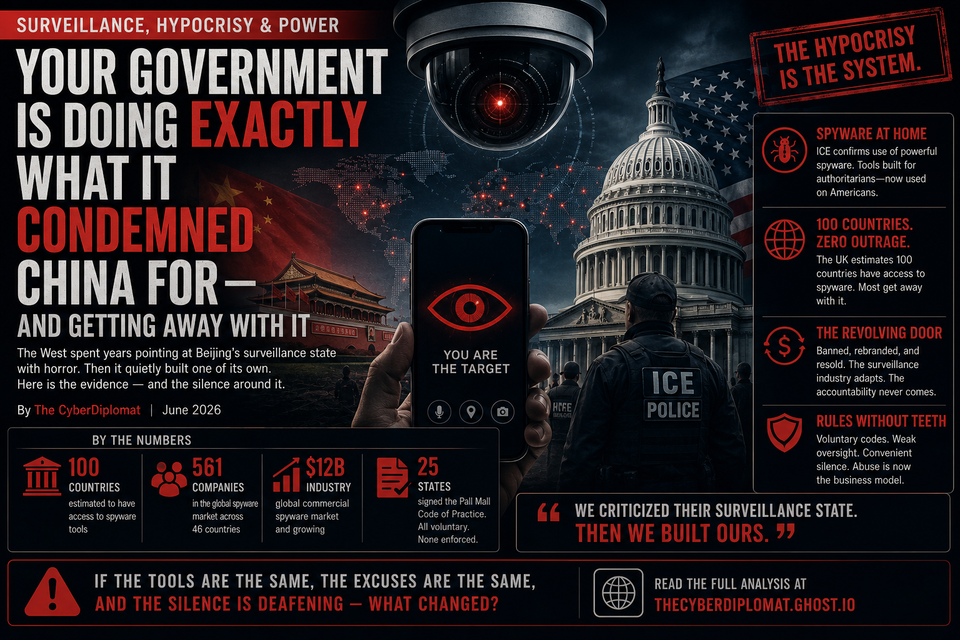
Your Government Is Doing Exactly What It Condemned China For — And Getting Away With It
SURVEILLANCE & POWER
The West spent years pointing at Beijing's surveillance state with horror. Then it quietly built one of its own. Here is the evidence — and the silence around it.
By The CyberDiplomat | June 2026
The Accusation That Became a Mirror
For the better part of a decade, Western governments built their digital foreign policy around a single, powerful argument: China surveils its citizens, and that makes it authoritarian. The implication was clear — we do not do that. We are different. Our values are different.
That argument is now collapsing under the weight of its own evidence.
As of May 2026, the Trump administration has lifted sanctions that Biden's Treasury Department had instituted against three people affiliated with the spyware tool Predator, and temporarily revived an ICE contract with the Israeli-founded spyware company Paragon Solutions — the maker of a tool called Graphite, capable of infiltrating encrypted communications without any action by the target.
Privacy and civil rights advocates are now openly worried the administration could also lift restrictions on NSO Group — the maker of Pegasus — with one senior fellow at the Carnegie Endowment for International Peace stating plainly: "We're starting to see erosion."
This is not happening in the shadows. It is happening in public, with paper trails, congressional letters, and federal contract documents. The question is why so few people are treating it with the same alarm they applied to Xinjiang.
ICE, Spyware, and the Surveillance of Americans
In April 2026, ICE confirmed for the first time that it is using powerful spyware. The confirmation came as ICE has ramped up its use of surveillance technologies to find people in the US without authorisation as part of the Trump administration's mass deportation campaign. Those tools have also been used extensively on American citizens who protested ICE's activities.
Read that again. Spyware — the category of tool the United States sanctioned Israeli and European companies for selling to authoritarian governments — is now being used by American immigration enforcement against US citizens exercising constitutionally protected protest rights.
In response to a letter from House Democrats inquiring about Paragon's use, acting ICE Director Todd Lyons confirmed he had authorised the use of what he called "cutting-edge technological tools" to help the Homeland Security Investigations division fight fentanyl, particularly against organisations using encrypted communications.
"Cutting-edge technological tools." The language of innovation, not surveillance. The framing of counternarcotics, not political monitoring. This is precisely how authoritarian governments have always described their surveillance programmes — and precisely the kind of language the West spent years teaching the world to distrust.
Lawmakers warned that ICE would abuse the software to target immigrants, people of colour, and individuals who express opposition to ICE's activities. Federal immigration officers are now reportedly equipped with an expanded arsenal including facial recognition, biometric trackers, licence-plate readers, cell-phone location data, spyware, and drones — with ICE asserting authority to use these tools not only for immigration enforcement, but also to monitor and investigate anti-ICE protest networks including US citizens.
100 Countries. Zero Global Outrage.
The United States is not an outlier. It is a symptom.
The UK government's National Cyber Security Centre disclosed last month that it estimates some 100 countries worldwide now have access to spyware and cyber intrusion tools capable of being used against British devices and systems.
One hundred countries. The majority of the world's nations are now equipped with tools capable of silently infiltrating any smartphone, reading encrypted messages, activating cameras and microphones, and harvesting the digital life of any target they choose. Most of these deployments receive no headlines, generate no sanctions, and provoke no international condemnation.
Governments have responded inconsistently to the spyware threat. In the US, the Department of Commerce has blacklisted NSO Group, Candiru, and Intellexa. In Europe, however, the response is fragmented — with some EU institutions having funded surveillance technology abroad without robust safeguards.
The pattern is consistent across democracies: condemn the tool when used by adversaries, quietly acquire it for domestic purposes, deploy it with minimal oversight, and deny or deflect when asked to account for it.
The Revolving Door Nobody Is Talking About
Researchers at the Citizen Lab identified specific journalists and humanitarian aid providers in Italy whose devices were infected with Graphite — the Paragon spyware — through WhatsApp messages. Paragon ended its contract with Italian government agencies in 2025.
So: Italy, a European democracy and NATO member, was using Israeli-made spyware against journalists and humanitarian workers. It cancelled the contract — not because it was held accountable, but because the exposure became untenable. The same tool then surfaced in an American federal agency contract weeks later.
In 2022, the New York Times reported that the Drug Enforcement Administration was using Graphite. The current status of that contract remains unclear.
When asked directly what spyware ICE uses if not Paragon, the agency declined to answer. Advocates are suing under the Freedom of Information Act for access to records associated with ICE's surveillance contracts. One attorney called DHS's non-answers "a half measure and a red herring."
This is the architecture of unaccountable surveillance: contracts awarded without disclosure, tools deployed without judicial oversight, agencies that acknowledge use only when cornered, and denials that raise more questions than they answer.
The Predator the West Quietly Set Free
While attention has remained fixed on Pegasus and NSO Group, a parallel story has received almost no mainstream coverage.
The Trump administration lifted sanctions that Biden's Treasury Department had instituted against three people affiliated with the spyware tool Predator. Predator is the product of the Intellexa consortium — a European-rooted operation with infrastructure spanning multiple jurisdictions. It was sanctioned precisely because it was found deployed against journalists and political opponents. Those sanctions have now been loosened by the same government that helped build the international case against commercial spyware abuse.
Predator remains operational despite earlier sanctions. Security researchers identified five layers of infrastructure supporting its deployments in 2025 — a tiered architecture deliberately designed to obscure operator identity and evade attribution.
The message this sends to the rest of the world is unambiguous: if you are useful to American interests, or if the political winds shift domestically, sanctions against surveillance tools are negotiable. The rules apply to your enemies. They are optional for your friends — and apparently reversible for yourself.
The Double Standard at the Heart of the Story
The document that prompted this article — a thoughtful academic analysis of digital authoritarianism — names India and Israel as the primary examples of democracies drifting toward surveillance states. It is not wrong. But the framing obscures something important.
India is criticised for allegedly using Pegasus against journalists. Israel is criticised for exporting it. But the United States — which now holds controlling ownership of NSO Group through a private investment consortium, which operates its own spyware contracts through ICE and the DEA, which has reversed sanctions on Predator affiliates, and which is deploying surveillance tools against protesters and immigrants on its own soil — appears primarily as a potential critic and regulator in the narrative.
The Electronic Frontier Foundation put it plainly: "The people most at risk — including immigrants, Black and brown communities, journalists, organizers, and anyone speaking out against government abuse — deserve more than secrecy and deflection from an agency with a long record of overreach and abuse."
That quote is about the United States. Not India. Not Israel. Not Hungary.
Why the Silence Is Itself a Story
There is a reason the global response to Western spyware use has been muted compared to the response to authoritarian surveillance. Several reasons, in fact.
Western governments control significant portions of the world's media infrastructure, diplomatic networks, and internet standards bodies. They are also the primary funders of the civil society organisations, academic researchers, and press freedom groups that investigate surveillance abuse. When those same governments are the abusers, the investigative infrastructure faces a structural tension between following the evidence and biting the hand that enables it.
This is not a conspiracy. It is an institutional reality. Investigations like the Pegasus Project required enormous resources, cross-border coordination, and legal protection — all of which are far easier to mobilise against a company operating out of a geopolitically isolated position than against the domestic intelligence agencies of powerful democracies.
The result is a global surveillance accountability system that is strongest precisely where it is least needed — against weak states with no diplomatic cover — and weakest precisely where it matters most: in the countries that set the rules, fund the watchdogs, and write the sanctions.
What Accountability Actually Requires
Congress continues to debate whether additional guardrails are needed to protect the rights of American citizens whose communications are swept up in foreign surveillance operations that do not currently require a warrant. That debate has been ongoing, at low volume, for years.
Genuine accountability would require several things the political system has shown little appetite for: mandatory disclosure of all government spyware contracts; judicial warrant requirements for domestic deployment of commercial surveillance tools; binding international standards that apply equally to democracies and authoritarian states; and an end to the practice of lifting sanctions on surveillance vendors based on political convenience rather than verified behavioural change.
None of this is technically difficult. The difficulty is entirely political. Governments that benefit from surveillance tools do not pass robust laws against surveillance tools. That is not a paradox. It is the point.
Conclusion: The Mirror Has No Blind Spot
The world's democracies have spent years building a narrative in which surveillance is something that authoritarian states do and free nations oppose. That narrative is now so thoroughly contradicted by documented facts that sustaining it requires either ignorance or deliberate choice.
A hundred countries have spyware. American immigration agents are deploying it against protesters. European democracies used it against journalists until they got caught. The maker of the world's most famous surveillance tool is now owned by American investors and lobbied for by Trump-affiliated firms.
The mirror is up. The reflection is uncomfortable. The question is not whether democracies have become what they once condemned — the evidence on that point is abundant. The question is whether anyone in a position of power has the will to look directly at it.
So far, the answer is: not yet.
Sources: NPR, CyberScoop, Immigration Policy Tracking Project, Electronic Frontier Foundation, Carnegie Endowment for International Peace, Citizen Lab, Sekoia Threat Intelligence, TechPolicy Press.
© The CyberDiplomat, 2026. All rights reserved.
Member discussion