
A Letter to the World From Inside the Firewall
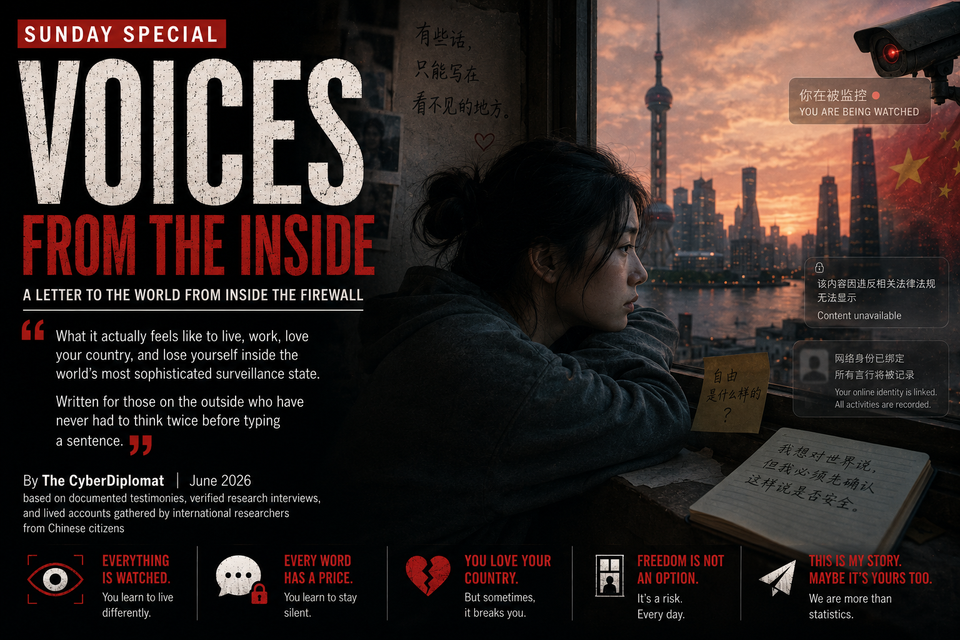
VOICES FROM THE INSIDE
What it actually feels like to live, work, love your country, and lose yourself inside the world's most sophisticated surveillance state. Written for those on the outside who have never had to think twice before typing a sentence.
By The CyberDiplomat | June 2026 — based on documented testimonies, verified research interviews, and lived accounts gathered by international researchers from Chinese citizens
I Want to Tell You Something. But First I Have to Check That It Is Safe to Say It.
That sentence is not dramatic. That sentence is Tuesday.
If you live outside China, you probably typed something today without thinking about it. A complaint about your government. A news article that contradicted official policy. A message to a friend that contained an opinion. You sent it, forgot you sent it, and moved on.
Here, that sequence — think, type, send, forget — is a sequence that has been interrupted. Not by a dramatic knock on the door. Not by a uniformed officer reading over your shoulder. By something quieter and more total than either of those things. By the knowledge, absorbed so deeply it no longer feels like knowledge but simply like weather, that everything you type is potentially visible, everything you share is potentially retrievable, and the line between a private thought and a prosecutable statement is a line that moves without warning and is never drawn in a place you can clearly see.
Over 60 percent of Chinese internet users self-censor their online expressions. Many report refraining from posting on sensitive issues even in private chats to avoid algorithmic detection. A national cyber ID system launched on July 15, 2025 now links all online activity to government-issued personal identities — eliminating anonymity at the platform level. Following its implementation, politically charged content from newly registered accounts on platforms like Weibo dropped by 20 to 30 percent.
I am one of the 60 percent. I am writing this because someone needs to say what it feels like from the inside — not as a statistic, but as a person sitting in a city of millions, connected to the world through a wire I am not supposed to use, trying to find words for something that has no official language because the official language has been designed specifically to make it inexpressible.
The VPN Is Not an Act of Rebellion. It Is an Act of Breathing.
I use a VPN. Most educated urban people I know use one. We do not discuss it openly, the way neighbours in a building might all know about a structural fault in the shared wall and agree, collectively, not to be the one who reports it. There is a mutual, unspoken acknowledgement. A shared non-discussion.
The Chinese government can detect VPN usage even if it cannot read what passes through the encrypted tunnel. China's infrastructure uses deep packet inspection to identify VPN connections. Unlicensed VPNs — which means all the ones people actually use — are banned. Enforcement targets providers and high-profile cases rather than ordinary individuals, for now. The risk to an individual user in a major city is currently low. But "currently" is doing a great deal of work in that sentence. The rules can tighten. They have before. They are tightening now.
As of January 2026, new amendments to China's Cybersecurity Law increased penalties for violations and expanded state power to monitor AI-generated content. A 68-article Draft Law on Cybercrime Prevention and Control, published in January 2026, would bring telecommunications, internet, and banking systems under a single surveillance framework — strengthening the ability to trace user activity across platforms, suspend financial accounts and communication services, and bar people from leaving the country in cybercrime-related cases. The law has extraterritorial reach. Human Rights Watch described it plainly: it "reflects President Xi Jinping's broad efforts to restrict digital and physical spaces by allowing state security to expand and tighten social controls, including beyond borders."
So when I open my VPN each evening, I am not making a political statement. I am accessing weather data from a planet I actually live on. I am reading news that contains the country I inhabit rather than the country I am supposed to inhabit. I am talking to the two friends who moved abroad without a filter installed between my words and their ears.
It is the most ordinary thing in the world. It is also, technically, illegal.
There Are Two Chinas and I Live in Both of Them Simultaneously
On the domestic internet, China is ascending. Our economy is resilient. Our technology is world-leading. Our young people are full of opportunity and patriotic purpose. CCTV runs the same basic headline in different configurations most days of the week.
On the other internet — the one that requires the VPN and the particular quality of alertness that comes with using it — I read that youth unemployment in my country sits between 16 and 17 percent and is likely higher. I read about people I know the names for: the rat people, retreating into dark rooms; the rotten-tail kids, delivering food with degrees they cannot use; the lying flat generation, refusing marriage and children not from laziness but from the exhausted logic of people who have concluded that the game is rigged and the only move is not to play.
I know these people. Some of them are my friends. Some days, in the gap between what I know and what I can say, I am one of them in everything but name.
The researchers call what I experience cognitive dissonance — the discomfort of holding contradictory beliefs simultaneously. What they do not capture in that clinical phrase is that for people living inside this system, cognitive dissonance is not a temporary psychological state awaiting resolution. It is a permanent architecture of survival. You do not resolve it. You build your life inside it. You construct a self that can function with the contradiction installed at its centre, load-bearing, every day.
One research participant interviewed by academics studying digital surveillance in China described it this way: "You never know, you never know. Because the horror, the horror, the horror is always there."
She was not describing a dramatic event. She was describing Tuesday.
What the Cameras Feel Like After You Stop Seeing Them
By 2024, China had installed more than 600 million surveillance cameras. Roughly one for every two adults. I pass several of them on my walk to the subway every morning. I stopped noticing them years ago the way you stop noticing streetlights. They are simply part of the architecture of being here.
What I notice far more is the internal camera. The one I have constructed inside myself over years of knowing, with the body-knowledge that precedes conscious thought, where the lines are. It monitors my speech, my searches, my social media posts, the wording of messages to friends. It operates so automatically now that I sometimes cannot tell, in the middle of forming a thought, whether I have actually arrived at an opinion or whether I have pre-emptively edited myself into a silence that feels like neutrality but is actually something else. Something more like erosion.
A filmmaker named Chen Pinlin was sentenced in January 2025 to three and a half years in prison. His crime was making a film about the 2022 White Paper protests — the demonstrations where people held up blank sheets of paper because blank paper was the only speech left that the censors had not yet found a way to prohibit. A man named Mei Shilin was forcibly disappeared in April 2025 for hanging three banners on an overpass. One of them read: "The people do not need a political party with unrestrained power."
He is gone. The banners are gone. The overpass is still there.
I walk past overpasses every day.
What Patriotism Feels Like When It Has Nowhere to Go
Here is the thing I most need the world to understand, because I think it is the thing most misunderstood from the outside.
I love China. This is not the managed sentiment of a person reciting what they are supposed to say. It is something older and more physical than ideology — the smell of a specific kind of morning, the sound of my parents' dialect, the ferocious warmth of people who have survived things that would have ended lesser civilisations, the genuine pride in what this country has built inside a single lifetime.
My grandparents grew up in poverty so structural it was simply called life. My parents had a different life. I have a different life still. That trajectory is real and it was built by real people with real work and real sacrifice and I carry it with me like a bone in my chest.
And precisely because I love this place — not despite it, but because of it — the grief is so sharp I have to be careful where I let myself feel it.
Because what this country could be, if the people who built it were allowed to speak freely about it, is so much larger than what it is. The young people currently lying flat in dark rooms are not lazy. They are the most educated generation China has ever produced, in a system that educated them for a future and then failed to build it. Over 12 million graduates enter the workforce every year. The economy cannot absorb them. And they cannot say so publicly without the language being deleted.
Dissent in China does not disappear. It changes shape. It goes underground. It becomes a meme so layered with irony that the censors take a week to recognise it. It becomes blank paper held in silence. It becomes the studied apathy of an entire generation that has internalised the calculation that the cost of hope is too high and the cost of despair is at least predictable.
It becomes this letter, written behind a VPN, sent to a world I cannot fully access, from a country I cannot fully describe in the language available to me here.
What I Want You to Know
I am not asking for your pity. I want to say that clearly. The pity of people who live in countries where they can type sentences without checking them is a cold comfort and I have no use for it.
What I want is for you to understand that the surveillance state is not a dramatic thing that happens to dissidents and journalists and obvious enemies of the system. It happens to ordinary people, in ordinary apartments, on ordinary Tuesday evenings. It happens to people who love their country and want nothing more complicated than to talk about it honestly. It happens through the slow accumulation of a thousand small adjustments — a word changed here, a thought abandoned there, a conversation not had — until one day you look up and discover that the distance between who you are and who you are allowed to be has grown so large and so familiar that you can no longer clearly locate the border.
What I want is for the people designing these systems to understand — and I am speaking now to the governments and the technology companies and the investors in surveillance infrastructure across the entire world, not only in China — that this is what your architecture produces. Not order. Not safety. People who have learned to be very, very good at being fine.
And the thing about people who have learned to be fine is that you never see them. You never hear from them. They don't march. They don't protest. They don't write public letters under their own names.
They write things like this, at night, behind a VPN, under no name at all.
And then they close the browser, reset to the approved version of themselves, and go to sleep.
Tomorrow, the cameras will still be there.
So will we.
This account is drawn from documented testimonies gathered by researchers at Routledge (Living with Digital Surveillance in China, 2023), SAGE Journals (Navigating through the Fog, 2025), The Conversation (2024), and Freedom House (Freedom on the Net 2024). Statistical data is sourced from Human Rights Watch World Report 2026, Grokipedia internet censorship analysis, and China's Ministry of Public Security draft cybercrime legislation. All identifying details have been withheld. The voice is composite. The reality it reflects is not.
© The CyberDiplomat, 2026. All rights reserved.
Member discussion