
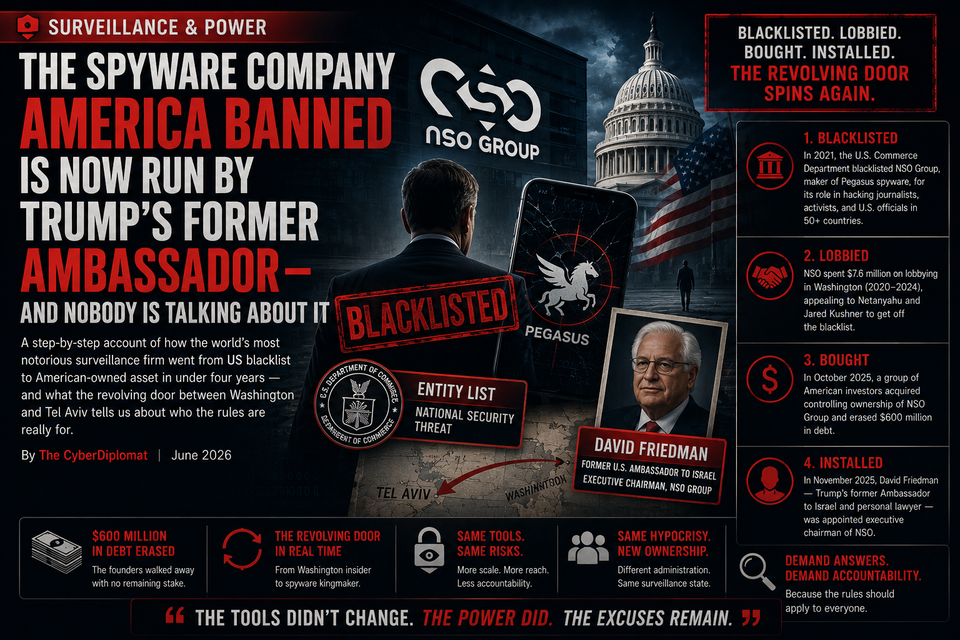
The Spyware Company America Banned Is Now Run by Trump's Former Ambassador — And Nobody Is Talking About It
SURVEILLANCE & POWER
A step-by-step account of how the world's most notorious surveillance firm went from US blacklist to American-owned asset in under four years — and what the revolving door between Washington and Tel Aviv tells us about who the rules are really for.
By The CyberDiplomat | June 2026
A Story Told in Four Steps
Some political scandals are complicated. This one is not. It has four steps, a clear timeline, and an ending that should be front-page news. It is not.
Step one. In 2021, the US Commerce Department placed NSO Group — maker of Pegasus spyware — on its Entity List, designating it a national security threat and banning American companies from doing business with it. The reason: NSO's clients had used Pegasus to hack the phones of US government officials, journalists, and human rights activists across more than 50 countries.
Step two. NSO spent $7.6 million on lobbying in Washington between 2020 and 2024, appealing personally to Prime Minister Benjamin Netanyahu and to Trump's adviser and son-in-law Jared Kushner, in an effort to get off the blacklist. As recently as May 2025, NSO was still trying to get off the blocklist with the help of a lobbying firm tied to the Trump administration.
Step three. In October 2025, a group of American investors acquired controlling ownership of NSO Group — buying the company that the United States had declared a national security threat just four years earlier.
Step four. One month later, NSO announced that David Friedman — who served as US Ambassador to Israel during Trump's first administration and previously worked as Trump's personal bankruptcy lawyer — had been appointed executive chairman of the company.
That is the story. Blacklisted. Lobbied. Bought. Installed with a Trump insider at the top.
The Man at the Centre
David Friedman is not a cybersecurity professional. He is not a technologist. He is a lawyer and a diplomat — one of the most connected political figures in the Trump orbit.
Friedman told the Wall Street Journal that he would make the case to the Trump administration that NSO's technology could help make Americans safer, saying: "If the administration, as I expect they'll be, is receptive to considering any opportunity that might keep Americans safer, it will consider us."
In a separate interview, Friedman was blunt about the political framing: "The Biden administration's decision to punish NSO was political. It was made by people who are not particularly strong supporters of Israel. Clearly, today we are in a very different world. We have the most supportive president in US history when it comes to Israel."
So the chairman of the world's most controversial spyware company has said, on the record, that the sanctions against his company were politically motivated — implying they can be politically reversed. He has done this while being the former personal lawyer of the sitting president. And his explicit stated goal is to win US government contracts for a company that remains on America's own national security blacklist.
This is not subtle. It is the revolving door spinning in real time, in public, with nobody stopping it.
$600 Million in Debt. Erased. Overnight.
The financial dimensions of this story are equally remarkable.
The American investment group that acquired NSO injected several tens of millions of dollars into the company and erased debts totalling $600 million. The founders — who built the company that produced one of the most widely abused surveillance tools in history — walked away with no remaining stake.
In the words of NSO's own executive chairman, the acquisition came at a time when NSO had "been struggling and looking for capital," and the deal "brings with it sufficient capital to maintain the business" — allowing it to continue to sell spyware.
Who absorbs $600 million in debt to acquire a blacklisted spyware company? What return are they expecting? The investors have not been fully named. The terms have not been disclosed. The deal was structured in a way that, as one analyst noted, appears designed to give NSO an "end run" around the restrictions that technically still apply to it.
NSO has long claimed its spyware is designed not to target US phone numbers — a safeguard it maintained to preserve future market access. With US ownership, those barriers to the American surveillance market could finally crumble.
The Transparency Report That Fooled Nobody
In January 2026, newly installed as chairman, Friedman released what NSO called a transparency report — promising what he described as "a renewed focus on accountability in an increasingly complex global environment."
Researchers and advocates were not impressed. One attorney called it "more of a propaganda document" that made broad pledges but offered few details about substantial changes to operations or strategy, and failed to address past human rights violations.
The timing was not coincidental. NSO was actively lobbying for removal from the Entity List amid what it perceived as a more favourable political climate. Recent signals had already fuelled optimism within the industry — in December 2025, the Trump administration lifted sanctions on three executives from rival spyware firm Intellexa, suggesting restrictions on surveillance tech providers could ease across the board.
A transparency report issued by a blacklisted company whose chairman is Trump's former ambassador, timed to coincide with a lobbying push to lift sanctions, released weeks after a rival's sanctions were quietly reversed. This is the document the industry wants you to call accountability.
The Pattern the Sanctions Were Supposed to Stop
Step back from the NSO story for a moment and look at the architecture of what has been built.
ICE confirmed in April 2026 that it is using Paragon spyware — another Israeli-founded surveillance firm — authorised by acting ICE Director Todd Lyons for use against targets in Homeland Security investigations. Paragon's Graphite technology has been found on the devices of journalists, and WhatsApp confirmed it disrupted a campaign employing the spyware against nearly 100 of its users.
The Trump administration lifted sanctions on three individuals affiliated with Predator — the Intellexa spyware — and revived an ICE contract with Paragon Solutions that had been paused by the Biden administration.
Meanwhile, the UK's National Cyber Security Centre disclosed that it now estimates approximately 100 countries worldwide have access to spyware and cyber intrusion tools.
The US government banned these tools because foreign governments were using them against journalists and political opponents. It is now using them against protesters and immigrants on its own soil, lifting sanctions on their manufacturers, and installing political insiders at the top of the companies that produce them.
The Question Washington Refuses to Answer
Congressman after congressman has written letters demanding answers. In May 2026, legislators formally wrote to the Commerce Secretary requesting information about NSO Group technologies, potential US government use of commercial spyware, and the purchase of NSO by an American company.
When asked directly what spyware ICE uses — if not Paragon — the agency declined to provide details. One deputy director called DHS's non-answers "a half measure and a red herring." Another attorney put the core question plainly: "If it's not Paragon spyware, then what company and what spyware does ICE use? The agency should provide a full account of its surveillance technologies to the American public."
That question has not been answered. It likely will not be answered without sustained public pressure, aggressive oversight, or a leak. And the pressure remains low — in part because the story is complicated, in part because the political beneficiaries of surveillance expansion have little incentive to illuminate it, and in part because much of the press coverage that would normally drive accountability has been fragmented across dozens of individual stories rather than assembled into the coherent picture it actually represents.
What This Looks Like From the Outside
Imagine a version of this story with different actors. Imagine a Chinese state-linked investor group acquired a blacklisted surveillance company. Imagine that company then appointed a former Chinese diplomat — someone who previously served as a personal legal adviser to the President of China — as its chairman. Imagine that chairman publicly stating the sanctions against his company were politically motivated and would be reversed under the current government. Imagine the company simultaneously lobbying for contracts with Chinese federal agencies to use the surveillance tool against dissidents.
The response would be immediate. The headlines would be sustained. Congressional hearings would be scheduled within days.
When the actors are American, Israeli, and connected to the Trump political network, the response is muted. A few dozen paragraphs across specialist publications. Some letters to cabinet secretaries that go unanswered. A transparency report that gets politely shredded by civil society and then forgotten.
The rules, it seems, have always been about who is applying them — and who they are being applied to.
Conclusion: The Blacklist Was Never a Principle
The US government's 2021 designation of NSO Group was presented as a principled stand against the abuse of commercial surveillance tools. It may have been, at the time. What the years since have revealed is that the principle was contingent — contingent on who held political power, who owned the company, and who was positioned to benefit from its rehabilitation.
As one expert put it plainly: NSO "lobbied extremely hard to get off the sanctions list, and the sale to a US investor group is obviously part of that."
A blacklisted company. $7.6 million in lobbying. A Hollywood producer fronting the acquisition. Trump's former ambassador installed as chairman. Sanctions on a rival quietly lifted. ICE deploying spyware against protesters. Congressional letters going unanswered.
This is not a conspiracy. It does not need to be. It is simply what happens when the regulation of a powerful industry is left to the political process — and the industry is willing to spend whatever it takes to own that process.
The question is no longer whether NSO Group will get off America's blacklist. Given what has been assembled around it, the question is what is left of the principle the blacklist was supposed to represent.
Sources: TechCrunch, Times of Israel, Haaretz, The Record, Globes, Jerusalem Post, Dark Reading, WAMC/NPR, CyberScoop, Immigration Policy Tracking Project, Summer Lee Congressional Letter to Commerce Department (May 2026), Israel Hayom.
© The CyberDiplomat, 2026. All rights reserved.
Member discussion