
Signal and Sovereignty: Starlink's Role in the Yemen War
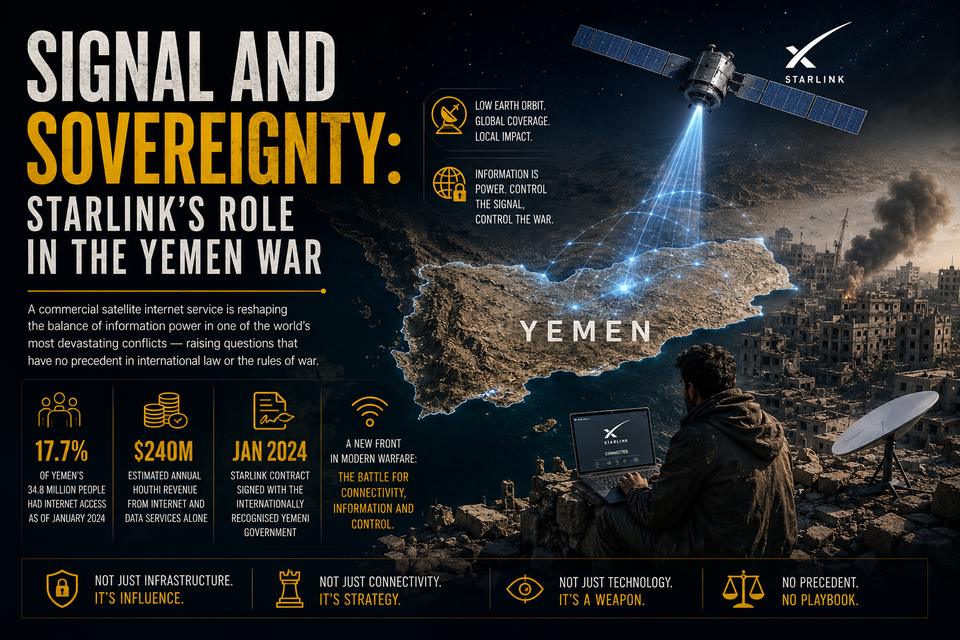
A commercial satellite internet service is reshaping the balance of information power in one of the world's most devastating conflicts — raising questions that have no precedent in international law or the rules of war.
In Lahj governorate, southern Yemen, a content creator named Khaled al-Faqih uploaded a full video to the internet for the first time in his life without the connection dropping midway. For him, it was a personal triumph. For the geopoliticians watching Yemen, it was a symptom of something far more consequential: the arrival of a new front in the war — a battle over who controls the electromagnetic spectrum above a shattered country, and what that means for those fighting and dying below it.
Starlink, SpaceX's low-Earth-orbit satellite internet constellation, has become the latest technology to collide with the realities of modern asymmetric warfare. In Yemen, where the internet itself has been weaponised by all sides for over a decade, Starlink's entrance has upended assumptions about who controls information, who can be monitored, and who can coordinate an attack.
17.7% of Yemen's 34.8 million people had internet access as of January 2024
$240M - Estimated annual Houthi revenue from internet and data services alone
Jan 2024 - Starlink contract signed with the internationally recognised Yemeni government
A Decade of Digital Subjugation
To understand Starlink's significance in Yemen, one must first understand what the internet has been in Yemen: not a neutral utility, but a weapon of control. Since the Houthi movement seized Sana'a in 2014, it has placed the country's telecommunications ministry and its largest operators — Yemen Mobile, Sabafon, YOU, TeleYemen, and YemenNet — under direct military command. Fahmi al-Bahith, a digital-rights advocate and founding member of Yemen's Internet Society, describes the architecture bluntly: "The internet infrastructure is built so that a single service provider, based in Sana'a, holds all the keys."
Those keys unlock a formidable set of tools. The Houthis have used their telecommunications monopoly to monitor opposition figures, throttle or block news websites (including Alhurra's), and sever service to government-held territories as a form of collective punishment. According to Raed al-Thabiti, an adviser to Yemen's Ministry of Telecommunications, the centralised network has been "directly connected to the National Security building since 2006." Yemen's internet infrastructure is, in effect, a panopticon that predates the current conflict and was purpose-built for surveillance.
The financial stakes are substantial. Information Minister Moammar al-Eryani has stated that the Houthis generate roughly half a billion dollars a year from telecommunications, with $240 million coming from internet and data services. The network is not merely a tool of war — it is one of the war's primary economic engines.
"The Houthi militia has militarised the telecommunications sector — using its grip on the industry to track opponents' movements and target field commanders." - RAED AL-THABITI, ADVISER TO YEMEN'S MINISTRY OF TELECOMMUNICATIONS
Yemen's attempts to build a parallel infrastructure have largely failed. The 2022 "AdenNet" project, which sought to route connectivity through an undersea cable to Djibouti, bypassing Sana'a entirely, was hobbled by the challenge of building competing infrastructure from scratch, and by allegations of corruption. Meaningful control remained with the Houthis.
Starlink Arrives — at the Worst Possible Moment
Against this backdrop, the Yemeni government began negotiations with SpaceX in 2021. A contract was signed in January 2024, and by September of that year, Starlink formally launched in the country — making Yemen, by some accounts, the first state in West Asia to receive full satellite-internet coverage. The US Embassy described it as "an achievement that opens new horizons."
The timing could hardly have been more sensitive. The announcement coincided with an intensifying campaign of US airstrikes on Houthi positions and a escalating Houthi campaign of attacks on commercial shipping in the Red Sea. The Houthis were already engaged in a direct confrontation with Washington; Starlink, an American technology company, entering Yemen under a contract with their adversary was read not as a commercial development but as a military one.
CONTEXT: THE CONTRACT'S SURVEILLANCE PROVISIONS
The roughly 30-page contract between SpaceX and the Yemeni government contains, under Article 27 — titled "Lawful Intercept, Security, and Network Blocking" — sweeping authority for the government to block websites and intercept electronic communications. Researchers note that these provisions mirror the surveillance architecture long condemned when operated by the Houthis, and may conflict with Yemen's Telecommunications Law No. 33 of 1996, which guarantees confidential communications and requires prior judicial authorisation for surveillance. Yemen has no comprehensive data-protection legislation to moderate these provisions.
The Houthi response was swift and declaratory. Their Ministry of Communications in Sana'a issued orders in April 2025 directing all residents in Houthi-controlled territory to surrender Starlink devices to the nearest telecommunications office by 1 May, with threats of security investigation and fines for non-compliance. The group framed the technology as "a direct threat to national security" and accused the Yemeni government of using it to serve "US and Israeli intelligence."
The Military Calculus: Who Benefits?
The Yemeni government's calculation is straightforward: Starlink can break the Houthi information monopoly. If government forces, intelligence officers, and ordinary citizens in Houthi-controlled areas can access unmonitored communications, the surveillance infrastructure that the Houthis have spent a decade building loses a significant part of its value. William Akoto, a professor of global security at American University, frames the military dimension more sharply: Starlink provides "high-speed connectivity that is difficult to jam or intercept," potentially enabling front-line forces to coordinate operations without being detected on networks the Houthis control.
The lessons from Ukraine are instructive — and alarming in equal measure. In that conflict, Starlink became what analysts described as "the essential backbone of communication" on Ukrainian battlefields. Reconnaissance units used it to relay targeting data from surveillance drones to artillery units, compressing the sensor-to-shooter loop that determines who strikes first. Drones operated at night with thermal cameras, their feeds transmitted via satellite to commanders kilometers away. By 2024 and 2025, Starlink had ceased to be an emergency backup and had become a routine military infrastructure, deeply embedded in the operational architecture of a modern army.
Russia's response to Ukraine's Starlink advantage — publicly condemning the technology while covertly deploying it — has a direct parallel in Yemen. By early 2025, Russian forces were fitting Shahed loitering munitions with Starlink terminals, using the satellite link to extend drone range, resist electronic warfare jamming, and conduct precision strikes deep behind Ukrainian lines. Ukrainian defence intelligence described the development as one of the most significant tactical challenges of the war. The irony of the world's most prominent commercial satellite network providing connectivity to both sides of a conflict was not lost on observers.
The Smokescreen Hypothesis
Al-Bahith, the digital-rights advocate, offers a reading of the Houthi campaign that goes beyond face value. The declared "fight against Starlink," he argues, may be precisely that — a declaration, calibrated for public consumption, that conceals a more pragmatic field reality. In the Russia-Ukraine war, Moscow attacked Kyiv's use of Starlink in official statements; Starlink dishes were subsequently found in areas under Russian control, some captured, some smuggled. The technology proved too tactically valuable for any serious military force to forgo simply because it was identified with the enemy.
Several sources who spoke to journalists during the preparation of this analysis believe that some Houthi commanders are already using Starlink in secret. If accurate, this mirrors a pattern seen across modern conflicts: ideological declarations about technology diverge sharply from operational necessity. A movement that has demonstrated sophisticated use of drones, ballistic missiles, and maritime mines is unlikely to forgo the connectivity advantage that Starlink provides simply because it bears an American brand.
The technical reality supports the hypothesis. Starlink equipment can function in countries not officially listed on the coverage map, through the network's roaming feature, which connects dishes to satellites serving adjacent countries where the service is available. This created a thriving informal market in Yemen before the official launch — devices sold through unauthorised channels, activated through foreign accounts, and used well beyond the government's oversight.
The Broader Pattern: Satellite Internet as Battlefield Infrastructure
Yemen is not an isolated case. In Sudan, both the Sudanese Armed Forces and the paramilitary Rapid Support Forces have reportedly sought Starlink access to maintain field communications amid collapsing terrestrial infrastructure. In Myanmar, reports have described regime forces and resistance groups alike attempting to acquire terminals. In each case, the same dynamic plays out: the technology is commercially available, militarily transformative, and impossible to confine to one side of a conflict.
This creates a dilemma without a clear resolution. SpaceX has maintained, at various points, that Starlink was "never meant to be weaponised" — a position that became untenable once the Ukraine war demonstrated how thoroughly civilian connectivity infrastructure could be integrated into military operations. The company's response was to develop Starshield, a separate, military-grade constellation for government customers with classified encryption and payload-hosting capability. But Starlink itself remains commercially available, and the gap between civilian and military use in conflict zones is narrowing to the point of irrelevance.
"Modern internet systems blur the boundary between civilian engineering and military operations. Ukraine has given us a clear example — and a warning to nations not yet prepared." - ANALYSIS, CIRCLEID — JANUARY 2026
The legal framework governing this blurring is underdeveloped to the point of being non-functional. Whether signal jamming or cyber interference with satellite infrastructure constitutes a "use of force" under the UN Charter remains, as military.com noted in early 2026, "unresolved in international jurisprudence." When a Houthi commander uses a Starlink terminal to coordinate a drone strike, and that terminal was ostensibly sold for civilian use under a contract between a commercial company and a recognised government, the chain of legal responsibility is genuinely obscure.
Yemen's Specific Stakes
For Yemen, the arrival of Starlink has altered the information landscape in ways that are simultaneously liberating and dangerous. For civilians in Houthi-controlled areas, the prospect of accessing the internet outside the surveillance architecture of the Sana'a-based network represents a genuine expansion of freedom — the freedom to read, to publish, to communicate with family abroad, and to access information that the Houthis have suppressed. Al-Faqih's uploaded video is a small but real instance of this.
For the Yemeni government, Starlink is a strategic asset that could weaken the Houthi information monopoly, enable more effective intelligence operations, and provide connectivity to government-held areas whose terrestrial infrastructure has been destroyed or never built. These are legitimate goals, and the government's contract with SpaceX reflects a rational calculation about how to strengthen its position in a conflict where information control has been decisive.
But the contract's surveillance provisions — the Article 27 authority to intercept communications and block websites — raise a question that the Yemeni government has not publicly answered: what distinguishes legitimate national security surveillance from the same practices it condemns when carried out by the Houthis? Yemen has no data-protection law, no independent judicial oversight mechanism, and a history of using telecommunications infrastructure to target political opponents that predates Houthi control. Starlink's arrival does not resolve Yemen's information-rights crisis. It relocates it.
Conclusion: Infrastructure Is Never Neutral
The signal that reaches Khaled al-Faqih's dish in Lahj arrives from a constellation of roughly 7,000 satellites in low Earth orbit, built by a private American company, regulated by the FCC, contracted to a government fighting a civil war, banned by an opposing force that may secretly be using it, and subject to a legal framework that has not kept pace with any of these facts.
Starlink is not, in Yemen or anywhere else, a neutral utility. It is infrastructure — and infrastructure in a conflict zone is always contested, always dual-use, and always political. The question that Yemen poses to the world is not whether satellite internet should be available in war zones. It almost certainly will be, by all sides, regardless of what any company's terms of service say. The question is who bears responsibility when the same satellites that let a content creator upload a video also let a commander coordinate a strike — and whether any existing legal or regulatory framework is adequate to answer it.
For now, in the skies above Yemen, those questions remain unanswered. The satellites orbit on.
SOURCES & NOTES
This analysis draws on reporting by Alhurra / Middle East Broadcasting Networks (Ezat Wagdi Ba Awaidhan, August 2025); Global Voices Advox (March 2025); Total Telecom (April 2025); South24 Center (April 2025); CircleID analysis of Starlink in Ukraine (January 2026); Ukrainska Pravda reporting on Starlink-equipped Russian drones (February 2026); Military.com analysis of Starlink and conflict law (January 2026); and Wikipedia entries on the 2025 US attacks in Yemen, 2025 Israeli attacks in Yemen, and Starlink in the Russia-Ukraine war.
Quotes from Fahmi al-Bahith, Raed al-Thabiti, and William Akoto are sourced from the Alhurra original report. Financial figures attributed to Information Minister Moammar al-Eryani. Starlink contract provisions summarised from Alhurra's review of the January 2024 agreement.
Member discussion