
The Endless Debate: What Instagram's Encryption Reversal Reveals About E2EE, Governance, and the Global Stakes
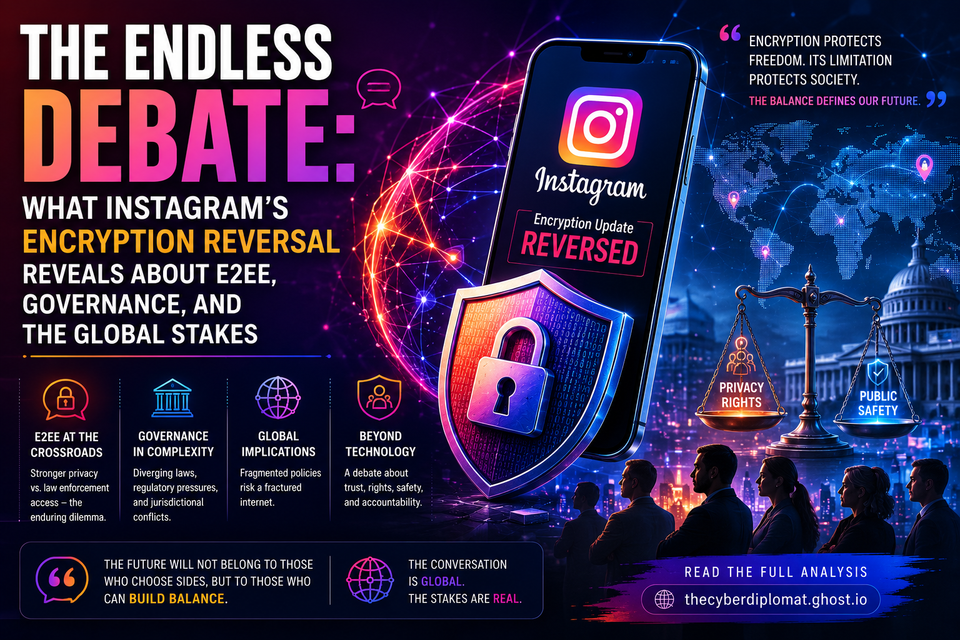
Meta quietly killed end-to-end encryption on Instagram DMs in May 2026. For Victoria Baines, the episode was neither surprising nor simple — it is a fresh chapter in a conflict that has never been resolved, and that now intersects with a largely overlooked domain: international export control law.
On 8 May 2026, Meta quietly removed end-to-end encrypted direct messaging from Instagram. There was no press release, no in-app notification — just a Help Centre update in March informing users that the optional feature, available since 2019 and more broadly deployed in 2023, would cease to exist globally. The change means Meta can now technically read every private conversation, image, video, and voice note sent through Instagram's messaging system. Child safety organisations applauded. Privacy advocates were alarmed. Most users, it appears, did not notice.
For Victoria Baines, professor emerita at Gresham College, former head of trust and safety at Facebook EMEA, and before that a senior figure at Europol's European Cybercrime Centre, the episode crystallised something she has argued for years: the end-to-end encryption debate is not really about technology. It is about values, power, and whose perspective shapes the rules.
"When I first heard this, I couldn't quite decide whether I was really surprised or really unsurprised, and to me, that sums up the whole end-to-end encryption debate: it's complex, it's nuanced and lots of factors play into it."VICTORIA BAINES, PROFESSOR EMERITA, GRESHAM COLLEGE — ISMG, JUNE 2, 2026
WHAT INSTAGRAM JUST DID — AND WHY IT MATTERS
The official explanation from Meta's spokesperson was disarmingly flat: "Very few people were opting in to end-to-end encrypted messaging in DMs, so we're removing this option." Anyone who wants E2EE, Meta said, can use WhatsApp.
Critics were quick to note the circularity of that argument. The feature had never been made the default on Instagram, was buried in settings most users never navigate to, and had been available for less than three years following a decade of delays. Low adoption of a feature that was never promoted is, some observers argued, not a user preference signal — it is the predictable result of a deliberate design choice. A digital forensics professional writing in April 2026, before the change took effect, put it bluntly: "That is not a safety decision. That is a business decision wearing a safety jacket."
Internal documents revealed through a New Mexico lawsuit add a darker dimension. In 2019, Meta's own Head of Content Policy, Monika Bickert, wrote to colleagues in a private chat: "We are about to do a bad thing as a company. This is so irresponsible" — referring to the planned expansion of encryption and its likely impact on detecting child exploitation. That the company reversed course years later and removed the feature entirely gives those words an uncomfortable resonance: not as evidence that the concerns were wrong, but as evidence that the tension between safety and privacy at Meta has been unresolved for at least seven years.
2019Year Meta first promised E2EE across Instagram and Messenger7 yrsTime between that promise and the feature's removal in May 20260In-app notifications sent to users when Instagram removed the feature
THE CAMPS HAVE NOT MOVED
Baines describes the debate as one that "very much depends on your perspective and where you work" — a formulation that is generous to both sides but also accurate. The positions are well-worn and have barely shifted since Edward Snowden's 2013 revelations about mass surveillance by the NSA and GCHQ, and since the Cambridge Analytica scandal demonstrated how private data held by platforms could be exploited at scale.
Those events, Baines argues, were formative. They generated a wave of pro-encryption sentiment among technologists, privacy advocates, and a segment of the public that had not previously engaged with surveillance as a personal concern. They also hardened the opposing camp — law enforcement agencies and child safety organisations — in their view that platforms bearing legal responsibilities for user safety had been handed a structural obstacle to fulfilling those responsibilities.
THE CASE FOR E2EE
- Protects journalists, activists, and dissidents from state surveillance
- Shields domestic abuse survivors from abusers who may monitor their communications
- Post-Snowden, baseline protection against government mass collection
- Encryption is a security standard — weakening it creates vulnerabilities for all users
- Displacing criminal activity does not eliminate it; platforms are not police
- WhatsApp, Signal, iMessage all remain E2EE — banning it on one platform achieves little
THE CASE AGAINST (OR FOR LIMITS)
- Child sexual exploitation material circulates in encrypted channels beyond detection
- Terrorism and violent extremism planning is increasingly conducted in E2EE environments
- Platforms have legal and moral duties of care that E2EE structurally prevents them from meeting
- Only platforms and their users benefit from the opacity — not the public
- Age assurance and targeted access mechanisms offer middle-ground alternatives
- TikTok has explicitly declined to introduce E2EE, citing its predominantly young user base
The practical reality of displacement — the phenomenon where criminal activity migrates to other platforms when access is restricted — is one that Baines specifically addresses. Restricting encrypted services does not eliminate the harm; it shifts it, often to platforms with fewer resources and less regulatory attention. This is not an argument for unlimited encryption, she suggests, but it is a reason to be cautious about assuming that removal equals protection.
THE LEGISLATION FACTOR: FROM OSA TO AGE ASSURANCE
Instagram's decision did not occur in a vacuum. Britain's Online Safety Act, which received Royal Assent in October 2023 and has been coming into force in stages since, places significant obligations on platforms to prevent and detect harmful content — including child sexual abuse material — regardless of whether messaging is encrypted. The Act's provisions on "user-to-user" services create a direct tension with E2EE that Ofcom, the regulator, has been navigating cautiously.
The Act also mandates age assurance or age verification for platforms that host pornography or other content harmful to children — a requirement that has generated its own heated debate about privacy, data security, and who is trusted to hold the verified age data of millions of users. Baines' point about the intersection of online safety legislation and E2EE is particularly sharp here: age assurance requires platforms to know something about their users, which requires either a reduction in anonymity or the introduction of trusted third parties into the verification chain — both of which conflict with the architecture of true end-to-end encryption.
"We can feel quite polarised, really, about whether end-to-end encryption is the best thing in the world, or the very worst thing. It very much depends on your perspective and where you work."VICTORIA BAINES, GRESHAM COLLEGE
THE EXPORT CONTROL DIMENSION: A PARALLEL BATTLEGROUND
Lost in most public discussion of the E2EE debate is a separate but closely related regulatory layer that has been governing encryption technology for decades: export control law. This is not a theoretical concern. It is a live compliance obligation for almost any technology company that builds, sells, or distributes encryption products internationally — and it reveals a striking paradox at the heart of the encryption debate.
How encryption export controls work
Under the US Export Administration Regulations (EAR), encryption products are classified on the Commerce Control List (CCL) under Category 5 Part 2, with specific Export Control Classification Numbers (ECCNs). The key categories are 5A002 (hardware) and 5D002 (software), which cover most commercial encryption products used for data confidentiality.
Most mainstream encryption products — the kind used in consumer messaging apps — qualify for export under License Exception ENC, which permits broad export to most non-sanctioned destinations without an individual licence, subject to annual self-classification reporting to the US government. More advanced products — network infrastructure, non-public source code, quantum cryptography — require formal commodity classification review by BIS before export.
Under the International Traffic in Arms Regulations (ITAR), encryption software designed specifically for military use is treated as a defence article and subject to far stricter controls via the US Munitions List (USML). The boundary between EAR-controlled commercial encryption and ITAR-controlled military encryption is, in practice, a matter of design intent and end use — not an absolute technical distinction.
A critical development: since 2016, the EAR has contained an "end-to-end encryption rule" under Section 734.18, which provides a safe harbour for companies transmitting controlled technology or source code to cloud systems. If the transmission is genuinely end-to-end encrypted and the cloud provider cannot access the plaintext, it does not count as an export under EAR. Remove the E2EE, and that safe harbour potentially disappears.
The paradox is direct: US export control law has, since 2016, used the presence of genuine end-to-end encryption as a legal safe harbour — a mechanism for declaring that a cross-border data transmission does not constitute a controlled export. Weakening or removing E2EE from a platform used by millions of people internationally may therefore have consequences not just for user privacy, but for how the companies involved classify and report their data flows under trade compliance frameworks.
This dimension of the debate is almost entirely absent from public discussion. Regulators, journalists, and advocates focus on the child safety versus privacy axis — a real and important tension — while the trade law implications of encryption policy go largely unexamined. Companies operating globally must simultaneously satisfy domestic online safety regulators (who may prefer or require access to message content), export control authorities (who have built regulatory exemptions around E2EE), and data protection frameworks (which require that personal data transmitted internationally be protected to a defined standard).
IS E2EE A CONTROLLED TECHNOLOGY? SHOULD IT BE?
The question of whether end-to-end encryption itself — as a design principle or a software category — should be classified under export control regimes is not as straightforward as it might appear. Historically, strong encryption was treated as a munition. In the early 1990s, the US government classified encryption above a certain key length as a weapon, subjecting it to the same export restrictions as firearms and missiles. Phil Zimmermann, creator of the PGP encryption standard, was investigated for criminal export violations for making his software freely available online. The "Crypto Wars" of the 1990s ended with a partial liberalisation: strong encryption was moved from the Munitions List to the Commerce Control List, and License Exception ENC was created to permit broad commercial export.
That liberalisation has never been complete or permanent. The BIS regularly amends the EAR, and more advanced encryption technologies — particularly those with quantum-resistant properties or specialised government applications — remain subject to significant restrictions. The 2016 end-to-end encryption cloud rule was a pragmatic acknowledgement that global cloud computing had outpaced the regulatory framework. Whether that rule survives future amendments, or whether it would survive a court challenge in the event of a major data breach involving cloud-stored material from a sanctioned jurisdiction, is genuinely uncertain.
1991–93 PGP released; US government treats strong encryption as a munition, restricts export. Phil Zimmermann faces criminal investigation.
1996–2000 Crypto Wars end with liberalisation. Encryption moved from Munitions List to Commerce Control List. License Exception ENC created for broad commercial export.
2013 Snowden revelations trigger global debate on state surveillance and drive commercial demand for encrypted messaging.
2016 BIS introduces EAR Section 734.18 "end-to-end encryption rule" — E2EE transmission to cloud is not an export if the provider cannot access plaintext. ITAR amended similarly.
2019 Meta promises E2EE across Instagram and Messenger. Internal documents later reveal senior executives warned the move would harm child safety detection.
2023UK Online Safety Act passed. Age assurance mandated for harmful content. Ofcom begins navigating tension with E2EE platforms.
MAY 2026 Meta removes E2EE from Instagram DMs globally, citing low opt-in rates. TikTok confirms it will never introduce E2EE. WhatsApp, Signal, iMessage retain E2EE by default.
BAINES' CENTRAL POINT: LANGUAGE SHAPES THE DEBATE
What makes Victoria Baines an unusual voice in this debate is that her analysis goes beyond the technical and the legal into the rhetorical. Her 2021 book, "Rhetoric of Insecurity," draws on 2,000 years of security discourse to argue that the way security threats are framed — as novel, urgent, and existential — systematically forecloses nuanced thinking. The E2EE debate, she implies, is a case study in exactly this dynamic.
When child safety advocates describe E2EE as a "digital black box for predators," and when privacy advocates describe removing it as "handing states a surveillance infrastructure," both framings have rhetorical force that outpaces their empirical precision. The evidence base for how encryption changes the incidence, detectability, and prosecution of child sexual abuse material is contested and incomplete. The evidence base for the harms of surveillance — to dissidents, journalists, abuse survivors, and political minorities — is more developed but rarely features in the same conversation.
The imperative for "balanced, evidence-based communications around all things cybersecurity," which Baines articulates as a core concern, is not a call for false equivalence. It is a call to resist the rhetorical shortcuts — the "worst thing in the world" versus "best thing in the world" framing she identifies — that make the debate feel irresolvable even when practical compromise might be available. Technical tools like client-side scanning, metadata analysis, and behavioural monitoring offer partial alternatives to the binary of full E2EE or full platform access. None of them are perfect. None of them have received the serious public policy evaluation they merit, in part because the debate is conducted at the level of absolutes.
WHAT COMES NEXT
The immediate landscape after Instagram's move is unambiguous in its direction. TikTok has confirmed it will never introduce E2EE for direct messages. Instagram has removed it. WhatsApp, iMessage, Signal, and Facebook Messenger remain encrypted — for now. The UK's Online Safety Act continues to generate compliance pressure on any platform with a significant British user base. The EU's proposals around lawful access to encrypted communications — paused but not abandoned — will return in some form as political conditions evolve.
On the export control front, the BIS published an Interim Final Rule in January 2026, and further amendments are expected. The intersection of E2EE policy, cloud computing rules, and export compliance remains underexamined in policy circles and almost entirely invisible in public debate. For any company making platform decisions about encryption — Meta, Google, Apple, or the dozens of enterprise software providers whose compliance obligations are shaped by the presence or absence of genuine E2EE — this is not an abstract consideration.
Victoria Baines' response to the Instagram news — "really surprised or really unsurprised" — is not indecisiveness. It is the honest reaction of someone who has watched this particular argument cycle through governments, companies, courts, and parliaments for over two decades without resolution. The technology changes. The underlying conflict — between the legitimate interests of safety, privacy, law enforcement, commerce, and sovereignty — does not. What changes is which interest, in a given moment, holds the most political leverage. In May 2026, in the specific context of Meta, Instagram, and a regulatory environment shaped by online safety law and the aftermath of the Cambridge Analytica era, that leverage pointed toward removing encryption. Tomorrow, it may point elsewhere. The debate is not over. It rarely is.
SOURCES
Victoria Baines interview: ISMG / GovInfoSecurity (Mathew J. Schwartz, June 2, 2026). Instagram E2EE removal: Meta Help Centre (March 2026), ACS / Information Age, BrandsAwareness, Open The Magazine, Neowin, The Hans India (May 2026). Meta internal documents: New Mexico AG lawsuit, reported by Neowin. TikTok E2EE decision: Reported March 2026. Export controls: US EAR Section 734.18; BIS January 2026 Interim Final Rule; ECTI Inc.; Wiley Law; TermsFeed / Lawcenta analysis. Historical context: EAR Category 5 Part 2; ITAR / USML; Torres Trade Law; Diaz Trade Law. UK Online Safety Act: October 2023, Ofcom implementation ongoing.
Member discussion