
SniperDz Dismantled: Inside the Takedown of a Decade-Long Phishing Empire
A Global Threat Hiding in Plain Sight
For nearly ten years, a sophisticated cybercriminal platform known as SniperDz operated in the shadows of the internet, quietly powering phishing campaigns that targeted millions of unsuspecting victims across the globe. In a landmark operation, Algerian authorities — working in close collaboration with INTERPOL and cybersecurity firm Group-IB — have successfully dismantled the platform, marking one of the most significant takedowns of a Phishing-as-a-Service (PhaaS) infrastructure in recent memory.
What Was SniperDz?
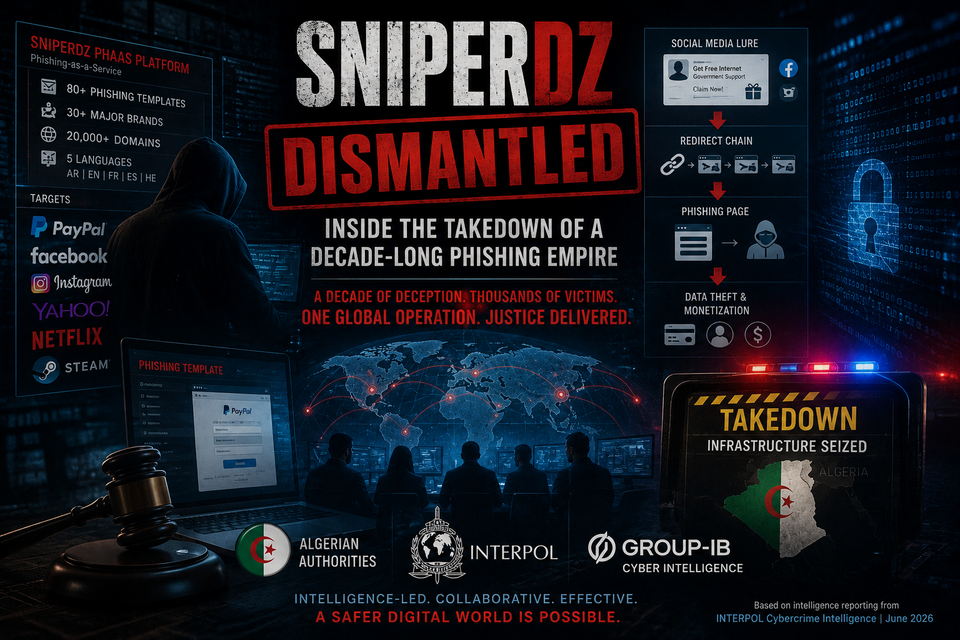
SniperDz was not your average phishing tool. It was a fully-fledged Phishing-as-a-Service (PhaaS) platform — essentially a criminal subscription service that allowed threat actors of any skill level to launch professional-grade phishing campaigns without needing technical expertise. Think of it as the dark web's answer to a SaaS product, complete with ready-to-deploy templates, multilingual support, and targeting tools.
The platform offered:
- 80 ready-made phishing templates designed to impersonate more than 30 major global brands
- Targets including PayPal, Facebook, Instagram, Yahoo, Netflix, and Steam
- Campaigns spanning more than 20,000 domains
- Templates available in five languages — Arabic, English, French, Spanish, and Hebrew — enabling attacks across multiple continents and demographics
This multilingual, multi-brand approach made SniperDz exceptionally dangerous. It wasn't targeting one region or one type of victim — it was designed for global scale.
How the Scam Worked
The attack methodology was deceptively simple but devastatingly effective. Fraudulent Facebook accounts — impersonating politicians, public figures, and trusted organizations — were used to lure victims with seemingly legitimate offers:
- Free mobile internet packages
- Financial compensation programs
- Government subsidy schemes
Victims who clicked on the embedded links were not taken directly to a phishing page. Instead, they were funnelled through a chain of intermediary websites, making the traffic harder to trace and the infrastructure more resilient against takedowns. At the end of this redirect chain lay phishing pages and traffic monetization infrastructure — harvesting credentials, personal data, and financial information.
The use of social proof (impersonating known public figures), urgency (limited-time offers), and authority (fake government programs) made these campaigns highly convincing, particularly to less digitally-savvy users.
The Scale of the Damage
By 2016 — years before the platform was dismantled — SniperDz had already published internal statistics boasting that its campaigns had collected more than 45,000 victim records. That figure, from over a decade ago, only hints at the true scale of harm inflicted over the platform's full operational lifespan.
Each victim record represents real people who lost credentials to banking platforms, social media accounts, and streaming services — data that is routinely resold on dark web marketplaces, used for identity theft, account takeovers, and further fraud.
The Power of Intelligence-Led Collaboration
The SniperDz takedown is a textbook example of what modern cybercrime investigations must look like. No single agency or country can dismantle a transnational cybercriminal ecosystem alone. This operation succeeded because it combined:
- Algerian national law enforcement — providing jurisdiction and the ability to make arrests and seize infrastructure on the ground
- INTERPOL — coordinating cross-border intelligence sharing and operational support
- Group-IB — a private-sector cybersecurity firm providing deep technical intelligence on the platform's infrastructure, tooling, and operators
This public-private partnership model is increasingly becoming the gold standard in cybercrime investigations. Platforms like SniperDz deliberately operate across borders, jurisdictions, and legal systems — making coordination not just helpful, but essential.
Why PhaaS Platforms Are So Dangerous
SniperDz belongs to a growing category of criminal infrastructure that has fundamentally lowered the barrier to entry for cybercrime. PhaaS platforms commoditize phishing attacks, meaning that:
- Technical skill is no longer required. Anyone with a credit card (or cryptocurrency) can launch a sophisticated campaign.
- Scale becomes trivial. Templates, domains, and redirect chains are pre-built. Attackers can target millions of users with minimal effort.
- Attribution is harder. The PhaaS operator sits behind layers of customers, infrastructure, and obfuscation, making it difficult to trace attacks back to the source.
- Professionalism increases. Branded templates that look identical to legitimate company websites are far more convincing than hand-crafted fakes.
The rise of PhaaS is a direct parallel to the broader "as-a-service" economy in cybercrime — alongside Ransomware-as-a-Service (RaaS), Malware-as-a-Service (MaaS), and DDoS-for-hire operations. SniperDz's dismantlement removes one node from this ecosystem, but the model itself remains alive and evolving.
What This Means for Organizations and Individuals
The brands targeted by SniperDz — PayPal, Facebook, Netflix, Yahoo, Instagram, Steam — are household names precisely because billions of people trust them. That trust is exactly what phishing attacks exploit.
For individuals, the key defenses remain:
- Be skeptical of unsolicited offers, especially those promising free services or government benefits via social media
- Verify before you click — check URLs carefully; phishing pages often use domains that look similar but are subtly different
- Enable multi-factor authentication (MFA) on all important accounts, so stolen passwords alone aren't enough
- Report suspicious Facebook posts or accounts impersonating public figures or organizations
For organizations whose brands are being impersonated:
- Active brand monitoring across domains and social media is essential
- Threat intelligence partnerships with firms like Group-IB can provide early warning when phishing kits using your brand emerge
- Customer education campaigns reminding users what legitimate communications look like
A Victory — and a Warning
The dismantlement of SniperDz is a genuine win for global cybersecurity. A platform that ran for nearly a decade, victimizing tens of thousands of people across multiple continents, has been shut down through persistence, collaboration, and intelligence-led policing.
But it is also a warning. SniperDz was not unique — it was one of many PhaaS platforms operating today. For every platform taken down, others emerge to fill the vacuum, often learning from the mistakes of their predecessors. The ecosystem that made SniperDz possible — the demand for phishing tools, the markets where stolen data is sold, the anonymizing infrastructure that hides operators — continues to function.
The lesson is clear: dismantling cybercriminal infrastructure requires sustained investment in international cooperation, private-sector intelligence sharing, and public awareness. The SniperDz operation shows it can be done. The challenge now is doing it at the scale and speed that the threat demands.
Conclusion
SniperDz's decade-long run as a phishing-as-a-service empire is over. But its story is a reminder of how sophisticated, organized, and global cybercrime has become. Eighty phishing templates, five languages, thirty major brands, twenty thousand domains, and forty-five thousand victims — these are not the numbers of opportunistic hackers. They are the metrics of a criminal enterprise.
The takedown, led by Algerian authorities with support from INTERPOL and Group-IB, demonstrates that intelligence-led, cross-border collaboration is both possible and effective. In the fight against transnational cybercrime, it may be the only approach that works.
Based on intelligence reporting from INTERPOL Cybercrime Intelligence | June 2026
Member discussion