
When the Factory Knows Too Much: The Tata Electronics Breach and the Hidden Vulnerability in Big Tech's Supply Chain
June 2026
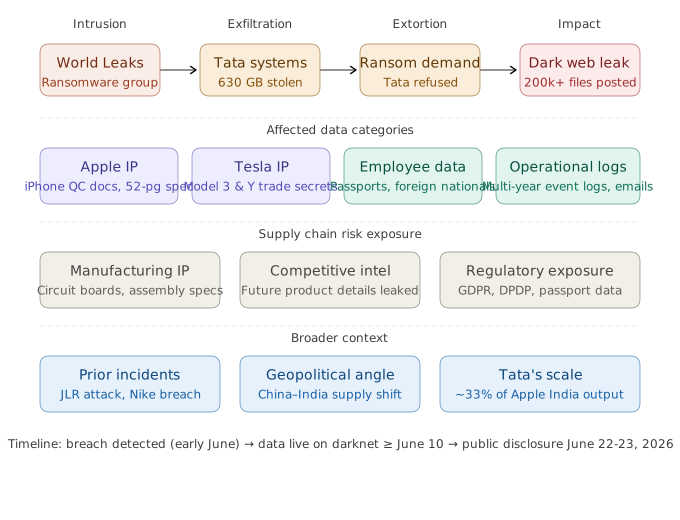
In early June 2026, somewhere inside Tata Electronics' network, an attacker completed the most dangerous part of their operation — the part no alarm went off for. More than 630 gigabytes of data, spanning 200,000 files, had been quietly copied and carried out. The encryption, the demands, the public humiliation — all of that came later. By the time anyone knew what had happened, the damage was done.
The ransomware group calling itself World Leaks published the stolen files on its darknet portal around June 10. What the dump contained stopped researchers cold: internal Apple manufacturing documents marked with the company's proprietary headers, quality-control specifications for iPhone circuit boards, a 52-page document bearing Apple's confidential markings, and engineering drawings from Tesla labeled "TRADE SECRET" — files tied to Project Highland, the internal codename for the revamped Model 3 sedan, and components for the upgraded Model Y SUV. Alongside them sat years of operational logs, employee emails, and passport copies of Tata workers, including foreign nationals.
Apple and Tesla had not been hacked. Their supplier had.
A Breach Hidden Inside a Breach
Tata Electronics is not a household name, but it occupies a critical position in the global technology supply chain. The company currently accounts for roughly one-third of Apple's iPhone production in India — a share that has grown rapidly as Apple accelerates its push to manufacture outside China. It is precisely the kind of partner that holds the technical soul of a product: the tolerances, the inspection standards, the assembly drawings, the specifications that took years and billions of dollars to develop.
When a company like Tata is breached, the blast radius extends far beyond its own walls.
This is what cybersecurity researchers call a supply chain attack — and it is increasingly the preferred method of sophisticated threat actors. The logic is simple. A company like Apple invests heavily in its own defenses. Attacking it directly is difficult, expensive, and likely to fail. But Apple's suppliers, partners, and contractors hold Apple's most sensitive data while operating with potentially lower security maturity. Target the supplier, and you effectively reach the OEM.
The pattern is not new. The 2013 breach of US retailer Target — in which attackers entered through a heating and ventilation contractor — became the canonical case study in third-party cyber risk. This breach is that case study, replicated at a far higher level of intellectual property sensitivity.
What Was Taken, and Why It Matters
The data categories in this breach carry distinct and serious consequences.
Apple's manufacturing documents — particularly circuit board quality inspection standards and the 52-page proprietary specification — represent competitive and operational intelligence of the highest order. A competitor in possession of these files gains insight into Apple's manufacturing tolerances, failure thresholds, and the precise engineering decisions that make an iPhone an iPhone. This is knowledge that typically cannot be bought. It can only be developed over years of iteration — or stolen.
Tesla's exposure is similarly pointed. The engineering drawings for Project Highland and the NV36 chargeport controller are product roadmap intelligence. In a competitive industry where a six-month head start in knowing a rival's next specifications can shape procurement decisions, patent filings, and marketing strategy, this data has direct commercial value to adversaries. Tesla labeled these files "TRADE SECRET" for a reason.
The employee records carry a different kind of harm. Passport copies, internal emails, and personnel files create the raw material for identity fraud and targeted phishing campaigns. For foreign nationals in the dump, there may be immigration and national security implications. Under the European Union's General Data Protection Regulation and India's own Digital Personal Data Protection Act of 2023, this category of exposure triggers mandatory notification obligations — with a 72-hour regulatory reporting window that the public timeline of this breach appears to have significantly exceeded.
And then there are the event logs. Multi-year operational logs — recording authentication patterns, internal traffic, system behaviors — are among the most overlooked and most dangerous categories of leaked data. They are a roadmap for the next attacker: a detailed picture of how Tata's systems behave under normal conditions, which makes future intrusions far easier to conduct without detection.
The Mechanics of the Attack
World Leaks operates what security researchers classify as a double-extortion ransomware model. The group does not simply encrypt a victim's systems and demand payment to restore access. It exfiltrates data first, silently, before making any move that might trigger an alert. Only then does it present the ransom demand — with a secondary threat: pay, or the data goes public.
This model has become dominant in the ransomware ecosystem since roughly 2019 because it solves a problem that plagued earlier ransomware operations. If a victim had good backups, encryption was largely toothless — they could restore and refuse to pay. Double extortion removes that escape. Even a company with perfect backups now has something to lose: its data.
Tata's statement that the incident had "no impact on operations" tells us something important about this attack. It almost certainly means that the encryption phase either did not occur or was contained before it caused disruption. But the exfiltration had already succeeded. In double-extortion ransomware, the exfiltration is the attack. The encryption is theater — leverage for a negotiation that, in Tata's case, appears to have failed.
The 630 gigabytes of stolen data did not leave Tata's network in a single burst. A dataset of this size, comprising years of operational logs and diverse file types, requires sustained access — reconnaissance, lateral movement through systems, selective harvesting of high-value material. The attackers had dwell time. They were inside long enough to learn the network, identify what was worth taking, and extract it without triggering a response.
The data was live on the dark web for at least twelve days before public disclosure. Tata detected the incident, by its own account, "a few weeks" before the statement was issued. That gap — between internal knowledge and public disclosure — reflects a pattern that repeats across major breaches: organizations learn what was taken before they are ready to say so.
A Structural Vulnerability, Not Just an Incident
It would be convenient to frame this breach as a one-off failure — a single company's security shortcomings, correctable with better tools and more vigilance. That framing misses the point.
The deeper problem is architectural. The relationship between large technology OEMs and their contract manufacturers requires the manufacturer to hold an enormous volume of sensitive information: product specifications, quality standards, assembly processes, component sourcing data. This information must exist somewhere on the manufacturer's systems for the work to get done. There is no version of this relationship in which Tata does not hold Apple's most sensitive manufacturing data.
That data concentration is the vulnerability. And it is structural, not accidental.
Apple's supply chain diversification strategy — the deliberate shift of production from China into India, with Tata as the primary beneficiary — was designed to reduce geopolitical risk. It has, to some extent. But the concentration of production capacity in a single Indian partner has created a parallel concentration of informational risk. One company now holds a third of Apple's Indian production and, by extension, a significant share of Apple's most sensitive operational data. When that company is breached, Apple is breached — even if Apple's own systems are never touched.
This is what supply chain security researchers refer to as cascade risk: a failure at one node of a tightly coupled network propagates to every node that shares information with it. The more concentrated the network, the higher the blast radius of any single failure.
The solution — partial and imperfect as it is — lies in what security architects call Zero Trust supply chain design: granting suppliers access only to the specific data required for their immediate task, with no persistent access to broader internal repositories, and with continuous monitoring of what is accessed and transferred. The current model, in which a contract manufacturer can accumulate years of OEM data on its internal systems, is the architectural choice that made this breach as damaging as it was.
The Broader Pattern
This breach does not arrive in isolation. It follows a cyberattack on Tata's UK subsidiary Jaguar Land Rover, which halted production for six weeks. It follows World Leaks' previously reported breach of Nike. It follows years of escalating ransomware campaigns targeting high-value supplier networks in electronics, automotive, defense, and pharmaceuticals.
The pattern is consistent with a threat environment that has matured considerably from the era of opportunistic ransomware targeting hospitals and municipal governments for quick payouts. Modern ransomware groups operating at this level conduct deliberate target selection, prioritizing organizations whose data has value beyond the ransom itself — to competitors, to state actors, to markets where intellectual property can be monetized.
Tata Electronics, as the manufacturing nerve center of one of the world's most valuable technology companies, was exactly the kind of target worth investing in.
What Comes Next
For Apple and Tesla, the immediate task is forensic: a full accounting of which documents were leaked, which product lines are exposed, and whether any specifications are sensitive enough to warrant redesign — not because the products are compromised in a functional sense, but because the competitive advantage embedded in those specifications has now been erased.
For Tata, the legal and regulatory reckoning is likely to be significant. Notification obligations under multiple jurisdictions, potential liability for the exposure of third-party intellectual property, and the reputational cost of being the company through which Apple's secrets leaked are all incoming.
For the technology industry more broadly, this breach should serve as the case study that accelerates a shift already long overdue. The assumption that a supplier can be trusted with unlimited, persistent access to OEM data — because they need it to do the work — is no longer tenable. The data that makes modern electronics possible is too valuable, and the threats targeting it too sophisticated, for that trust to go unverified and unmonitored.
The factory knows too much. And until the industry finds a way to change that, every factory is a potential door.
Member discussion