
Sovereignty Is Not for Sale: Starlink, India and the Off Switch
The real oligarch holds the switch
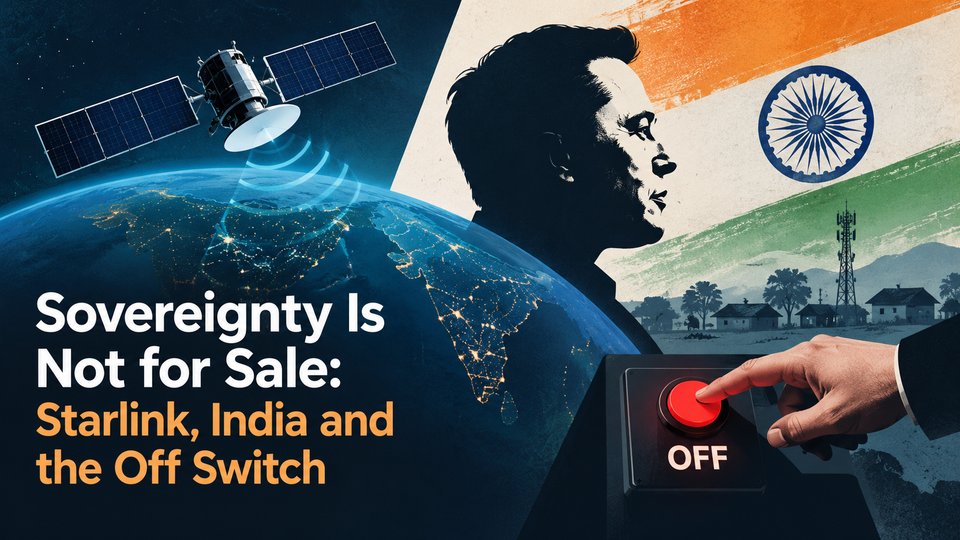
India is being asked to trade its sovereignty for a satellite dish. The price is control over who can switch a nation's communications off in a crisis. The CyberDiplomat's view is plain: India should not pay it.
On 7 October 2026, Elon Musk quoted a post claiming 11,256 Indian villages still lacked 4G and said Starlink was being blocked by "certain oligarchs" protecting a "monopolistic chokehold" on Indians. He called it "a crime against the people of India".
The accusation is upside down. The two telecom groups it most obviously points at, Reliance Jio and Bharti Airtel, both signed agreements with SpaceX in 2025 to distribute Starlink in India. They are his partners, not his blockers.
An oligarch is someone whose private wealth buys power over public life. By that test, the oligarch in this story is the man who wants to decide, from a control room in another country, whether an Indian village, an Indian army unit or an Indian city stays online. Musk has already used that power. He decided where Ukraine's forces could have connectivity in 2022, and he has confirmed on X that Starlink is active over Iran, a country that has outlawed it (Malay Mail). He is now asking India to accept the same arrangement.
A switch held by an elected government answers to Parliament, the courts and voters. A switch held by one man answers to his business interests. That is the line India is right to hold.
Where Starlink actually stands
Starlink has its operating licences but not the security clearance to launch commercially. Spectrum rules are now settled; the Ministry of Home Affairs is the gate.
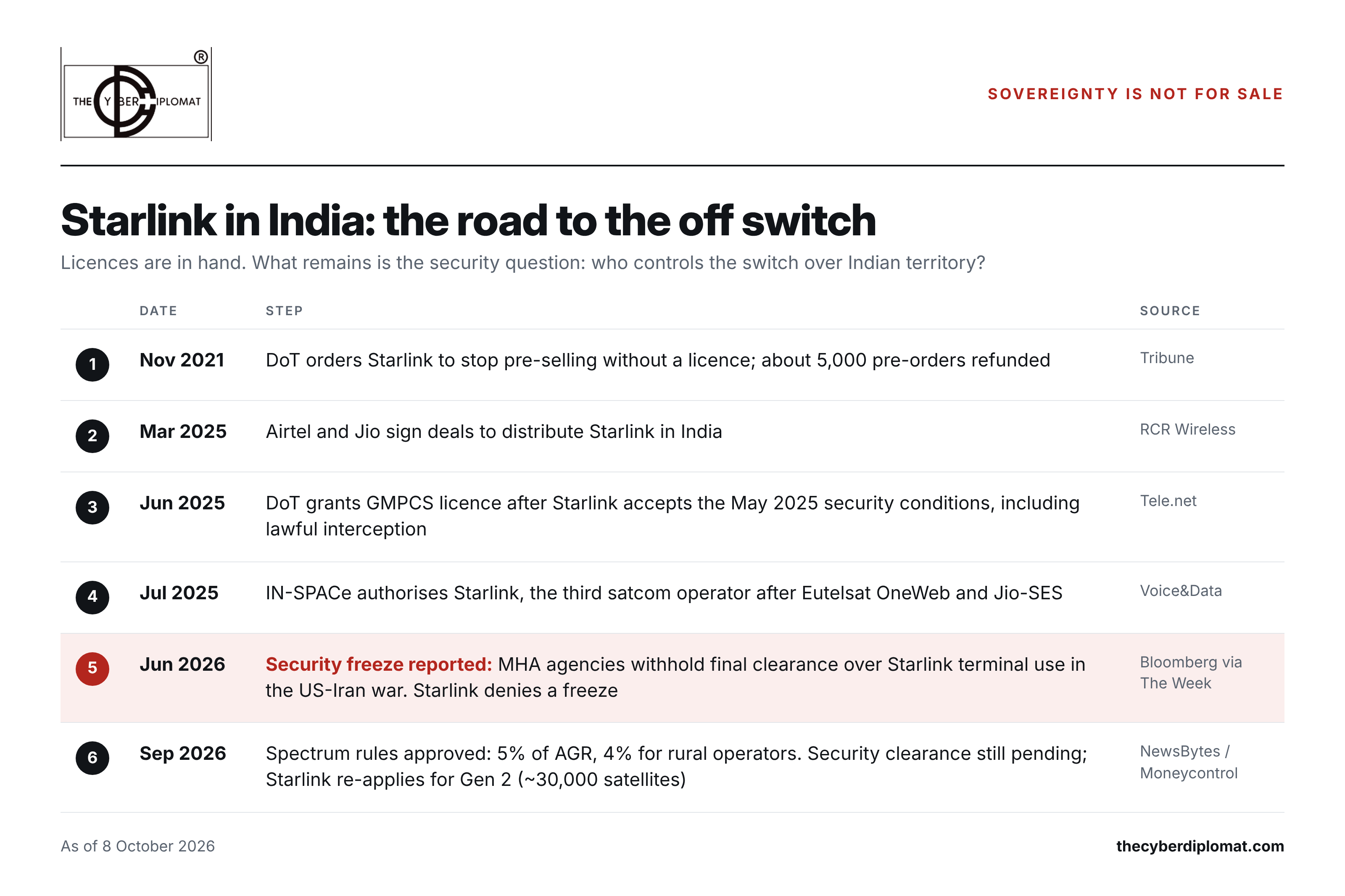
One detail matters for the "oligarch" charge: Musk lobbied for administrative spectrum allocation over auctions, against Jio's position, and won. The commercial fight is over. What remains is a security question.
The gap is real, and it is ours to close
The connectivity gap is not invented, and India's own fibre programme is behind. Defending sovereignty means owning that failure too.
- 4G in villages. In 2022 about 45,180 of 6.44 lakh villages had no 4G (Lok Sabha). The state-funded 4G Saturation project had reached 20,547 villages by December 2025 (DoT/USOF). We could not verify the 11,256 figure in the viral post, but a residual gap of that order is plausible.
- BharatNet. About 2.15 lakh gram panchayats are counted as "connected" (PIB, Jan 2026). Yet only 78,899 of roughly 2.64 lakh had operational Points of Presence by February 2026, after ₹40,635 crore spent, the parliamentary standing committee was told (ThePrint).
- Satellite is not a mass fix. DoT's own estimate is that one constellation could serve only 10,000 to 20,000 connections in a city like Delhi (NewsBytes). It suits the last few thousand villages, ships and disaster zones, not a billion users.
So the honest position cuts both ways. Satellite broadband has a real role for the hardest-to-reach. And India cannot use sovereignty as cover for a fibre programme that is years late.
The off-switch problem
Three episodes show that a satellite network's coverage can be decided by its owner or its home government, not by the country beneath it.
Ukraine, 2022. Kyiv made an emergency request to extend Starlink over Crimea for a drone strike on the Russian fleet at Sevastopol. Musk refused, citing fear of escalation and later US sanctions law (Reuters via DT Next). He says coverage was never switched off, only never switched on; Walter Isaacson's biography was corrected on that point (Jalopnik). Either way, one executive decided where a military operation could have connectivity. The Pentagon then contracted directly with SpaceX for Ukraine's service in June 2023 (Reuters via Atoll Times).
Iran, 2026. Starlink is unlicensed and illegal in Iran, which passed a law with severe penalties after the June 2025 war (Malay Mail). Even so, US officials told the Wall Street Journal that Washington covertly shipped about 6,000 terminals into Iran during the January 2026 shutdown (Iran International). Tens of thousands more are thought to be in the country. The service worked over a sovereign state that had expressly forbidden it.
India, 2024. On 13 December 2024 the Army's Spear Corps seized a Starlink-branded terminal with weapons in Manipur, marked with the initials of a banned militant group (MediaNama). Weeks earlier, Andaman police found a Starlink Mini on a meth-smuggling vessel (Nicobar Times). Musk said beams over India were "never on"; later reporting cited militants saying they had used it during shutdowns (Deccan Herald).
The lesson is symmetrical. Coverage can be withheld from a state that wants it, and supplied over a state that refuses it. That is the sovereignty question, and it is why the Bloomberg-reported freeze cites the Iran war specifically.
6G: China writes the rules, Starlink lays the pipes
The Starlink fight is really a 6G fight. In 6G, satellites stop being a side service and become part of the network itself. Whoever controls those satellites controls a share of the network every phone will use.
The rules. The ITU's framework for 6G, called IMT-2030, was finalised in June 2023. It adds "Ubiquitous Connectivity" as a core scenario, built on terrestrial and non-terrestrial networks working together (Huawei summary of ITU-R WP 5D). Candidate technologies are due between 2027 and early 2029, with the standard set in 2030. 3GPP's Release 20 is the main 6G study phase, and its first usable 6G specifications are expected in Release 21 by end-2028 (BIS Infotech). Unlike 5G, where satellites were added later, 6G treats them as native.
China at the table. Beijing launched official 6G research in November 2019. It built a national IMT-2030 Promotion Group of government, universities and firms. In one survey of 20,000 6G patent filings, Chinese applicants held 40.3%, led by Huawei, State Grid and China Aerospace Science and Technology Corporation (6GWorld). China also reserved the 6425–7125 MHz band for 5G and 6G, a move that could steer global spectrum decisions. In practice, much of the 6G rulebook is being drafted in rooms where Chinese delegations are the best prepared.
The pipes. SpaceX, meanwhile, is building the hardware the rulebook will describe. It bought EchoStar's AWS-4 and H-block spectrum for $17 billion in September 2025 to deliver broadband straight to ordinary smartphones (RCR Wireless). In February 2026, at an ITU conference, it set a 150 Mbps target for direct-to-cell service. It has also filed for 15,000 more very-low-orbit satellites that act as "cell towers in space" (SatNews). Its India Gen 2 application covers nearly 30,000 satellites with direct-to-device capability.
Why this matters for India. 5G runs on towers on Indian soil, under Indian licences and Indian law. A 6G network with native satellite links can reach an Indian phone from orbit, through a control centre in another country. If India lets one foreign company become the space layer of its 6G network, it will not get that control back. China writes the rules; Starlink builds the pipes. India must not be left holding only the bill.
The China factor inside SpaceX
Beijing has already got from Musk the guarantee India is still asking for. In October 2022, Musk told the Financial Times that Chinese officials had sought assurances he would not sell Starlink in China (Mezha, citing the FT). Starlink is still not offered there. The same switch that stayed on over Iran against Tehran's wishes stays off over China, as Beijing asked.
The ties run deep:
- Tesla depends on China. Tesla builds about half its cars in Shanghai, and Beijing backed the Gigafactory's expansion (Linkiesta, Jul 2026). In March 2025 President Trump said Musk should not see US war plans for China because he "would be susceptible perhaps" to pressure, given his businesses there (Arab News).
- Chinese money is in SpaceX. Delaware court records show SpaceX lets Chinese investors buy stakes if the money comes through offshore vehicles in the Cayman Islands, the British Virgin Islands or Hong Kong (ProPublica, Mar 2025). SpaceX's CFO testified that it has no formal policy on investment from adversary countries. The known sums are small, under $100 million, and nothing alleges they broke the law. But SpaceX itself does not disclose who ultimately owns the vehicles.
- Musk's position on Taiwan. In 2022 Musk suggested Taiwan become a "special administrative zone" of China. Beijing welcomed it and Taipei rejected it (Linkiesta). Taiwan is now opening its market to foreign satellite operators, but under a strict national-security review.
- China is building its own switch. State-backed constellations Guowang (12,992 satellites planned) and Qianfan (15,000 by 2030) are launching. Qianfan is already marketing abroad under the Sailspace brand (CircleID).
For India this is a double exposure. Handing the space layer to Starlink means trusting a company whose owner has business interests Beijing can squeeze, and which has kept its switch off over China at Beijing's request. Turning to a Chinese constellation instead would be worse. The only answer that keeps Indians in control is an Indian switch.
What India's rules cover, and what they don't
India's satcom rules localise the data. They do not localise the control.
The DoT's 5 May 2025 security conditions for satellite licensees set out 29 requirements (Storyboard18). Among them:
- Security clearance for every gateway and hub location in India, and lawful interception at the gateway (Communications Today).
- Network control and monitoring functions, data centres and DNS resolution located in India.
- No Indian user connected through a foreign gateway; no Indian data copied or decrypted abroad; terminals geo-fenced so they cannot connect from outside the coverage area (Indian Infrastructure).
- Real-time location of any user terminal on request by security agencies.
- A phased plan to source 20% of the ground segment in India within five years (Advanced Television).
These are serious safeguards, and Starlink accepted them. But they govern the ground. The constellation itself, its beam scheduling, software updates and satellite command, is operated from the United States under US law. A gateway in Mumbai does not stop an operator, or a US court or export-control order, from dimming coverage over a region. Nor does it stop unregistered terminals, smuggled in as they were into Iran and Manipur, from being served if the operator chooses.
That is the gap Indian negotiators should be closing, and the likeliest reason clearance is still pending.
What sovereign connectivity looks like
The principle is simple: the switch over Indian territory belongs to the Government of India, answerable to Indian citizens. Satellite operators can serve India, but only as tenants, never as landlords.
- Write service continuity into the licence. No reduction of coverage over Indian territory without notice to and consent of the Indian licensor, except for documented technical faults. Back it with financial penalties and step-in rights.
- Put real authority in the Indian control centre. The in-India network control centre should be able to see and veto changes to beam allocation over India, not merely mirror decisions made elsewhere.
- Never depend on one constellation. Eutelsat OneWeb and Jio-SES are already licensed. Critical users (defence, disaster response, border districts) should be multi-homed across at least two operators from different jurisdictions.
- Close the terminal loophole. Require operators to deny service to any terminal over India not registered with an Indian licensee, and to report detected rogue terminals to security agencies.
- Build an Indian constellation. IN-SPACe's private-sector framework should be backed with anchor-tenant contracts from government, as the Pentagon does for US firms.
- Fix the fibre we already paid for. BharatNet's operational PoPs, 78,899 of 2.64 lakh gram panchayats, are the real bottleneck. A time-bound audit, as the parliamentary committee recommends, is the fastest connectivity win available.
- Fund the last mile, not the brand. DoT declined to subsidise rural satellite terminals through Digital Bharat Nidhi. A technology-neutral voucher for the last uncovered villages, open to any compliant operator, would test whether rural demand or regulation is the real constraint.
The real question
Connectivity can be bought. Sovereignty, once sold, cannot be bought back. India should welcome every satellite operator that accepts Indian law, and above all Indian control of the switch. An operator that wants a billion customers without conceding that control is asking India to sell its sovereignty for the price of a monthly plan.
Musk is right that villages are waiting. He is wrong about who is holding them back, and wrong about who should hold the switch. China is writing 6G's rules. SpaceX is building its pipes. India must make sure it does not end up as a mere customer of both. Calling that caution "a crime against the people of India" gets it backwards. The crime would be handing their communications to a man in another country.
The CyberDiplomat is a global cybersecurity and cyber diplomacy organisation working across India, the UK, Africa and the United States.
Sources
- The Week: Starlink pushes back on reports of India licence block (Jun 2026)
- NewsBytes: DCC approves satellite spectrum recommendations (Sep 2026)
- ThePrint: BharatNet still loading (Aug 2026)
- DoT/USOF: villages covered under 4G Saturation project, Lok Sabha Jul 2026
- Storyboard18: DoT satcom security conditions (May 2025)
- Iran International: US covertly sent Starlink terminals to Iran (Feb 2026)
- Reuters via DT Next: Musk refused Kyiv request (Sep 2023)
- MediaNama: Army recovers Starlink device in Manipur (Dec 2024)
- RCR Wireless: Starlink secures IN-SPACe nod (Jul 2025)
- Huawei: ITU-R WP 5D completes IMT-2030 framework (Jun 2023)
- BIS Infotech: China's 6G strategy
- 6GWorld: What's really going on with China and 6G
- SatNews: SpaceX 150 Mbps direct-to-cell target (Feb 2026)
- ProPublica: SpaceX allows Chinese investment via offshore vehicles (Mar 2025)
- Arab News: Trump says Musk "susceptible" on China (Mar 2025)
- Linkiesta: Taiwan opens door to Starlink (Jul 2026)
- CircleID: Guowang, Qianfan and Honghu-3 update
Member discussion