
Supply Chain Cybersecurity: Why the Weakest Link Now Decides Global Security
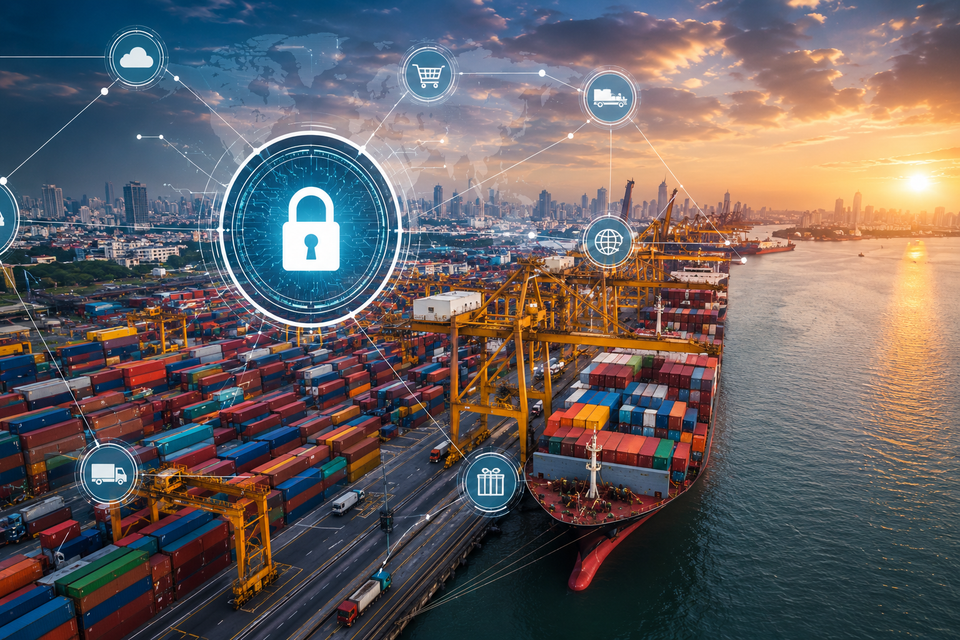
Every phone, car, or piece of industrial equipment we use today is really a patchwork of parts: hardware designed in one country, firmware written in another, software assembled somewhere else entirely, and final assembly happening in a fourth location. This is the modern technology supply chain, and it's a triumph of globalization — but it's also become one of the most serious and least understood risks in cybersecurity.
Supply chain cybersecurity is the discipline that sits at the intersection of two older fields: cybersecurity and supply chain management. It asks a simple but uncomfortable question — if a product touches dozens of vendors, countries, and hands before it reaches you, how do you know it's still trustworthy by the time it arrives? The honest answer, in most cases, is that nobody fully does.
Why This Isn't Just an IT Problem
It's tempting to think of supply chain security as something the IT department handles. In reality, agencies like the U.S. National Institute of Standards and Technology (NIST) frame it differently: it's a problem of people, products, and processes across an entire supply network, not a single company's servers. A vulnerability can be introduced by a careless subcontractor, a compromised software update, a counterfeit component, or a disgruntled employee three tiers removed from the final brand name on the box.
That distance is exactly what makes the problem hard. When a company suffers a breach through its own systems, it can trace, patch, and respond. When the breach comes through a supplier's supplier, the affected organization may not even know that vendor exists — let alone what security practices it follows.
The Weakest-Link Problem
Security researchers have long observed that a supply chain's cybersecurity is only as strong as its weakest participant. Sophisticated attackers, including state-linked "advanced persistent threats," don't necessarily attack the best-defended target directly. They look for the smallest, least-resourced vendor in the chain — the one without a dedicated security team — and use it as a foothold to reach larger, better-defended organizations further down the line.
This dynamic has played out in real incidents. In 2015 and again in 2017, cyberattacks on the energy sector — one in Ukraine, one at Saudi Aramco — demonstrated how compromising supply chain software could disrupt physical infrastructure, not just data. In another documented case, a group known as Dragonfly infiltrated pharmaceutical and industrial companies across Europe and North America by quietly altering code on a supplier's website, turning a routine software update into a delivery mechanism for malware.
These aren't edge cases. They illustrate a broader pattern: software is the most flexible — and most exploitable — layer of any supply chain. A flaw can be "unintended," meaning an accidental defect baked in during design, or "malicious," meaning it was deliberately planted. Both are difficult to detect, but malicious tainting is far harder to defend against because it's specifically engineered to look normal.
From a Business Problem to a Geopolitical One
What makes supply chain cybersecurity especially complex today is that it has stopped being purely a corporate risk-management issue and become a matter of state policy and international trade.
For decades, globalization pushed countries toward what's sometimes called "international production fragmentation" — the idea that a product's design, manufacturing, and assembly could each happen wherever it was cheapest or most efficient, coordinated through global trade rules set by bodies like the World Trade Organization (WTO). Cybersecurity risk is now reversing that logic in places. Governments increasingly see an internationally scattered supply chain as something they can't fully secure or control, and their response has been to pull it back within their own borders.
China's 2017 Cybersecurity Law is the clearest example. It requires companies operating in China to store certain data domestically, submit source code and technical details for government review, and demonstrate that their products are "secure, controllable, and transparent" — a standard that isn't precisely defined but has generally been read as favoring domestic technology and government-accessible systems over foreign alternatives. Apple's decision to move Chinese users' iCloud data to a domestically operated data center is a direct consequence of this kind of law.
The effect is a kind of digital protectionism dressed up as security policy. Other countries have watched this playbook and begun adopting similar approaches, effectively trading the efficiency benefits of a globalized supply chain for tighter national control over data and technology. Whether or not each of these laws is primarily about security, industrial policy, or intellectual property protection is often genuinely ambiguous — and that ambiguity itself is part of the problem, because it makes it hard for trading partners to respond to on principled terms.
Who's Supposed to Be in Charge? Nobody, Really
Given how global this problem is, you'd expect international institutions to have stepped in with clear rules. They mostly haven't.
- The World Trade Organization focuses on reducing tariffs and harmonizing trade rules, and works with international standards bodies on product safety — but has no supply-chain-specific cybersecurity standard.
- The World Customs Organization built a "customs supply chain security paradigm" after the September 11 attacks, aimed largely at physical security and smuggling, not the security of embedded software and hardware.
- The World Intellectual Property Organization protects intellectual property rights on paper but has no enforcement role when that property is stolen through cyber-espionage rather than conventional infringement.
Each organization touches a piece of the puzzle — trade, customs, or intellectual property — but none owns cybersecurity as a cross-border responsibility. The result is a genuine policy gap: a risk that is unmistakably global in nature, addressed almost entirely through fragmented national laws that don't talk to each other.
The Human Dimension: Wages, Skills, and Incentives
One of the less obvious threads in this story is economic inequality. As manufacturing and lower-skill tasks shift to countries with cheaper labor, those countries often also have less mature cybersecurity regulation and fewer resources to enforce what rules do exist. That combination — economic incentive plus weaker oversight — creates conditions where vulnerabilities are more likely to appear and less likely to be caught. It also means that the human cost of a weak link isn't abstract: it tracks the same global wage gaps that drive production decisions in the first place.
What Would Actually Help
Drawing the threads together, a few directions come up repeatedly in serious discussions of this problem:
- Shared vocabulary and visibility. Many organizations still lack a common way to talk about supply chain risk, let alone map who their suppliers' suppliers even are. Basic visibility has to come before mitigation.
- Sector-specific standards, not one-size-fits-all rules. A pharmaceutical supply chain and an energy grid have very different failure modes; treating cybersecurity as a generic checkbox tends to miss what matters most in each sector.
- Incentives for smaller vendors. Since attackers target the weakest link, raising the security floor for small and mid-sized suppliers — not just large prime contractors — has an outsized effect on the whole chain.
- International rulemaking that actually addresses cyber risk, rather than trade agreements and IP treaties that were designed for a pre-digital economy and have been only loosely retrofitted.
- Transparency about what "security" laws are really doing. When a national cybersecurity law doubles as an industrial policy tool, trading partners deserve a clearer accounting of which parts are genuinely about security and which are about market control.
The Bigger Picture
Supply chain cybersecurity sits at an unusual crossroads: it's a technical problem (how do you verify a component wasn't tampered with), a management problem (how do you monitor vendors you don't control), and a geopolitical problem (how do nations balance security, sovereignty, and trade). Treating it as only one of these — purely technical, purely legal, or purely diplomatic — misses why it's so hard to solve.
As long as products are designed in one country, built in another, and run on software written in a third, the question of who is responsible when something goes wrong will remain genuinely unsettled. Closing that gap will take more than better firewalls. It will take institutions — corporate and international — willing to treat supply chain trust as seriously as they already treat supply chain cost and speed.
This article draws on themes from academic and policy literature on cyber supply chain risk, including work by Sandor Boyson, NIST, CERT-UK, and analyses of China's 2017 Cybersecurity Law, among others.
Member discussion