
Talking Security While Waging a Tech War: The Hidden Tensions Inside India-China SCO Diplomacy
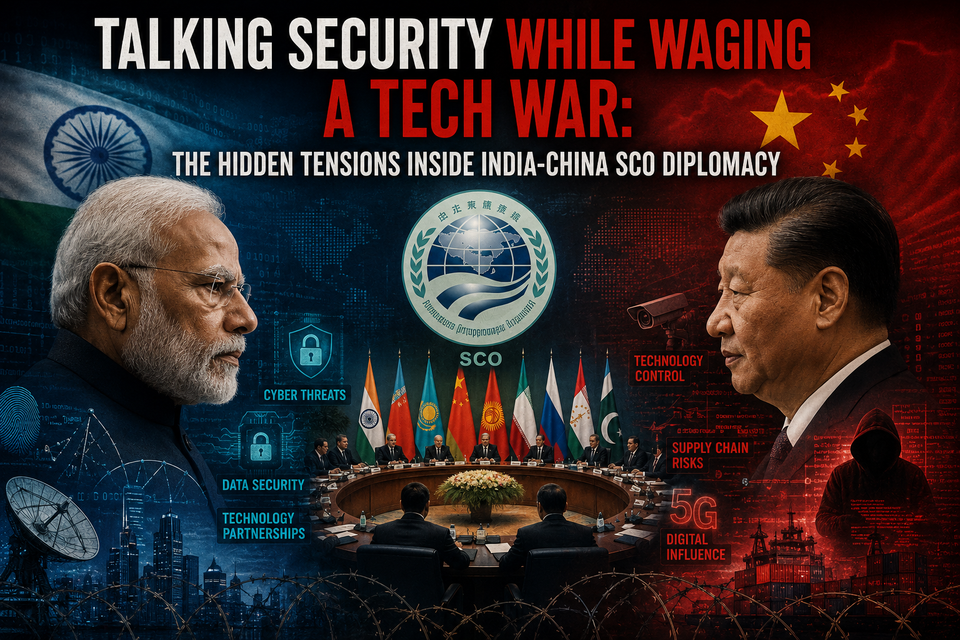
As New Delhi and Beijing hold their first bilateral SCO consultations, a deeper contest plays out beneath the diplomatic surface — one fought in silicon, cyberspace, and artificial intelligence.
The optics of the April 16–17 bilateral consultations in New Delhi were careful and measured. India's SCO National Coordinator Alok A. Dimri and China's Ambassador Yan Wenbin sat across from each other in a structured two-day meeting — the first of its kind dedicated exclusively to SCO matters between the two countries. The agenda: security, trade, connectivity, people-to-people ties. The outcome: mutual agreement to keep talking.
What the formal readouts did not capture was the subtext. Because even as the two delegations exchanged diplomatic pleasantries in Lutyens' Delhi, the same two countries were waging a fierce, multidimensional contest across semiconductors, artificial intelligence, cybersecurity norms, and digital sovereignty — a contest with no neat multilateral forum and no easy resolution.
To understand the SCO bilateral, you have to understand what it sits inside: a technology cold war between Asia's two largest powers, conducted in parallel with every diplomatic handshake.
The SCO's Tech Agenda: More Than It Appears
The Shanghai Cooperation Organisation has, over the past two years, quietly expanded its mandate into territory that looks less like regional security and more like a digital order-building exercise.
At the 2025 SCO Summit in Tianjin, the Tianjin Declaration reaffirmed commitments to strengthen artificial intelligence cooperation, explicitly underscoring "equal rights of all countries to develop and use AI." An SCO AI Cooperation Forum held in May 2025 saw Beijing call on member states to build a collaboration centre for AI applications and pledge to promote open-source AI models across the bloc's digital economies. The SCO's broadened agenda now includes platforms covering the digital economy, cybersecurity, and artificial intelligence — areas that were barely on the organisation's radar a decade ago.
This is not incidental. For China, embedding AI and digital cooperation within the SCO framework serves a strategic purpose: it creates a multilateral architecture for technology diffusion under Beijing's preferred norms, in a bloc that does not include the United States.
For India, this is precisely where the SCO becomes complicated.
India's Cybersecurity Posture: Structured Ambivalence
India has built a sophisticated, if still-developing, cybersecurity architecture. In 2024, it secured Tier 1 status in the International Telecommunication Union's Global Cybersecurity Index — recognition of its legal frameworks, technical capacity, and international cooperation record. India's Cyber Diplomacy Division (CDD), established under the Ministry of External Affairs in 2017, formally leads bilateral and multilateral cyber engagements, including at the SCO.
But the CDD's task within the SCO is not straightforward. India actively participates in international forums aimed at shaping global cyber governance. However, as analysts at Carnegie Endowment have bluntly observed, "bilateral tensions between India and other member states — China in BRICS, and both China and Pakistan in the SCO — render these organisations implausible as vehicles for substantive cybersecurity cooperation."
This is the core tension. India is present at the table. It engages on norms. But it does not trust the two most consequential parties at that same table — and those parties know it.
At the domestic level, India faces a genuine cybersecurity challenge. It experiences nearly double the global average of cyber incidents. Ransomware payments doubled between 2022 and 2023. India ranks tenth globally on the Oxford Cybercrime Index. And its cybersecurity workforce gap — currently estimated at 30 percent against a requirement of 1.5 million professionals — is expected to widen faster than supply can close it.
Meanwhile, India's primary cyber partnership for offensive and defensive capability development is not within the SCO at all. It is with the Quad — the grouping comprising the US, Japan, and Australia — which has developed a joint initiative to improve cybersecurity of critical infrastructure, supply chains, and software development across the Indo-Pacific. The Quad and the SCO represent two entirely different visions of how cyber norms should be governed. India sits inside both.
The Digital Sovereignty Fault Line
Beneath the surface of every SCO technology discussion runs a deeper philosophical divide: what does digital sovereignty actually mean?
China and Russia — the SCO's two most influential members — have long championed a doctrine of "information sovereignty": the idea that states have the right to control the internet within their borders, that cyberspace is an extension of national territory, and that international information security requires state authority over content and infrastructure. This position was formalised as far back as 2006 in the SCO's Declaration on International Information Security, and in 2011, SCO members submitted a draft Code of Conduct for Information Security to the UN General Assembly that explicitly asserted "policy authority for Internet-related public issues is the sovereign right of states."
India's position is more nuanced and, in key respects, at odds with Beijing's. New Delhi has backed a free and open internet, aligned more closely with Western liberal norms on cross-border data flows, and actively resisted the SCO's "information sovereignty" framing in global forums. India's participation in Pax Silica — the US-led framework for securing semiconductor and AI supply chains — announced at the India AI Impact Summit in February 2026, is perhaps the clearest signal of which camp it has chosen on the technology sovereignty question.
The contradiction is stark: India attends SCO digital economy discussions while simultaneously joining a US-led coalition explicitly designed to counter Chinese technology expansion. It participates in SCO AI forums while investing in semiconductor infrastructure specifically aimed at reducing dependence on Chinese supply chains, in which China still supplies over 90 percent of India's rare earth imports.
The Silicon Battlefield: India's Chip Gambit
Perhaps nowhere is the India-China tech tension more visible than in semiconductors — the physical foundation of every AI system, cybersecurity tool, and digital economy.
India has made a decisive choice. Through the India Semiconductor Mission, the government has approved 12 semiconductor projects across six states with total investment commitments of approximately 1.64 trillion rupees as of mid-2026. In May 2026, Prime Minister Modi signed an MoU between Tata Electronics and ASML — the Dutch company that manufactures the world's only Extreme Ultraviolet lithography systems, the machines that make advanced chips possible. Not even China, despite spending record sums on semiconductor equipment imports, has replicated ASML's technology.
India's semiconductor strategy is explicitly framed as part of a "Tech Sovereignty" doctrine — the ability to manufacture silicon as equivalent to national security. By joining the US-centric tech sphere through the Quad, Pax Silica, and partnerships with Intel, Micron, ASML, and Taiwan's PSMC, India has aligned its chip future against a world where China seeks to dominate mature-node chip supply globally.
Yet across the table at the SCO bilateral sits China — a country whose companies India has banned from its 5G networks, whose apps India has blocked by the hundreds, and whose chip ambitions India is actively working to outmanoeuvre. The two sides can agree to discuss "trade and connectivity" at the SCO. But the underlying technology architecture they are each building is designed, in fundamental ways, to be independent of the other.
The AI Triangle and the SCO as a Proving Ground
Global AI in 2026 has entered what analysts describe as a triangular era. The United States leads at the frontier of research, through proprietary labs and secure supply chains. China leads in applied diffusion, pairing open-weight models with deep industrial integration. India is emerging as what some are calling the "interoperability and diplomacy hub" for the Global South — a trusted bridge between East and West for the world's fastest-growing digital markets.
India's decision to invite China as a partner nation at the India AI Impact Summit 2026 — despite unresolved border tensions — was itself a signal. New Delhi is learning to convene without aligning. It can sit in the same room as Beijing on AI governance without endorsing Beijing's preferred norms. This is the same logic it applies within the SCO.
For China, the SCO's AI agenda offers something different: a platform to promote open-source large language models and digital infrastructure in Eurasia and the Global South, outside the reach of US export controls or Western governance frameworks. Beijing's push for an SCO AI collaboration centre, and its emphasis on "equal rights of all countries to develop and use AI," is not altruistic norm-building. It is an attempt to set the technical and governance standards for a multi-billion-person digital market before Western institutions do.
India sees this clearly. And it is precisely why New Delhi simultaneously engages with the SCO's AI platforms while investing its technology future in a different direction entirely.
The Compartmentalisation Model Has a Ceiling
The April bilateral — and the broader India-China diplomatic reset it represents — rests on a concept that strategic analysts call compartmentalisation: the deliberate separation of border disputes from multilateral cooperation, and now, by extension, the separation of technology rivalry from diplomatic engagement.
It is a pragmatic model. It has worked, to a degree, in managing a relationship that could otherwise spiral. Both countries face US tariff pressure. Both have an interest in Eurasian trade routes. Both benefit from a functional SCO. And both are making the calculation, as one analyst at Observer Research Foundation put it, that "a less hostile relationship is a hedge against Washington's regional unpredictability."
But compartmentalisation has a ceiling. You can agree to discuss "connectivity" in a bilateral while competing for semiconductor supply chain supremacy. You can attend an SCO cybersecurity forum while running incompatible doctrines of digital sovereignty. You can hold the first-ever SCO bilateral in New Delhi and simultaneously join a US-led coalition designed to reduce dependence on Chinese technology.
What you cannot do indefinitely is pretend that the technology contest and the diplomatic engagement are happening in separate rooms. They are happening in the same room. The cables, chips, algorithms, and data flows that underpin every trade corridor, every security cooperation agreement, and every people-to-people connection the SCO facilitates are the very things India and China are competing hardest to control.
What to Watch
The SCO's next major gathering later in 2026, under Kyrgyzstan's chairmanship, will be a test of how far the compartmentalisation model can hold. India will push its positions on counterterrorism, trade connectivity outside BRI, and — increasingly — digital governance norms. China will push for deeper AI cooperation frameworks and infrastructure financing through SCO-aligned mechanisms.
The cybersecurity dimension will be the sharpest battleground. India's CDD is present at every SCO cyber discussion. But India's Quad partnerships, Pax Silica membership, and domestic tech sovereignty investments all point away from the governance frameworks that China and Russia are building inside the SCO.
At some point, being present in both architectures simultaneously will require India to make choices it has so far been able to defer.
The April bilateral in New Delhi was a sign that both sides want to keep talking. The technology contest is a sign that talking, by itself, is not enough.
India's cybersecurity framework is coordinated by CERT-IN under MeitY and the Cyber Diplomacy Division under MEA. Information on India's SCO engagements is available through the Ministry of External Affairs at mea.gov.in.
Member discussion