
When Trust Becomes a Weapon: The BSE Deepfake Crisis Gripping India's Retail Investors
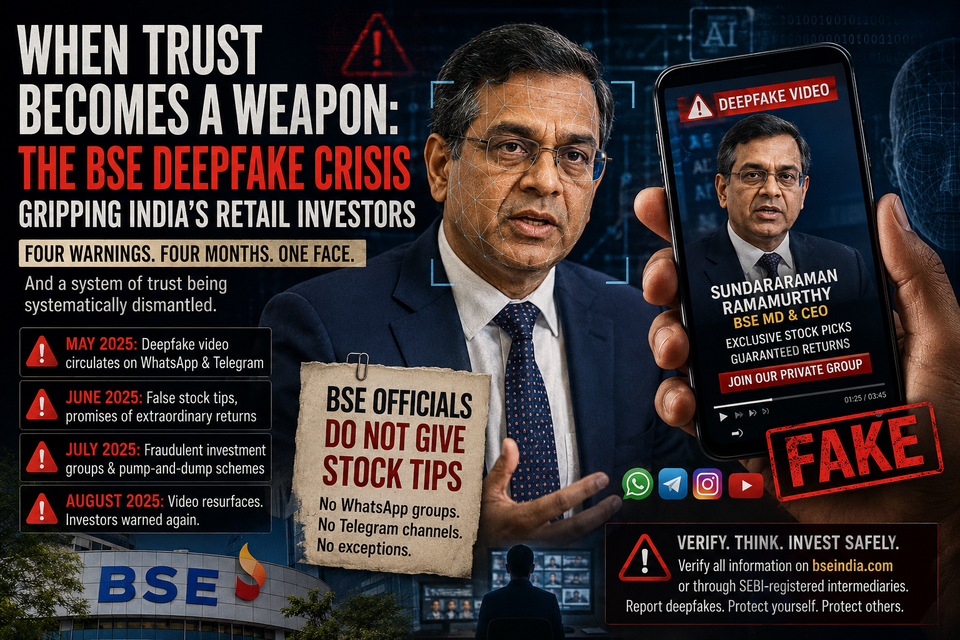
Four warnings. Four months. One face. And a system of trust being systematically dismantled.
India's oldest stock exchange has found itself fighting an unprecedented battle — not against market manipulation in the traditional sense, but against a far more insidious adversary: artificial intelligence weaponised to steal the credibility of the institution itself.
The Pattern That Should Alarm Everyone
BSE Limited has now issued four separate public warnings in four months, each time alerting investors to a fraudulent deepfake video circulating on social media and messaging platforms like WhatsApp and Telegram. Each video falsely depicts its Managing Director and CEO, Sundararaman Ramamurthy, appearing to offer stock market tips, promise extraordinary returns, and invite viewers to join private investment groups.
Each time, BSE has had to issue a clarification, file complaints with law enforcement, and pressure platforms to take the content down. And each time, the video resurfaces.
Four times. Four months. The same face. The same fraud.
This Isn't Just "Deepfake Fraud" — It's an Assault on Institutional Trust
Calling this a deepfake scam understates what is actually happening. BSE is not merely a brand being misused — it is the backbone of Indian retail investing. It has spent decades building itself into an institution that crores of ordinary Indians trust with their savings and financial futures.
When fraudsters use Ramamurthy's face and voice to push fake stock tips, they are not just committing fraud. They are directly exploiting the credibility that BSE has painstakingly built — and turning it against the very investors the exchange exists to protect.
Consider who falls victim to these videos: not sophisticated algorithmic traders with compliance teams, but a retired schoolteacher in Nagpur, a salaried employee in Pune, a homemaker in Coimbatore — people who trust their eyes, and who have been conditioned to believe that a recommendation from an exchange official carries authority.
That trust is the real target. And it is being hit, repeatedly, with precision.
The Anatomy of the Scam
The mechanics are straightforward, which is precisely what makes them dangerous:
- A convincing deepfake video of Ramamurthy is generated using widely available AI tools.
- The video is seeded across WhatsApp groups, Instagram, YouTube, and Telegram — platforms with massive reach into India's retail investor base.
- The fabricated Ramamurthy recommends specific stocks, promises guaranteed or extraordinary returns, and urges viewers to join private groups for "exclusive tips."
- Victims who join these groups are then funnelled into pump-and-dump schemes, fraudulent investment platforms, or direct scams.
BSE has been categorical: neither Ramamurthy nor any BSE official provides stock tips, investment recommendations, or operates any WhatsApp or Telegram group. Any video, message, or channel claiming otherwise is fraudulent.
The Broader Threat Landscape
This crisis at BSE is not an isolated incident — it is a symptom of a global epidemic.
According to the Sumsub 2025–2026 Identity Fraud Report, deepfakes are now used in 11% of all first-party fraud cases. Deepfake usage has reportedly increased nearly 3,000% over just two years. The cost of creating a convincing deepfake video has collapsed from tens of thousands of dollars to near zero, thanks to the democratisation of AI tools.
Karim Toubba, CEO of LastPass, was targeted in a similar deepfake impersonation attempt in 2024, when an employee received a fraudulent WhatsApp audio clip mimicking his voice. The attack only failed because the employee noticed the unusual communication channel.
India's retail investors — many of whom are first-generation participants in the stock market — do not yet have that same institutional suspicion. They are precisely the audience that fraudsters are targeting.
What BSE Is Doing — And Why It Isn't Enough
BSE has not been passive. The exchange has:
- Filed complaints with law enforcement agencies after each incident
- Worked with social media platforms to have videos removed
- Issued repeated public advisories urging investors to verify information through official channels and SEBI-registered intermediaries
- Launched nationwide investor awareness campaigns in coordination with SEBI on the threat of fake finfluencers and fraudulent investment advice
- Promised strict legal proceedings against those responsible
But the structural problem persists. Taking down a video after it has circulated for days across thousands of WhatsApp groups does not undo the harm. By the time BSE issues a clarification, the video has often already reached its intended victims.
The reactive model — warn, take down, repeat — is losing the race against a technology that can generate and redistribute content faster than any institution can respond.
The Regulatory and Platform Accountability Question
This crisis raises uncomfortable questions that go beyond BSE.
For social media platforms: Why does it take formal complaints from a major financial institution for deepfake fraud videos to be removed? Where is the proactive detection? India has over 500 million social media users. The infrastructure to detect AI-generated financial misinformation at scale is not optional — it is urgent.
For SEBI: India's markets regulator has been active on the finfluencer front, but deepfake impersonation of exchange officials represents a qualitatively different threat. Regulatory frameworks that govern financial advertising and advice were not designed for a world where anyone can fabricate a video of the BSE CEO in minutes.
For AI developers: The tools that make these deepfakes possible are commercially available and often free. The industry's self-regulatory commitments on preventing misuse are being tested in real time — and found wanting.
What Investors Must Do Right Now
Until systemic solutions are in place, the burden of protection falls — unfairly, but unavoidably — on individual investors. Here is what you need to know:
- BSE officials do not give stock tips. If any video, WhatsApp message, or social media post shows a BSE official recommending stocks, it is fake. No exceptions.
- No exchange official operates private WhatsApp or Telegram groups. Any such group claiming BSE affiliation is a scam.
- Verify all investment information through official BSE channels at bseindia.com or through SEBI-registered intermediaries only.
- Do not forward suspicious videos — even to warn others. Forwarding increases reach and legitimises distribution.
- Report deepfake content to the platform and to the Cyber Crime portal at cybercrime.gov.in.
- If you have lost money to such a scam, file a complaint immediately with your local police and SEBI's SCORES platform.
The Deeper Shift We Must Acknowledge
For three decades, the evolution of digital attacks followed a predictable arc: technical exploits gave way to phishing, which gave way to social engineering. Each generation required attackers to find a gap in a system.
The deepfake era is different. It requires no gap. The attacker does not need to breach your firewall, intercept your data, or compromise your account. They only need to make their content look credible enough that you believe it.
Trust — institutional, interpersonal, perceptual — is now the attack surface. And it is wide open.
The BSE deepfake crisis is not just a financial crime story. It is a signal of what happens when AI tools that were built without adequate safeguards collide with societies that are being asked to place unprecedented faith in digital information.
Four warnings in four months should not be necessary. That they are tells us something important: the problem is no longer on the horizon. It is here.
Investors with concerns or queries can visit the official BSE website at bseindia.com or contact SEBI's investor helpline at 1800 22 7575. Cybercrime complaints can be filed at cybercrime.gov.in.
Member discussion