
The Digital Front Line: Taiwan's Intelligence Gambit, China's Cyber Army, and What It All Means for Security in the South China Sea
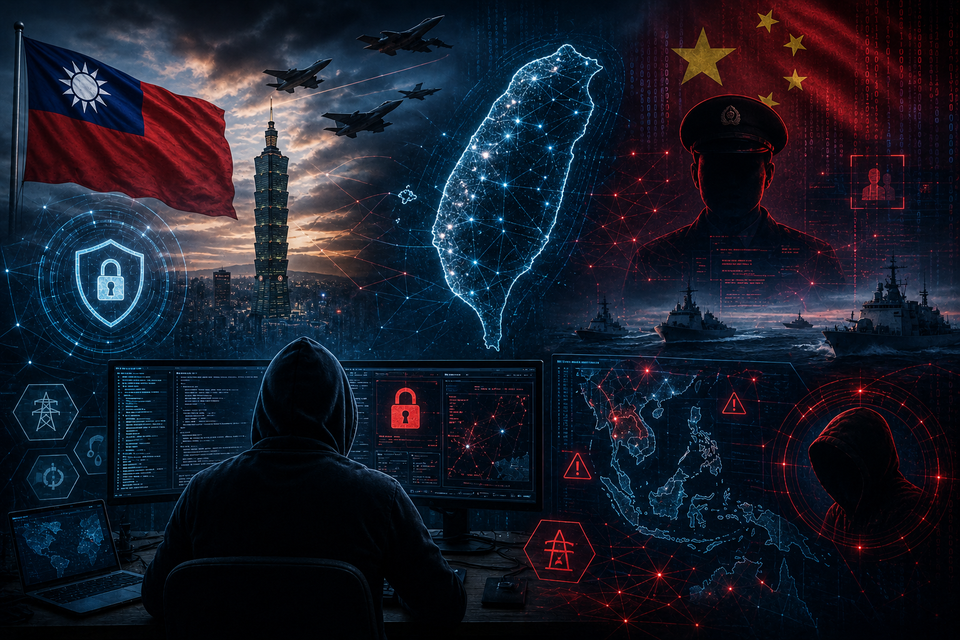
On 15 June 2026, Taiwan's National Security Bureau quietly opened a new front in one of the world's most consequential strategic competitions. The launch of an online intelligence-reporting platform — inviting Chinese citizens to submit information through a secure digital channel — was simultaneously a tactical intelligence operation, a psychological signal to Beijing, and a symbol of how thoroughly the Taiwan Strait conflict has migrated into the digital domain.
The platform itself is only the most visible recent development in a multi-layered cyber contest that now touches every country with a stake in the Indo-Pacific's most disputed waters. To understand what Taiwan's initiative means, it must be read not in isolation, but against the full architecture of Chinese cyber operations, the cascading vulnerability of South China Sea claimant states, and the infrastructure risks that could reshape the entire region's digital sovereignty in a crisis.
Taiwan's Intelligence Platform: Reading the Signal Correctly
Taiwan's NSB said the platform was created in response to a growing number of Chinese nationals who had recently approached Taiwanese authorities seeking to share information. The agency cited China's slowing economy, tighter political controls, and mounting social challenges as factors contributing to public dissatisfaction that is encouraging some individuals to reach out.
The campaign follows the CIA's Mandarin-language initiative encouraging disillusioned Chinese officials to share information, and Taiwan's website features an AI-generated promotional video portraying a Chinese civil servant witnessing what appears to be misconduct and deciding to contact Taiwan — ending with the declaration, "Now is the time to change." Taiwan's website is reportedly blocked inside China, although many Chinese internet users access restricted foreign websites through VPNs.
Read purely as an intelligence-gathering instrument, the platform is rational: crowdsourced intelligence from disaffected Chinese civil servants, military personnel, or state enterprise employees has historically been a rich source. Analysts note that online intelligence platforms provide governments with a scalable and low-cost method of collecting information without relying exclusively on traditional espionage networks.
But the platform is also a document of strategic intent that Beijing will read very carefully. It signals that Taiwan has concluded it can operate openly in the cognitive and digital space, competing directly with China for the loyalty — or at least the defection — of Chinese nationals. Taiwan's NSB Director-General has described China's infiltration of Taiwan as systematic, integrating national security, intelligence operations, and "united front" work into a dense network — planned, with specific networks screening targets, and increasingly targeted toward lower-ranking military personnel at the grassroots level. The new platform is, in part, Taiwan's attempt to mirror that architecture in reverse.
China's response was predictable. It launched its own intelligence-reporting system in 2024 encouraging citizens to report activities linked to what Beijing characterises as Taiwan independence. The two platforms now face each other across the strait — a digital intelligence duel superimposed on the military confrontation.
2.63 Million Attacks Per Day: The Scale of China's Cyber Campaign Against Taiwan
The intelligence platform is Taiwan's most recent public initiative. But the most consequential numbers are the ones published earlier this year by the NSB's own annual threat assessment.
China's cyber army launched 2.63 million intrusion attempts against Taiwan's critical infrastructure every day in 2025 — a 6% increase from 2024. Most alarming was that attacks on critical energy infrastructure increased by a factor of ten compared to the previous year. This is not a hacking campaign. It is the most sustained cyber operation in history against a single target — the digital equivalent of a permanent siege.
Taiwan's NSB described China's cyber tactics as organised through the PLA and national security and police agencies, which have together created a coordinated "cyber army" also drawing on the Chinese public, combining covert infiltration with political manipulation to conduct psychological operations aimed at undermining Taiwanese public faith in the government. Officials characterised these efforts as a "state-level" strategy involving the PLA, the Ministry of State Security, and the Public Security Bureau — employing a mix of military, civilian, and private-sector hackers to conduct espionage, manipulate online discourse, and steal sensitive information.
In the first nine months of 2025 alone, 24 individuals were indicted for involvement in espionage, including 13 retired and incumbent military officers. Most cases involved former officers who attempted to persuade active duty colleagues to collect and hand over classified information.
Chinese influence operators have used AI-generated memes and videos to amplify false narratives about sensitive issues including tariff negotiations with Washington and domestic energy policies. The NSB said these efforts are part of a coordinated strategy to shape public perception ahead of Taiwan's 2026 local elections. China has been using IT and marketing companies to create fake news sites, manage accounts, and collect and spread misinformation as part of a systematic cognitive warfare campaign against Taiwan.
The Typhoon Ecosystem: China's Cyber Arsenal in the Indo-Pacific
To understand what Taiwan and its regional neighbours face, the specific threat actors involved must be named and understood. China operates what analysts have described as a "specialised ecosystem" of Advanced Persistent Threat groups — each with distinct targeting mandates, techniques, and strategic roles in the Indo-Pacific theatre.
Volt Typhoon is the most strategically significant. Active since at least 2021 and affiliated with the PLA, Volt Typhoon focuses on espionage, data theft, and credential access, targeting critical infrastructure sectors including communications, manufacturing, utilities, transportation, maritime, government, and education. CISA issued a supplementary advisory in February 2026 noting that Volt Typhoon activity had intensified since mid-2025, with new indicators of compromise identified in the water and communications sectors, and characterised the heightened activity as consistent with "pre-conflict positioning." The group is not hacking for intelligence — it is pre-positioning for disruption in the event of a Taiwan conflict, embedding access in the infrastructure that would matter most to US and allied responses.
Salt Typhoon has been the telecommunications specialist. Investigators traced Salt Typhoon intrusions to Chinese state infrastructure connected to the Ministry of State Security. The group targeted global telecom providers, obtaining call records, subscriber data, and in some cases access to surveillance-related systems. On October 19, 2025, Salt Typhoon was detected attempting to infiltrate another European telecommunications provider. In Asia, Mustang Panda has focused particularly on telecom providers in Taiwan and other countries of Chinese strategic interest, with goals centred on creating "persistence" inside carrier infrastructure.
Flax Typhoon operates through IoT botnets. Flax Typhoon maintained persistent access across telecom networks in Indonesia, Malaysia, and the Philippines through IoT device exploitation. Meanwhile, Mustang Panda (also tracked as Earth Baxia) used phishing lures and PlugX malware to exfiltrate sensitive data from governments across Southeast Asia, particularly targeting issues tied to South China Sea disputes.
APT40 has specifically targeted maritime infrastructure. APT40/Leviathan conducted extensive operations against port authorities and maritime communication networks in Malaysia and other ASEAN members, testing techniques to compromise operational technology in the South China Sea region. These campaigns established clear precursors to Volt Typhoon's later focus on ports and maritime logistics.
The pattern is deliberate: Southeast Asia served as China's cyber testing ground for over a decade. Techniques refined against Malaysian port systems, Vietnamese airport networks, and Philippine government servers were subsequently deployed against harder targets in the United States and Europe.
The South China Sea as Cybersecurity Theatre
The connection between physical territorial confrontation in the South China Sea and cyber operations is not metaphorical — it is operational and documented.
Among South China Sea claimant countries, the Philippines and Vietnam face the most intensive Chinese cyberattacks, directly correlated with the strong positions they have taken in asserting their sovereignty. The Philippine cyberattack surge of 325% in early 2024 coincided precisely with the peak of maritime confrontations at Second Thomas Shoal and Scarborough Shoal. The methods consisted of data breaches (55%), misinformation campaigns (35%), and DDoS attacks (10%).
South China Sea tensions have tightly linked maritime disputes with cyber operations in the Philippines, driving state-sponsored espionage, infrastructure targeting, and digital disruption. Chinese APT activity increasingly aligns with real-world incidents, focusing on government, military, telecom, and maritime sectors, while risks such as GPS interference and undersea cable exposure elevate national resilience concerns.
The undersea cable dimension is particularly alarming. As of 2024, more than 500 active and planned submarine cable systems span the globe. The Asia-Pacific is a major hub in this network, with systems like the Southeast Asia–Japan Cable extending over 10,500 kilometres connecting Japan, Singapore, South Korea, and Taiwan. Landing stations, where cables converge, are significant vulnerabilities. Many undersea cables connecting the Philippines to the global internet are owned in part by state-owned Chinese telecommunications companies — a major concern as South China Sea tensions rise, as China may leverage control over cables should conflict arise, leading to heavy surveillance or restricted internet access.
History offers a clear precedent: when Vietnam expressed disapproval of China's South China Sea position, Chinese investors froze cash flows to infrastructure projects. Chinese hackers also exploited their knowledge of Vietnam's airport systems — provided by Chinese contractors — to hack and suspend airport computers and airline websites during a period of diplomatic tension. What was done to Vietnam's airports in a relatively minor confrontation provides a template for what a serious crisis could mean for regional digital infrastructure.
The "Day One" Problem and What It Means
Southeast Asia served as China's cyber incubator. Techniques tested in the region — router exploitation, lawful intercept compromise, edge device infiltration — reappeared in more sophisticated form in later campaigns targeting the United States and Europe. Analysts now use the term "Day One" to describe the scenario cybersecurity planners most fear: the moment a Taiwan Strait crisis crosses from grey-zone competition into open conflict, and China activates the pre-positioned access its Typhoon groups have been accumulating for years.
In the context of elevated US-China tensions following geopolitical frictions and semiconductor export restrictions, the question of what these groups are positioned to do is no longer theoretical. Volt Typhoon embedded inside US energy and water systems, Salt Typhoon with persistent access inside global telecom providers, APT40 with knowledge of maritime port infrastructure across Southeast Asia — these groups do not need to initiate new intrusions on Day One. They are already inside.
For regional states in the South China Sea — the Philippines, Vietnam, Malaysia, and the others — this means that a Taiwan Strait conflict would not remain a distant spectacle. Their communications networks, undersea cables, government systems, and maritime coordination infrastructure would be simultaneously at risk, used as leverage, or actively disrupted as part of a Chinese strategy to prevent or complicate allied responses. The cyber and the kinetic are one integrated campaign.
Taiwan's Position: Resilience Under Unprecedented Pressure
Taiwan has responded to this pressure with a combination of defensive investment, offensive intelligence, and alliance deepening. Taiwan's 2026 defence budget was approved at approximately USD $30 billion — around 3.32% of GDP using broader accounting — reflecting sustained commitment to military and intelligence investment. The NSB, the Military Intelligence Bureau, and the Ministry of Justice Investigation Bureau constitute an intelligence community that has, despite the scale of the Chinese campaign, demonstrated the institutional capacity to detect, prosecute, and publicly expose Chinese operations.
The new intelligence platform fits within a broader doctrine: that Taiwan's security cannot be secured by defence alone, and that expanding the information asymmetry — knowing more about what China is planning, who inside China is dissatisfied, and what the PLA is preparing — is as important as hardening physical defences.
With nationwide local government elections coming in 2026, the NSB has assessed that the CCP is likely to intensify cognitive warfare operations targeting Taiwanese public confidence. The platform launch is partly a pre-emptive move — recruiting sources who might illuminate Chinese influence operation tactics before they reach full deployment.
What It Means: Five Implications for Regional Cybersecurity
The convergence of Taiwan's intelligence initiative, China's 2.63-million-daily-attack tempo, and the expanding Typhoon ecosystem in Southeast Asia carries five clear implications for the cybersecurity posture of every state in the region.
First, the grey zone is digital. Physical confrontations at Second Thomas Shoal and median line crossings over Taiwan are calibrated, deniable, and constrained by escalation risk. Cyber operations are not. They are continuous, deniable by design, and already operating at a scale that in any earlier strategic context would constitute an act of war. The grey zone that enables Beijing to pressure its neighbours without triggering formal conflict is, increasingly, a digital grey zone.
Second, telecommunications infrastructure is the new front line. Salt Typhoon's campaign establishing persistence inside global carrier networks represents a new strategic doctrine: control the communications infrastructure, and you control the information environment in a crisis. For regional states with Chinese-linked telecommunications infrastructure, this is not a future risk — it is a current vulnerability.
Third, disinformation and cyber operations are integrated. China employs a mix of military, civilian, and private-sector actors to conduct espionage, manipulate online discourse, and steal sensitive information simultaneously. The data stolen from Philippine government agencies and the disinformation campaigns targeting Taiwanese elections are not separate programmes — they are coordinated elements of a single information warfare strategy designed to weaken adversaries without firing a shot.
Fourth, undersea cables are a chokepoint. The concentration of cable infrastructure that passes through South China Sea waters, much of it with Chinese participation in ownership or maintenance, creates a structural vulnerability that military spending cannot address. Diversification of cable routes, development of alternative paths through allied-controlled territory, and hardened landing station security are strategic imperatives that have not yet received commensurate investment.
Fifth, Taiwan's intelligence gambit raises the stakes. By publicly launching a platform to recruit Chinese informants and framing it explicitly as a response to Chinese espionage, Taiwan has made the intelligence competition visible and adversarial in a new way. This escalation is deliberate — Taipei is signalling that it will not remain passive in the information domain. Beijing's response is predictable: intensified counter-intelligence operations, tighter digital controls within China to prevent citizens from accessing the platform, and likely an escalation of its own cognitive warfare operations against Taiwan ahead of the 2026 local elections.
The Broader Warning
The 32 Chinese aircraft detected near Taiwan on June 13, the confrontations at Scarborough Shoal, and the competing intelligence platforms are not separate stories. They are different expressions of the same strategic contest — a contest that has found its most consistent, scalable, and deniable expression in cyberspace.
For the Philippines, Vietnam, Japan, and every other state operating in the shadow of Chinese power in the Indo-Pacific, Taiwan's situation is not a distant warning. It is a near-term preview. The cyber operations, influence campaigns, infrastructure penetrations, and intelligence operations that China is running against Taiwan today were developed and tested in Southeast Asia yesterday. What happens in the Taiwan Strait does not stay in the Taiwan Strait.
The question for every government in the region is not whether they will face this threat. It is whether they will be ready when the 2.63 million daily attempts become 26 million — or when the pre-positioned access that Volt Typhoon has spent years accumulating is finally activated.
Member discussion