
The Synthetic Authority Playbook: How Deepfake 'Aid' Scams Industrialised Fraud in India
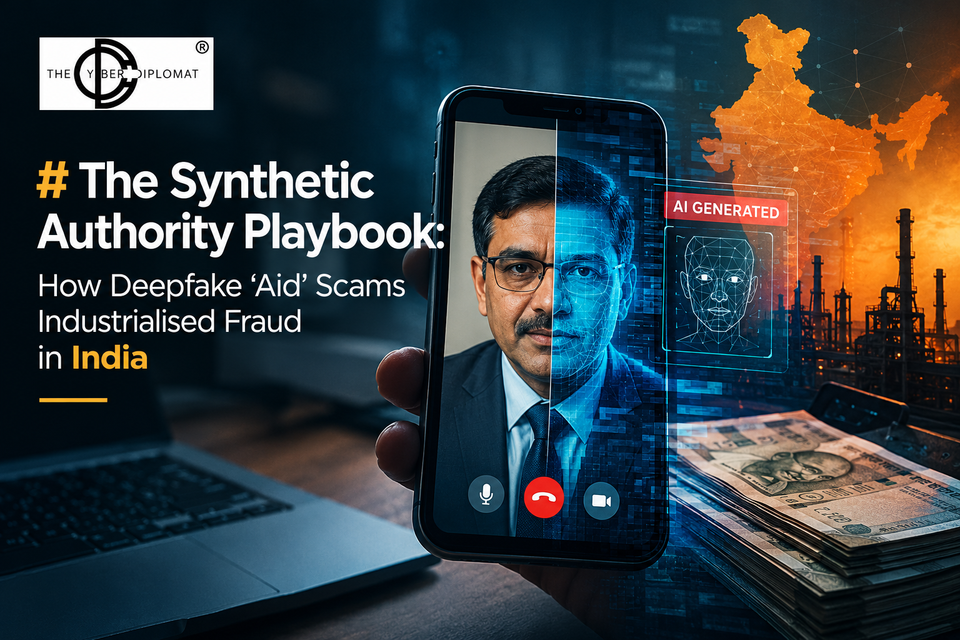
Indian fraud has moved from impersonating people to impersonating the state. The new playbook does not pretend to be your bank or your nephew. It borrows the face and voice of a minister, buys reach on social media, and walks the victim through a process that looks like government paperwork until the moment money leaves the account.
The scale behind this shift is no longer marginal. I4C data compiled from the National Cyber Crime Reporting Portal puts reported losses in 2025 at about ₹19,813 crore across roughly 21.8 lakh complaints, with 77% of it lost to schemes sold as investments (IANS). I4C's own projection for total 2025 cyber-fraud losses was around ₹1.2 lakh crore, roughly 0.7% of GDP (63SATS).
What follows reads the five-step "synthetic authority" chain as a supply chain: each step has its own enabler, its own failure point, and its own owner who could break it. The argument is simple. No single step is new. What is new is that generative AI has made step one nearly free, and the other four were already industrialised and waiting for it.
1. Persona cloning: the state as a costume
The first step turns real official footage into a synthetic announcement. A genuine speech supplies the face, setting and cadence; lip-sync models and voice cloning supply new words. The output looks like a broadcast because, for most of its frames, it was one.
The pattern is now routine rather than exceptional:
- July 2025: PIB Fact Check flagged a deepfake of the Prime Minister promoting a platform that promised ₹1.25 lakh a day on a ₹21,000 deposit (Storyboard18).
- August 2025: several Facebook clips of Finance Minister Nirmala Sitharaman pushed returns of up to 100x a month (Storyboard18).
- April 2026: another Sitharaman deepfake claimed ₹22,000 would become ₹5.5 lakh in a week; PIB debunked it on 16 April (AI Incident Database).
- September 2026: PIB's Fact Check Unit refuted AI-generated videos of the Prime Minister describing government schemes, and warned people off "registration forms" attached to them (News On AIR).
Two things stand out. First, the entry ticket is almost always the same odd figure, ₹21,000 or ₹22,000, which suggests shared scripts and templates across operators rather than isolated actors. Second, the September 2026 case marks a drift in the pitch: from "invest and multiply" towards "the government is giving you money, register here." That is the variant the five-step chart describes, and it is more dangerous. An investment pitch asks the victim to be greedy. A grant pitch only asks them to be eligible.
The choice of persona is deliberate. Apex leaders are the most filmed people in the country, so training material is abundant. Their authority also short-circuits scepticism: few citizens feel entitled to doubt a welfare announcement from the Finance Minister.
2. Paid ad placement: buying reach, renting legitimacy
A deepfake that nobody sees is harmless. Step two pays to put it in front of the right people, and this is where the economics of the chain become visible.
The mechanics rely on cloaking: the ad's landing link shows a harmless page to the platform's automated reviewer and the scam page to everyone else, often switched by location, device or referrer. Meta itself has said it upgraded detection of cloaked scam ads because the technique had hindered its internal review (Engadget).
The harder question is incentive. Internal Meta documents reviewed by Reuters in November 2025 estimated that roughly 10% of 2024 revenue, about $16 billion, came from scam ads and banned goods (Storyboard18). The same reporting said users across Meta's apps see an estimated 15 billion "high-risk" scam ads a day, and that people who click one are shown more because of ad personalisation (via Reuters coverage). A December 2025 Reuters follow-up described an internal "playbook" of clearing the specific searches regulators run, later applied in India among other markets (Communicate). Meta disputes these characterisations and points to large-scale removals.
Whatever one concludes about intent, the structural point holds. Ad personalisation is a targeting engine, and it does not distinguish a legitimate lender looking for borrowers from a scammer looking for the credulous. Once a victim engages, the system learns to find more people like them. Review that is reactive and keyword-driven will always lag operators who rotate creatives, accounts and domains daily.
3. Direct contact: moving the victim off-platform
The ad's real job is to hand the victim over. Clicks are routed to a look-alike "scheme portal" with a registration form, or to a WhatsApp number answered by someone posing as a government office. From here the fraud stops being content and becomes a conversation, which no ad reviewer will ever see.
The call leg often runs across borders. As early as March 2024 the Department of Telecommunications warned citizens about WhatsApp calls from foreign numbers such as +92 (Pakistan's country code) in which callers impersonated government officials to extract personal data (AIR). The +92 prefix is one visible corridor among several: CFCFRMS data cited for 2025 attributed 45% of cyber-fraud complaints to Southeast Asian origins, chiefly Cambodia, Myanmar and Laos (IANS).
The off-shoring matters for two reasons. Indian telecom controls such as caller identification and spam filtering apply to the domestic network, not to an over-the-top VoIP call into an encrypted messenger. And enforcement against callers abroad depends on cross-border cooperation that is slow at best and absent at worst. A foreign number should be a red flag, yet many victims read it the other way: they assume an "official" helpline can be anywhere.
The portal leg has its own trick. A fake page can borrow the national emblem, a .in look-alike domain and a familiar scheme name. Because the victim arrived from what they believe was an official video, the portal only needs to look consistent, not authentic.
4. Fees and identity capture: the escalating ladder
Step four is the oldest trick in the chain, the advance-fee fraud, dressed in bureaucratic language. The grant is approved, but first comes a "registration" fee, then "tax", then "clearance". Each payment is small relative to the promised benefit, and each one raises the victim's sunk cost, which makes the next payment more likely, not less.
The official vocabulary is the engine. Indian citizens are used to paying stamp duty, processing fees and GST before receiving something from the state. A fraudster who demands "TDS before disbursal" is exploiting real administrative experience, not ignorance.
Running in parallel is identity capture. Applicants are asked for Aadhaar and PAN details, photographs and bank information, framed as KYC for the grant. This is arguably the more durable harm. Money lost in step four is a one-time loss; a harvested identity kit can be reused to open accounts, take loans or, crucially, to supply the next step. Stolen and rented identities are a common raw material for the mule accounts that launder fraud proceeds.
PIB's September 2026 warning specifically told citizens not to share personal or financial details through suspicious registration forms (AIR). That the government now bundles the deepfake warning with a data-sharing warning shows how tightly the two steps are coupled.
5. Reverse payment: the PIN that sends instead of receives
The final step exploits a single misunderstanding: that entering a UPI PIN is how you receive money. A UPI collect request is a pull. The requester asks, the payer approves with their PIN, and money leaves the payer's account. Framed as "approve to receive your grant", it inverts the victim's mental model at the exact moment it matters.
Regulators have acted on this. NPCI's circular of 29 July 2025 barred person-to-person collect requests on UPI from 1 October 2025, so all P2P payments must now be payer-initiated (The Week/PTI). NPCI had capped such pulls at ₹2,000 back in 2019, but fraud continued.
The fix is real but partial. Merchant collect requests remain allowed, since e-commerce checkouts depend on them (Eastern Mirror). An operator who registers a merchant handle, or who simply sends a QR code and calls it a "verification scan", reproduces the same inversion. The chart's label, "collect reverse-PIN deception", describes a behaviour, not a feature, and behaviours survive feature removals.
Once money moves, it moves fast. Funds are dispersed through chains of mule accounts within minutes, and around three of every four rupees lost to cyber fraud in India is never recovered (Moneylife). The Centre froze about 4.5 lakh mule accounts in a single year, concentrated in large public-sector banks (Business Standard), and the RBI's innovation hub has built MuleHunter.AI to flag them from transaction patterns (IASGyan).
Analysis: a chain with five owners and no single defender
The synthetic authority fraud works because every step is owned by a different institution, and each one defends only its own link. The fact-checker debunks the video, the platform removes the ad, the telecom regulator warns about +92 calls, NPCI removes a payment feature, and the bank freezes mules. Each action is correct. None of them sees the whole chain.
Step | What the fraud depends on | Who can break it | Response so far | Gap that remains |
|---|---|---|---|---|
1. Persona cloning | Abundant footage of leaders; cheap lip-sync and voice models | Government communications, AI developers | PIB Fact Check debunks, case by case | Debunks follow virality; no provenance signal on genuine official video |
2. Paid ad placement | Self-serve ads, cloaking, interest targeting | Ad platforms, MeitY | Reactive takedowns, celebrity face-matching | No mandatory advertiser verification for finance or government-themed ads |
3. Direct contact | Encrypted VoIP from abroad; look-alike portals | DoT, messaging apps, domain registrars | Advisories, Sanchar Saathi Chakshu reporting | Over-the-top calls sit outside domestic caller ID |
4. Fees and identity capture | Familiarity with official fees; KYC habits | UIDAI, banks, citizens | Public warnings not to share documents | Leaked IDs keep feeding mule account creation |
5. Reverse payment | PIN confusion; mule accounts | NPCI, banks, RBI | P2P collect ended Oct 2025; mule freezes; MuleHunter.AI | Merchant collect and QR routes remain; recovery rates low |
Three conclusions follow from reading the chain as a whole.
The cheapest step is now the first. Before generative AI, a convincing official endorsement was the expensive, risky part. It is now close to free, while steps two to five were already mature from earlier waves of investment and digital-arrest scams. Deepfakes did not invent this fraud; they removed its bottleneck.
Steps two and five are the leverage points. Ad distribution is the only step where the fraud must pass through a small number of companies with full visibility and a payment trail. The payment rail is the only step where money is concentrated before it scatters. Interventions at the ends of the chain, debunking videos or warning citizens, are necessary but work at the scale of individual cases. Interventions at these two choke points work at the scale of the operation.
Fixes shift the fraud sideways. Ending P2P collect requests did not end reverse-payment fraud; it pushed it towards merchant handles and QR codes. Removing one ad does not stop an advertiser who can open ten accounts. Defence that targets features will keep losing to attackers who target behaviours.
What would a joined-up response look like? Verified-advertiser requirements for any ad that invokes a government scheme or official. Cryptographic provenance on genuine official video, so platforms can check authenticity rather than guess at fakery. A shared signal between platforms, telecoms and banks so that a reported ad, phone number and receiving account are linked as one case. And a citizen-facing rule simple enough to survive a convincing video: the government never asks for a fee, and you never enter your PIN to receive money.
Conclusion
Synthetic authority fraud is less a new crime than a new assembly of old ones: celebrity-bait advertising, foreign call centres, advance-fee ladders and payment-reversal tricks, now fronted by a face citizens are conditioned to trust. Its strength is that it borrows the credibility of the state at the top of the funnel and the speed of Indian digital payments at the bottom.
The defence has to be assembled the same way. Until the platforms that sell reach and the rails that move money are treated as joint owners of the problem, each institution will keep winning its own skirmish while the chain as a whole keeps working.
Sources
- AI Incident Database: Incident 1454, Sitharaman deepfake (Apr 2026)
- Storyboard18: PIB flags deepfake of PM endorsing ₹1.25 lakh/day scheme
- Storyboard18: PIB flags fake videos of FM endorsing fraudulent platforms
- News On AIR: Govt refutes AI-generated videos of PM on government schemes (Sep 2026)
- Storyboard18: Meta reportedly earns $16 billion from scam ads
- Communicate: Meta devised playbook to delay action against scam ads
- Engadget: Meta sues advertisers over celeb-bait scams
- News On AIR: DoT advisory on +92 WhatsApp calls (Mar 2024)
- The Week/PTI: NPCI to stop UPI P2P collect requests
- Eastern Mirror: Merchant collect requests continue
- IANS: Indians lose ₹52,976 crore to cyber frauds over six years
- 63SATS: I4C loss projection for 2025
- Moneylife: Recovery rates and mule dispersal
- Business Standard: Centre freezes 4.5 lakh mule accounts
- IASGyan: Mule accounts and MuleHunter.AI
Member discussion