
The Weakest Link in Your Supply Chain Might Be Invisible — And That's the Problem
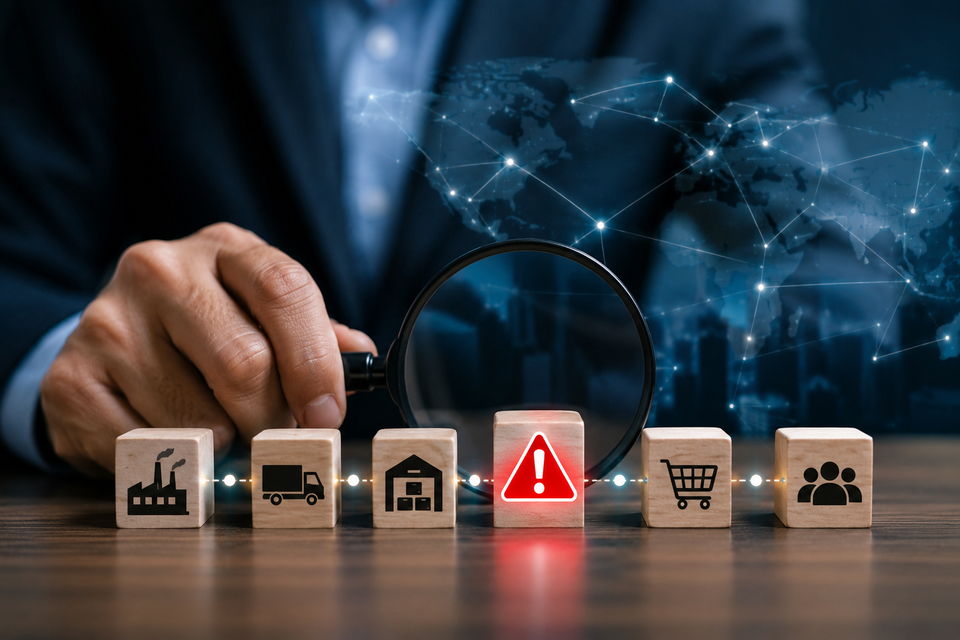
Picture the last piece of tech you bought. A phone, a Wi-Fi router, maybe a smart thermostat. Now ask: where was it actually made?
Not "assembled" — made. The chip inside might have been designed in one country, fabricated in another, the firmware written by a contractor somewhere else, and the whole thing bolted together in a fourth location before it ever got a brand name slapped on the box.
That's not an unusual supply chain. That's basically every piece of connected technology today. And it's created a security problem that most of us never think about: by the time a product reaches you, dozens of companies you've never heard of have already touched it. Any one of them could have introduced a flaw — accidentally, or on purpose.
Welcome to supply chain cybersecurity, one of those topics that sounds boring until you realize it's already caused blackouts, corporate espionage, and a genuine reshaping of global trade.
It's Not an IT Problem. It's a "Who Do You Trust" Problem.
Here's the uncomfortable truth: your company's cybersecurity is only as strong as the least secure vendor in your supply chain. Attackers know this. Instead of trying to breach a well-defended company head-on, they'll find the tiny, underfunded supplier three steps removed — the one still using outdated software because nobody budgeted for an upgrade — and use it as a side door.
This isn't theoretical. In 2015, attackers used a supply chain compromise to cut power to homes across Ukraine — the first confirmed cyberattack to take down an electric grid. A similar pattern hit Saudi Aramco in 2017. In another case, a group calling itself Dragonfly slipped malware into pharmaceutical and industrial companies across Europe and North America by quietly tampering with code on a supplier's website — turning a routine software update into an infection vector.
Notice what these all have in common: none of them started with the target. They started somewhere upstream, in a link nobody was watching closely.
Two Kinds of "Broken"
When something goes wrong in a supply chain, it's usually one of two things:
- Unintended taint — an honest mistake. A bug, a design flaw, nobody's fault in particular.
- Malicious taint — deliberate. Someone put it there on purpose.
The scary part is that malicious taint is built to look like unintended taint. A backdoor doesn't announce itself. It just sits there, indistinguishable from a bug, until someone uses it.
Then Geopolitics Showed Up
Here's where the story stops being just a corporate risk-management issue and turns into something bigger.
For years, globalization pushed companies to spread production everywhere — design here, manufacture there, assemble somewhere else, all in the name of efficiency. Cybersecurity risk is now pushing back the other way. Governments are starting to think: if we can't fully secure a supply chain that spans ten countries, maybe we shouldn't let it span ten countries.
China's 2017 Cybersecurity Law is the textbook example. It requires companies to store certain data inside China, hand over source code for government review, and prove their products are "secure, controllable, and transparent" — a phrase that's never been precisely defined but is widely read as: domestic technology and government-accessible systems get preference. Apple, for instance, ended up moving Chinese users' iCloud data to a data center run by a Beijing-based company. That's not a hypothetical policy effect — that's a real, tangible shift in how a trillion-dollar company operates, triggered by one country's cybersecurity law.
And other countries have noticed. Some are following the same playbook: trading the efficiency of a globalized supply chain for tighter national control over data and technology.
So Who's in Charge of Fixing This?
You'd hope some international body has this covered. Mostly, none does.
- The World Trade Organization deals with tariffs and trade harmonization — no cyber-specific supply chain standard.
- The World Customs Organization built security frameworks after 9/11 — aimed at smuggling and physical security, not firmware and embedded software.
- The World Intellectual Property Organization protects IP on paper — but has zero enforcement power when that IP gets stolen through cyber-espionage instead of conventional theft.
Three organizations, each holding a puzzle piece, none holding the whole picture. Which means the actual work of catching problems falls almost entirely to individual countries — with individual laws, individual standards, and very little coordination between them.
The Part Nobody Talks About: Money
There's a quieter thread running through all of this. As lower-cost manufacturing and labor shift to countries with cheaper wages, those same countries often have less mature cybersecurity regulation and fewer resources to enforce it. Cheaper labor plus lighter oversight is exactly the combination that creates blind spots — and it means the "weakest link" in a global supply chain often maps disturbingly well onto the same wage gaps driving where production happens in the first place.
What Would Actually Move the Needle
A few things come up again and again when people who study this seriously talk about fixes:
- Basic visibility first. A lot of companies genuinely don't know who their suppliers' suppliers are. You can't secure what you can't see.
- Standards that fit the sector. A pharmaceutical supply chain and a power grid fail in completely different ways — one-size-fits-all cybersecurity rules miss what matters.
- Protect the small players, not just the big ones. Since attackers go after the weakest link, raising the security floor for small vendors does more good than hardening the giants even further.
- International rules built for right now, not trade agreements written for a pre-internet economy and awkwardly stretched to cover it.
- Honesty about what "security laws" are really doing. When a cybersecurity law conveniently also boosts domestic industry, trading partners deserve to know which part is which.
The Bottom Line
Supply chain cybersecurity sits in a weird spot — too technical for policy people, too political for engineers, too global for any one country to solve alone. That in-between-ness is exactly why it's been so hard to fix.
As long as a single product can be designed in one country, built in another, and coded in a third, "who's responsible when it goes wrong" is going to stay a genuinely open question. Better firewalls won't close that gap. What will is treating supply chain trust as seriously as we already treat supply chain cost — because right now, it's not close.
Member discussion