
Your Phone May Be Watching Back: The Hidden Security Debate Behind China's Satellite Eyes
SPACE & CYBER SECURITY
When a sanctioned Chinese satellite company photographs Silicon Valley's most powerful tech campuses, it raises a question most smartphone users have never thought to ask — what is the relationship between the satellites above us and the devices in our pockets?
By The CyberDiplomat | June 5, 2026
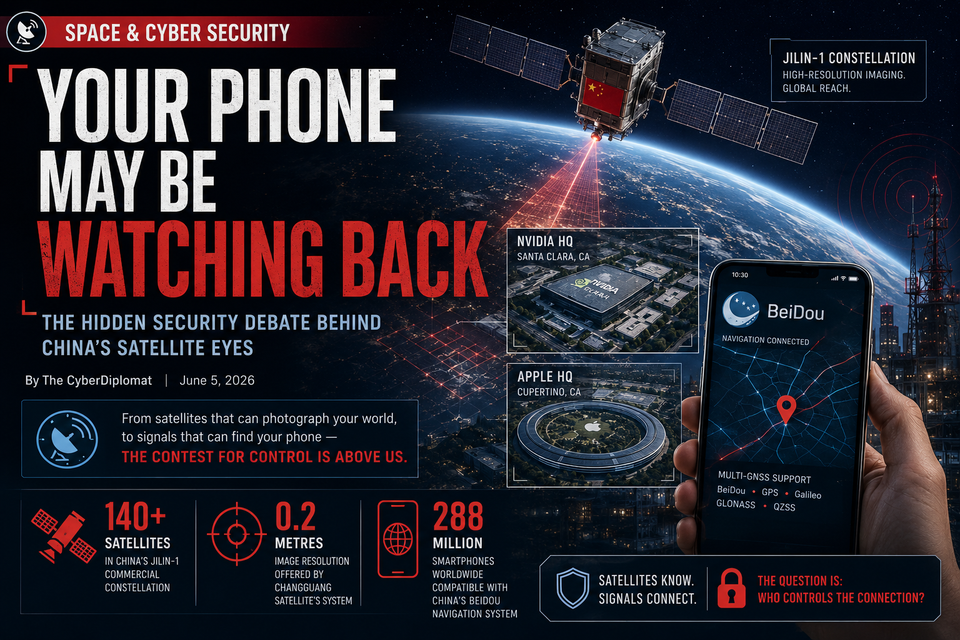
140+ — Satellites in China's Jilin-1 commercial constellation 0.2 metres — Image resolution offered by Changguang Satellite's system 288 million — Smartphones worldwide compatible with China's BeiDou navigation system
The Photograph That Started a Conversation
On June 5, 2026, Changguang Satellite — a Chinese company sanctioned by the US Treasury Department in May for allegedly assisting Iran in strikes against American forces — posted high-definition satellite images of the Nvidia and Apple headquarters in Silicon Valley's Santa Clara and Cupertino. The images, captured by the Jilin-1 constellation, were sharp enough to show building outlines, car park density, and construction changes within the facility grounds.
The company called it "routine satellite news."
Whether routine or not, the release landed in a geopolitically charged moment. In April, Iran's Islamic Revolutionary Guard Corps had named companies linked to 18 American tech and AI firms as "legitimate targets." Then came the US Treasury sanctions against Changguang and two other Chinese firms. And now, high-resolution images of the world's most powerful semiconductor and consumer technology campuses — posted casually to social media.
The photographs were a provocation. But they also pointed to a deeper, less visible question: what is the relationship between China's satellite infrastructure and the device currently sitting in your pocket?
BeiDou: The GPS You Never Knew You Were Using
Most people are familiar with GPS. Fewer know that their smartphone likely connects to multiple satellite navigation systems simultaneously — and one of them may be China's BeiDou.
China's BeiDou navigation system is compatible with 288 million smartphones, most of which are produced by Chinese manufacturers such as Huawei and Xiaomi, and is used to track locations more than one trillion times every day. But BeiDou's reach extends well beyond China's borders. Its signals are received by devices globally, and the FCC has raised concerns that US handheld devices are already receiving and processing satellite signals from foreign-controlled systems, including BeiDou, potentially in violation of commission rules.
In response, the FCC launched a formal investigation seeking answers from handset manufacturers including Apple, Google, Motorola, Nokia, and Samsung — companies that collectively cover over 90% of the US smartphone marketplace.
The Two-Way Problem
Here is where the technical debate gets serious.
GPS, Europe's Galileo, and Russia's GLONASS all function essentially as one-way beacons: they broadcast timing signals, and your device uses those signals to calculate its position. Nothing is sent back.
BeiDou is architecturally different. It is a two-way communication system, allowing it to identify the locations of receivers. BeiDou-compatible devices can transmit data back to the satellites, even in text messages of up to 1,200 Chinese characters. China's state broadcaster CCTV has described this openly: "You can not only know where you are through BeiDou, but also tell others where you are through the system."
This has generated significant alarm. Taiwan's Ministry of Science and Technology warned that mobile phones made on the mainland might be providing Beijing with information via embedded malware, stating that "malicious programs could be hidden in the navigation chip of the mobile phone, operating system or apps."
What the Experts Actually Say
It is important to be precise here, because the debate is genuinely contested.
Most satellite navigation experts view such concerns as far overblown. Industry experts say that all mass market chips for every GNSS system, including BeiDou, are "receive only." Only specially equipped devices will be able to take advantage of its two-way communications capability, and it should be quite apparent to users when it is in operation.
Critics have warned that BeiDou could be used to covertly track users or push malware to devices. But navigation satellites transmit limited, one-way data packets that contain only timing and location information — GNSS signals simply do not work in a way that would support either scenario on standard consumer hardware.
So the direct tracking concern, for most everyday smartphone users, is likely overstated. The real risks are subtler — and arguably more significant.
The Bigger Threat: Jamming, Spoofing, and Strategic Dependency
The more credible dangers are not about your individual phone being tracked. They are about what happens at scale, and what happens in a crisis.
Navigation errors would ripple through air and maritime operations; timing errors could disrupt communications, data links, and networked systems; and precision munitions, ISR tasking, and logistics synchronisation would all degrade. None of this requires attacks on GPS satellites — by targeting signals at the receiver level, adversaries can erode operational confidence without crossing clear escalation thresholds in space.
In a potential Taiwan contingency, China could leverage its advantage by selectively disabling GPS access in a region while maintaining full BeiDou functionality for its own forces — creating a stark asymmetry in navigational capability at a critical moment.
The Secure World Foundation's 2026 counterspace report found that 13 nations are now seeking capabilities to attack adversary satellites, and that rampant use of radio frequency jamming to prevent ground-based receivers from picking up GPS and other navigation signals is a growing trend.
The Geopolitical Chess Beneath the Constellation
Changguang's satellite photographs are best understood not in isolation, but as part of a broader pattern of competition playing out in orbit.
China has fully eliminated its military's reliance on GPS by transitioning to BeiDou, and is now actively marketing the system to partner nations — particularly those with anti-Western alignments. Countries such as Russia, Iran, Pakistan, and Venezuela have already begun integrating BeiDou into their military navigation systems, reducing US leverage over their operations.
China's broader plans include integrating BeiDou into its Space-Ground Integrated Information Network, merging satellite-based communication, remote sensing, and other services into a unified system — an effort that could significantly enhance China's global influence and military capabilities, while posing challenges to the dominance of GPS and similar Western systems.
Meanwhile, the Jilin-1 constellation — operated by the now-sanctioned Changguang Satellite — offers 0.2-metre resolution imagery and revisits any location on Earth approximately 40 times per day. It has already completed space-to-ground laser communication tests at 100 gigabits per second. This is not a hobbyist operation. It is a mature, dual-use infrastructure with both commercial and strategic applications.
What Should Ordinary Users Do?
For most individuals, the immediate risk from BeiDou signals on a standard smartphone is low. The far more relevant concerns are at the systemic and policy level. That said, several practical points are worth noting:
Know your device's origin. Smartphones manufactured in China for the Chinese domestic market are far more likely to have deep BeiDou integration. Devices manufactured for Western markets by Western-headquartered companies operate under different regulatory frameworks.
Understand that "satellite receiver" and "satellite transmitter" are different things. Your phone passively receives navigation signals. The security questions that matter more relate to the apps running on top of those signals, and who has access to that location data.
Watch the policy space. The FCC's formal inquiry, launched in March 2025, is ongoing. Its findings could result in regulatory requirements for how US smartphones handle foreign satellite signals — a development that could affect every major handset manufacturer in the market.
Conclusion: The Sky Is a Contested Domain
Changguang's images of Nvidia and Apple's headquarters were, on one level, just photographs. On another level, they were a reminder that the infrastructure overhead — the satellites, the signals, the constellations — is not neutral. It is built, owned, and operated by states with interests.
The phone in your hand connects to that infrastructure every time it tries to know where it is. Whether that connection poses a direct personal security risk is debated. That it exists within a larger geopolitical contest is not.
The sky has always been a domain of power. It is becoming one again — and this time, the competition is playing out at 0.2-metre resolution.
Sources: South China Morning Post, SpaceNews, Voice of America, Fox News, Foreign Policy Research Institute, Secure World Foundation, US-China Economic and Security Review Commission, Breaking Defense.
© The CyberDiplomat, 2026. All rights reserved.
Member discussion