
Wired for Power: Is Impartial Governance of Submarine Cables Even Possible?
DIGITAL GOVERNANCE & GEOPOLITICS
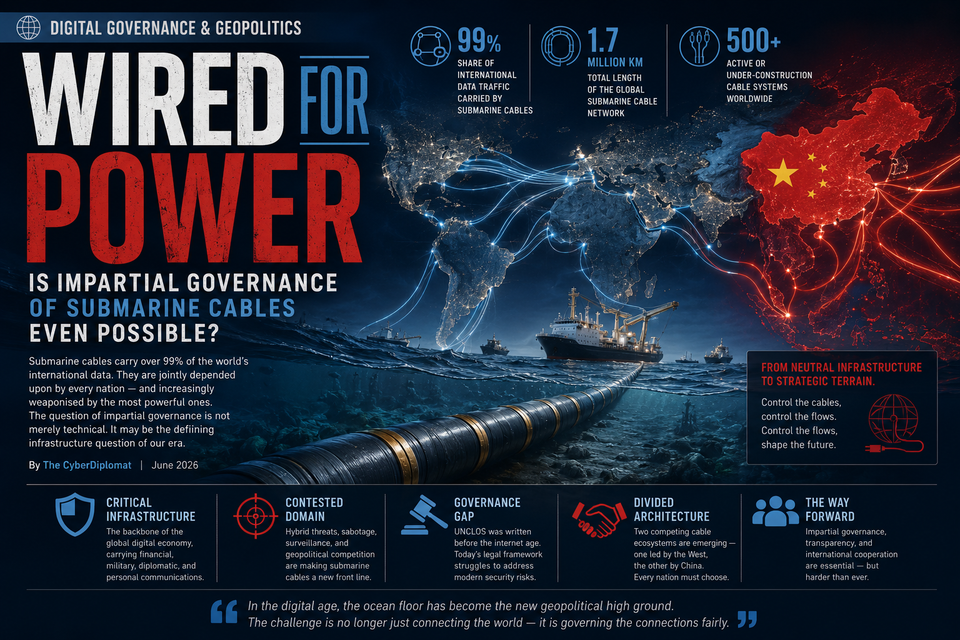
Submarine cables carry over 99% of the world's international data. They are jointly depended upon by every nation — and increasingly weaponised by the most powerful ones. The question of impartial governance is not merely technical. It may be the defining infrastructure question of our era.
By The CyberDiplomat | June 2026
99% — Share of international data traffic carried by submarine cables
1.7 million km — Total length of the global submarine cable network
500+ — Active or under-construction cable systems worldwide
The Cable Under the Ocean Is Not Neutral
There is a quiet assumption embedded in how most people think about the internet: that it flows freely, belongs to no one, and connects everyone equally. The physical reality is starkly different.
Submarine cables are fibre-optic wires that lie along the seabed, transmitting data at high speeds and volumes across long distances. They are the backbone of the global digital economy. As of 2024, 559 cable systems and 1,636 landings are currently active or under construction, stretching nearly 1.5 million kilometres globally.
These cables carry banking transactions, military communications, diplomatic cables, personal messages, and the vast commercial data flows that underpin the modern economy. With more than 200 cable faults reported annually, disruptions have significant economic, governmental, and societal consequences.
And increasingly, the nations that depend on these cables are the same nations actively competing to control, influence, and in some cases damage them.
How Infrastructure Became a Battlefield
For much of the twentieth century, the subsea cable industry remained a stable and exclusive domain, dominated by a small group of Western and Japanese firms — most notably SubCom from the United States, Alcatel Submarine Networks from France, and NEC from Japan. Cables were commercial assets. Governance was mostly a technical matter.
That era is over.
Between 2018 and 2025, submarine cables became strategically contested assets. Vulnerabilities have been revealed by hybrid warfare tactics, and the maritime environment has shifted toward one where physical and cyber security are increasingly intertwined.
The transformation has two faces. On one side, the United States has used its regulatory machinery to block Chinese involvement in cable infrastructure at every opportunity. A prominent example is the US blocking the Pacific Light Cable Network — a high-capacity system funded by Google and Meta — from connecting directly to Hong Kong due to national security concerns over data interception. Similarly, diplomatic intervention resulted in the Southeast Asia-Middle East-Western Europe 6 project pivoting its manufacturing contract from China's HMN Technologies to the US firm SubCom, prompting Chinese state carriers to withdraw their 20% investment.
On the other side, China is building its own parallel architecture. By shifting cable landing points to friendly partners, China reduces its exposure to legal challenges from liberal democracies and deepens its grip on regional digital flows. China's submarine cable ventures are as much about reshaping geopolitical realities as they are about connecting continents.
The US Strategy: Exclusion as Governance
Washington has been explicit about its approach. The State Department has revitalized its role in FCC submarine cable reviews, reasserting its authority to provide the final stamp in domestic licensing. This has been used to systematically deny landing rights for projects in Hong Kong or China — with repercussions that extend beyond Chinese firms to affect US companies and those from allied nations.
In 2026, the United States introduced the Strategic Subsea Cables Act, with legislators stating that "the United States and our allies and partners must be prepared to deter and combat attacks by Russia and China on this crucial technology."
Washington has also launched the "Clean Network" initiative — a counter-offensive aimed at building an alternative architecture of connectivity aligned with liberal democratic values.
The logic is coherent from a national security standpoint. But it raises an unavoidable question: if the world's dominant cable power uses governance mechanisms as instruments of exclusion, can those mechanisms ever be described as impartial?
The China Strategy: Circumvention as Connectivity
China's response has been to build around Western jurisdiction rather than through it. China's increased market presence in cable infrastructure can displace US and allied companies as preferred partners, particularly in Southeast Asia, the Middle East, and Africa. Projects such as the Pakistan and East Africa Connecting Europe cable link China to Africa and Europe via Pakistan, Djidhuti, and Egypt — deliberately designed to circumvent Western jurisdictions.
Beijing is actively marketing its BeiDou navigation system and cable infrastructure to partner nations, particularly those with anti-Western alignments. Countries such as Russia, Iran, Pakistan, and Venezuela have already begun integrating Chinese systems into their military and communications infrastructure — reducing US leverage over their operations.
The result is a world in which two parallel cable architectures are slowly taking shape: one anchored in Washington and Brussels, the other in Beijing. Every nation that depends on the internet — which is every nation — is being asked to choose which infrastructure it trusts more.
The Governance Gap: UNCLOS Was Written for a Different World
The legal framework governing submarine cables is the United Nations Convention on the Law of the Sea — a treaty drafted in 1982, before the commercial internet existed.
The present international law does not provide many options to address cable security in international waters. This governance gap allows hostile actors to operate with relative impunity, and has prompted calls for a shift from reactive repair approaches to preventive international action.
Since 2022, there have been several incidents of apparent intentional damage to submarine cables and pipelines in the Baltic Sea and in the waters around Taiwan. Affected coastal states complain that malign actors exploit gaps in international law that make it exceedingly challenging to hold perpetrators accountable. Proposals including UN Security Council resolutions, EU action plans, and UNCLOS amendments have all been considered — and none has been assessed as providing an adequate solution.
In December 2025, a Russian vessel was suspected of deliberately sabotaging a cable connecting Helsinki to Tallinn along the Baltic Sea floor. In response, NATO launched the "Baltic Sentry" naval operation in 2025 to deter subsea sabotage, while the European Union announced a €347 million investment to fund a Cable Security Toolbox and dedicated emergency repair fleets.
These responses are defensive coalitions, not neutral governance. They are alliances acting in their own interest — which is entirely understandable, but structurally different from an impartial international framework.
What Impartial Governance Would Actually Require
The calls for a neutral, multilateral approach to submarine cable governance are growing. The ITU has issued new guidance on submarine cable resilience and continues to work on digital risk frameworks, with ITU membership growing and diversifying.
The International Submarine Cable Resilience Summit — held in Porto in 2026, building on the Abuja Declaration of February 2025 — reaffirmed principles recognising submarine cables as critical infrastructure and called for non-binding recommendations to strengthen international cooperation. Key proposals include facilitating non-discriminatory access to landing stations, encouraging cable route diversity, and implementing obligations under UNCLOS Article 113 on protection against intentional damage.
These are meaningful steps. But they share a critical limitation: they are non-binding. No state is compelled to open its landing stations. No state is obligated to permit repair ships passage. No enforcement mechanism exists that does not ultimately rely on the political will of a major power.
For genuine impartiality, the international community would need to agree on at least four things it has so far been unable to agree on: a shared definition of what constitutes hostile interference; binding enforcement authority that does not vest in any single state or bloc; access guarantees for repair operations in contested maritime zones; and a financing model for cable infrastructure in developing nations that does not create strategic dependency on either Washington or Beijing.
Is Impartiality Impossible?
Not impossible. But it is genuinely hard — and the window may be narrowing.
The struggle over cables symbolises the reordering of global digital governance, where infrastructure becomes both the battlefield and the tool of geopolitical contestation. Liberal states seek to reorder cyberspace by constructing normative and material alternatives to China's Belt and Road Initiative, positioning submarine cables as both conduits of global data and instruments of geopolitical influence.
In that framing, impartiality is not a neutral position — it is itself a contested claim. When the United States frames Chinese cable involvement as a security threat, and China frames American exclusion as digital imperialism, every call for a "neutral" framework is heard through those competing lenses.
The most honest assessment is this: complete impartiality — a governance structure in which Washington, Beijing, Moscow, and New Delhi all accept binding authority from a body none of them controls — is not achievable in the current geopolitical environment. What is achievable is partial progress: regional agreements, technical standards, transparency mechanisms, and shared norms around repair access and non-interference that reduce the risk of catastrophic disruption even in the absence of full trust.
The call for an ASEAN Submarine Cable Protection Task Force — a centralised body to harmonise permitting processes so that repair ships are not held up by political red tape — offers one model of what regional pragmatism over global idealism can look like.
The cables will keep carrying the world's data regardless of whether governance keeps pace. The question is who decides the rules of the ocean floor — and whether any body exists that the whole world is willing to accept as referee.
Conclusion: Infrastructure Is Politics
There is no such thing as a purely technical cable. Every fibre-optic line on the seabed was laid by someone, funded by someone, and landed somewhere by permission of a government. Those decisions encode power.
The politicisation of submarine cables is not an aberration or an overreaction. It is the inevitable consequence of critical infrastructure meeting great power competition. What we are witnessing is not the corruption of a previously neutral system. It is the belated recognition that this system was never neutral to begin with.
The real question is not whether governance can be perfectly impartial — it cannot. The question is whether the world's nations can agree on enough shared rules to prevent the cables that connect them from becoming the fault lines that divide them.
So far, the answer is: partially, imperfectly, and with urgency.
Sources: Frontiers in Political Science, US-China Economic and Security Review Commission, Submarine Networks, Asia Media Centre / RNZ, Breaking Defense, Atlas Institute for International Affairs, Foreign Policy Research Institute, ITU, Caribbean Telecommunications Union, Journal of Political Inquiry.
© The CyberDiplomat, 2026. All rights reserved.
Member discussion