
Badges, Not Badges — Police Officers Who Hack for Good: San Juan's World-Class Win at White Hat 2026
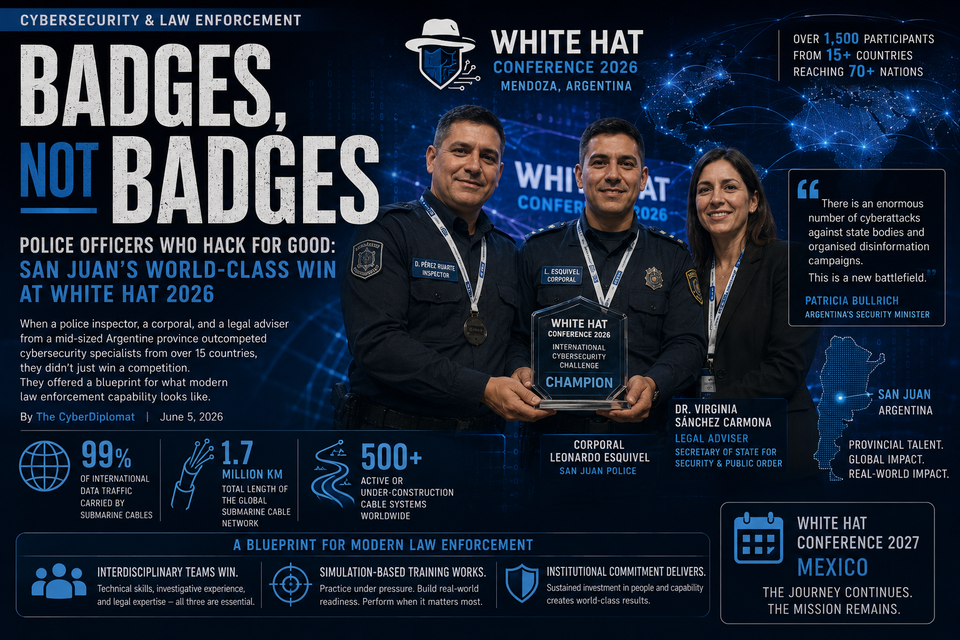
When a police inspector, a corporal, and a legal adviser from a mid-sized Argentine province outcompeted cybersecurity specialists from over 15 countries, they didn't just win a competition. They offered a blueprint for what modern law enforcement capability looks like.
By The CyberDiplomat | June 5, 2026
The Scene: Mendoza, Argentina — A Global Cybersecurity Capital for Three Days
The 2026 International White Hat Conference addressed the growing need for coordinated global readiness to prevent, investigate, and prosecute cybercrime and digital offences associated with large-scale international events. It convened law enforcement agencies, prosecutorial offices, cybersecurity and AI experts, cryptocurrency investigators, industry professionals, policymakers, and academic researchers from around the world. Eventbrite
This was the seventh edition of the conference, held for the first time in Argentina. Since its creation in Colombia in 2019, the White Hat Conference has consolidated itself as an international reference point for the exchange of knowledge and strategies linked to cybersecurity. Previous editions were held in Boston (2021, 2022, and 2023), Seoul (2024), and Spain (2025). El Sol
The gathering brought together specialists, investigators, prosecutors, security forces, ethical hackers, and academic figures from more than 15 countries, with international reach projecting to more than 70 nations — and over 1,500 participants attended in person. Punto a Punto
And when the dust settled on one of the central competitions, the team standing at the top was not from a major tech hub. It was from San Juan, Argentina.
Who Are the "San Juan Más Seguro" Team?
The winning team was not composed of professional hackers or academic researchers. It was made up of working law enforcement officers and a legal adviser.
The "San Juan Más Seguro" team consisted of Officer Inspector Darío Pérez Ruarte and Corporal Leonardo Esquivel of the San Juan Police, together with Dr. Virginia Sánchez Carmona, legal adviser of the Secretary of State for Security and Public Order. Diario La Provincia San Juan
The challenge they won required a specific blend of skills rarely found in a single team: technical forensic knowledge, legal reasoning, and investigative methodology. That combination — a serving officer, a non-commissioned officer, and a legal mind — proved to be exactly the right formula.
Their challenge focused on the analysis and investigation of a cybercrime case: identifying digital evidence, reconstructing criminal scenarios, and proposing solutions to complex situations linked to digital crime. In other words, the kind of real-world work their team does every day — applied, under competition conditions, against specialists from across the globe.
They won.
Why This Matters Beyond the Trophy
It would be easy to read this as a feel-good local story. It is more than that.
The White Hat Conference exists because the world has a serious problem: the people responsible for investigating cybercrime are often years behind the criminals they are chasing. Digital offences have exploded in volume and sophistication. Ransomware cripples hospitals. Financial fraud crosses borders in milliseconds. Child exploitation material circulates through encrypted networks. Disinformation campaigns destabilise elections.
And who investigates these crimes? In most countries, the answer is traditional police forces — trained primarily in physical-world procedures, equipped with analogue-era tools, and asked to navigate a digital landscape that changes faster than any training syllabus can track.
One of the central aims of the White Hat Conference is the international ethical hacker competition — an initiative oriented toward strengthening the capabilities of states in the face of growing digital crimes, cyberattacks, and the new threats emerging in the digital ecosystem. Sitio Andino
The San Juan team's victory signals something important: that when law enforcement is genuinely invested in, trained properly, and given the tools to compete at the highest level, it can. A police inspector and a corporal from a provincial force in Argentina just proved it on a world stage.
The Bigger Context: Cybersecurity, Mega Events, and Latin America
The timing of White Hat 2026 was not accidental. The conference developed under the theme "Cybersecurity and Digital Crime Prevention: Building Global Readiness for Mega Events", in a context marked by the proximity of the FIFA World Cup 2026 and the growing exposure of critical infrastructure to cyber threats. Mendoza
Topics addressed during the three-day programme included cyber intelligence, protection of critical infrastructure, digital crime investigation, large-scale cyberattacks, technological resilience, illicit financial flows, money laundering, cryptocurrency analysis, digital forensics, and international cooperation against new digital threats. Participating institutions included the Organisation of American States (OAS), Boston University, cybersecurity bodies from various countries, universities, prosecutors' offices, security forces, and technology companies. Mendoza
Argentina's Security Minister Patricia Bullrich, who attended the closing ceremony, affirmed that the country has positioned itself among Latin America's leaders in cybersecurity, and highlighted the role of artificial intelligence in addressing new scenarios of digital conflict. "There is an enormous number of cyberattacks against state bodies and organised disinformation campaigns," she stated. "This is a new battlefield." Sitio Andino
The Ethical Hacker: Redefining What a Cybersecurity Professional Looks Like
One of the most valuable things events like White Hat do is challenge the public image of who a "hacker" is.
The cultural shorthand is familiar: a lone figure in a darkened room, hoodie up, typing furiously into a black terminal, doing something illegal. The reality of modern cybersecurity is almost the opposite. Ethical hackers are specialists who use the same tools and techniques as criminal hackers — but in service of defence, detection, and prevention. They are the people organisations hire to find their own vulnerabilities before someone malicious does. Mendoza
What the San Juan team demonstrated is that this work is not confined to Silicon Valley startups or university research labs. It lives inside police stations too. Inspector Pérez Ruarte and Corporal Esquivel are not researchers. They are officers. The skills they deployed in that competition room are the same skills they bring to real cases involving real victims.
San Juan also sent a second team — "San Juan Cyber" — comprising agents from the Provincial Penitentiary Service: Yamila Schiffel, Franco Flores, and Franco Rojas. Their participation reflected the province's broader commitment to building cybersecurity capacity across all branches of its security apparatus, not just a single elite unit.
What Other Forces Can Learn from San Juan
The lesson from Mendoza is not simply that San Juan did well. It is that investment in human capability yields results that no piece of technology alone can replicate.
Three things stand out from the San Juan model worth considering by any law enforcement agency seeking to build genuine cybersecurity capacity:
Interdisciplinary teams win. The "San Juan Más Seguro" team combined technical skills, investigative experience, and legal expertise. Real cybercrime cases require all three. Teams that train only one type of specialist will always have blind spots.
Simulation-based training beats passive learning. Competition environments force participants to apply knowledge under pressure, make decisions with incomplete information, and operate as a team. That is closer to real investigative work than any lecture or slide deck.
Institutional commitment precedes individual excellence. The academic director of CLICLEX noted that a Mendoza team also finishing among the top three was "concrete proof that the training, cooperation, and capacity-building work we have been driving in the province for more than a year is producing results." Excellence at a world stage does not appear overnight. It is the visible result of sustained, deliberate investment made long before anyone was watching. Punto a Punto
Looking Ahead: Mexico 2027
The organisation confirmed that Mexico will host the White Hat Conference 2027 — continuing the event's trajectory through Latin America and reinforcing the region's growing centrality in the global cybersecurity conversation. El Sol de San Juan
For San Juan, the question now is how to build on the moment. Winning a world-class competition is a statement of capability. Sustaining that capability — and deploying it in the daily work of investigating digital crime — is the harder and more important challenge.
But for three days in Mendoza, a police inspector, a corporal, and a legal adviser from San Juan showed the world what is possible when a province decides to take cybersecurity seriously.
Sometimes the most sophisticated response to a sophisticated threat is simply sending the right people — and making sure they are ready.
Sources: Diario La Provincia San Juan, El Sol de San Juan, Punto a Punto, Los Andes, Sitio Andino, Prensa Gobierno de Mendoza, Boston University White Hat Conference 2026.
© The CyberDiplomat, 2026. All rights reserved.
Member discussion